John Gould
John Gould: The Bird Man of the Nineteenth Century
John Gould (1804–1881) was one of the most influential ornithologists and natural history publishers of the Victorian era. Renowned as the “Bird Man,” he combined scientific ambition with entrepreneurial flair, producing lavishly illustrated works that brought the beauty and diversity of the world’s avifauna to a broad audience.
Early Life and Career
Born in Lyme Regis, Dorset, Gould was the son of a gardener. His early training as a taxidermist sharpened his observational skills and gave him a practical grounding in natural history. In 1827, he was appointed curator and taxidermist to the Zoological Society of London, a position that placed him at the centre of Britain’s scientific community. There he encountered newly arrived bird specimens from across the globe, sparking a lifelong ambition to document and illustrate them systematically.
Major Publications
Gould’s first major work, A Century of Birds from the Himalaya Mountains (1831–1832), set the pattern for his career. Gould collaborated with talented illustrators such as his wife Elizabeth Coxen Gould, Edward Lear, and later Henry Constantine Richter. Gould supplied the scientific expertise, descriptions, and organisation, while his collaborators executed the exquisite hand-coloured lithographs.
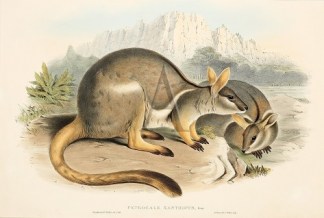
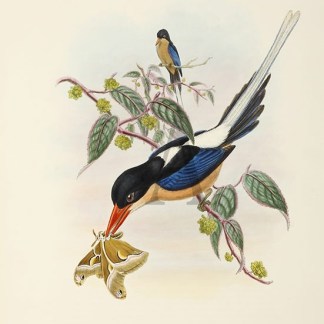
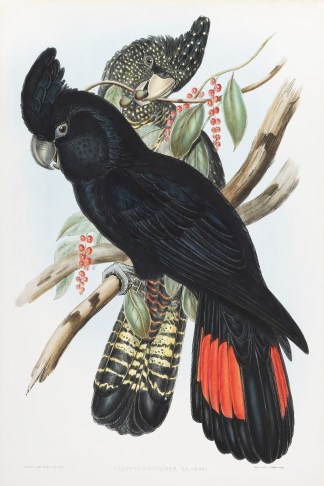
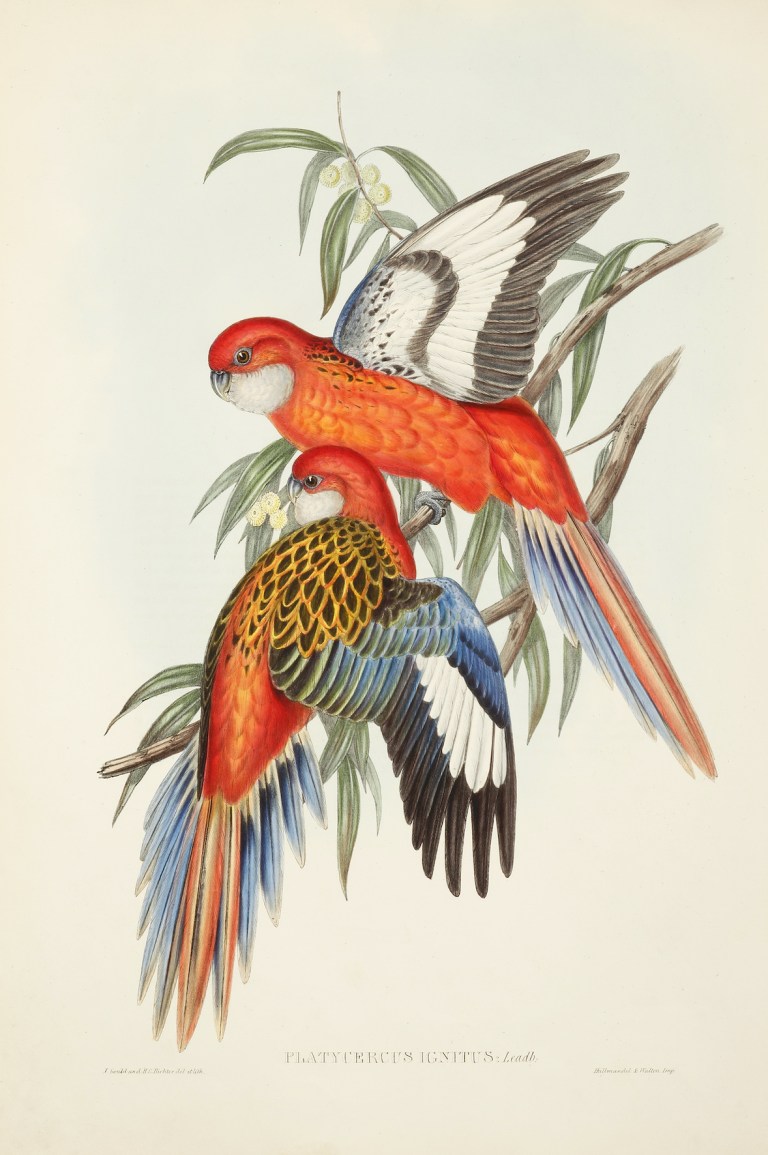
Over the next five decades, Gould oversaw the production of more than 40 folio volumes comprising some 3,000 plates. Among the most famous is The Birds of Australia (1840–1848). These monumental series blended artistry and science, each plate combining detailed accuracy with visual splendour. His Australian works were particularly groundbreaking, recording hundreds of species, many previously unknown to Europeans.
Connection to Darwin
Gould also played a small but significant role in the history of evolutionary theory. In 1837, he was asked by Charles Darwin to examine bird specimens collected during the voyage of HMS Beagle. Gould’s identification of the Galápagos finches as distinct species provided crucial evidence that helped Darwin develop his ideas on natural selection.
Australia and Beyond
Gould’s ties to Australia were especially strong. In 1838 he travelled there with his wife Elizabeth, collecting specimens and observing birds in the field. This expedition provided the material for The Birds of Australia, his most celebrated work, published in seven volumes between 1840 and 1848. It remains a landmark in both Australian natural history and the art of ornithological illustration.
Legacy
John Gould’s career exemplified the Victorian appetite for natural history, where science, art, and publishing converged. His works were issued by subscription, aimed at wealthy patrons and institutions, yet their influence extended far beyond elite circles. Today, original Gould plates are prized by collectors and museums alike, admired for their technical brilliance and decorative appeal.
Though some critics note that Gould was more entrepreneur than field naturalist, his role in disseminating ornithological knowledge cannot be overstated. By harnessing the talents of gifted artists and the enthusiasm of a public eager for exotic wonders, Gould created an enduring visual archive of birdlife that continues to inspire admiration and study more than a century after his death.