Alain Manesson Mallet (1630 - 1706)
French military engineer, mathematician, and cartographer whose work occupies an important place in the development of late seventeenth-century geographical and cosmographical illustration.
Born in Paris in 1630, Mallet trained in mathematics and military engineering, disciplines closely allied in the period through their shared emphasis on geometry, fortification design, and surveying. He entered the service of the Portuguese crown, working as a military engineer and instructor in mathematics during a time when technical expertise in fortification and artillery was in high demand across Europe. This practical background in applied mathematics and defensive architecture strongly informed the precision and structural clarity of his later published work.
After returning to France, Mallet was appointed “Maître de Mathématiques des Pages de la Petite Écurie” at the court of Louis XIV, a prestigious teaching post within the royal household. In this role he instructed young noble pages in geometry, fortification, and related sciences, positioning him within the intellectual and technical culture that supported France’s military and administrative ambitions under the Sun King.
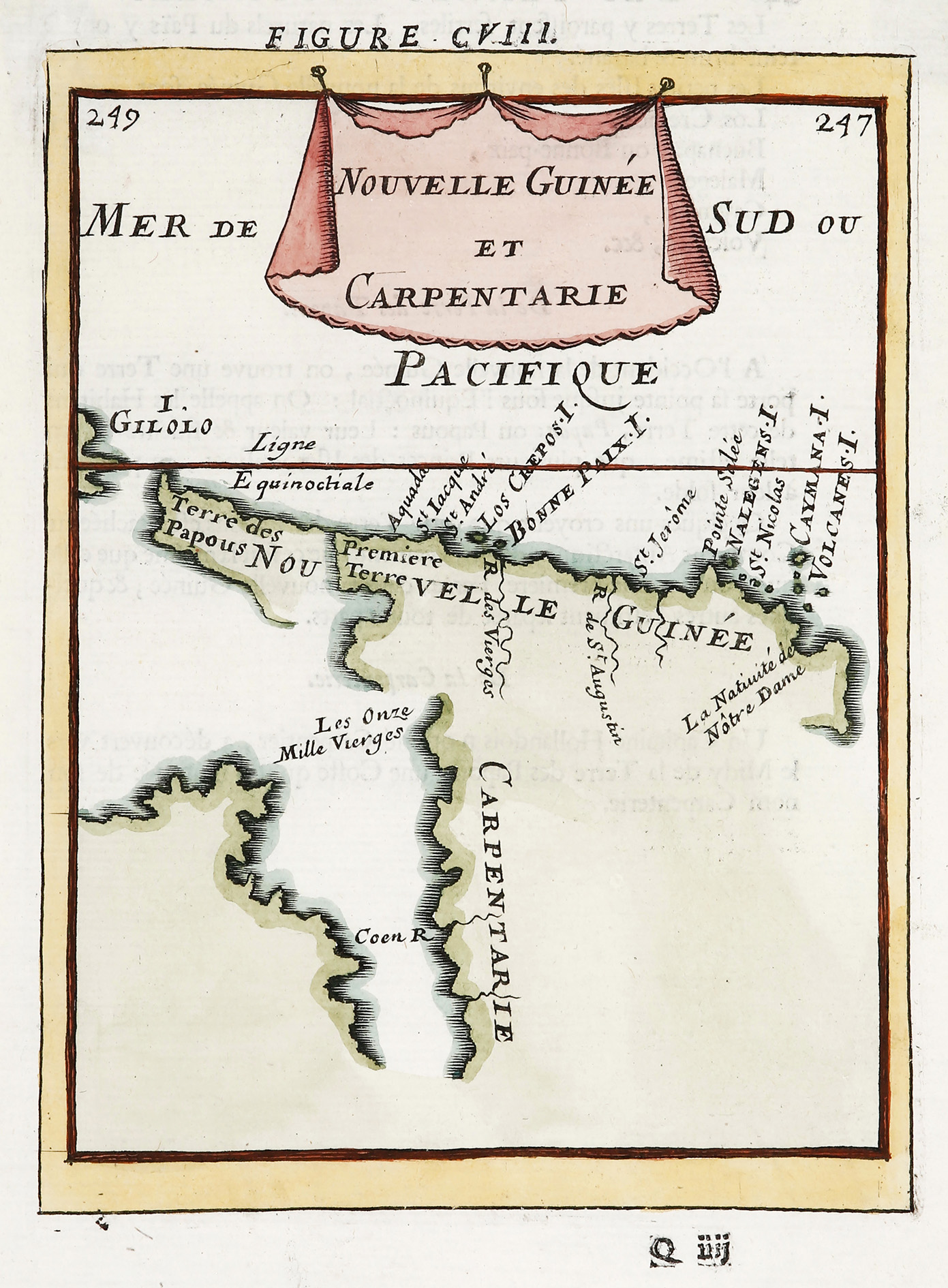
Mallet’s lasting reputation rests primarily on his published works, especially Les Travaux de Mars, ou l’Art de la Guerre (Paris, 1671), an illustrated treatise on fortification and military science, and the highly influential Description de l’Univers (first issued in 1683). The latter is a large, multi-volume cosmographical compendium containing maps, city views, costumes, and ethnographic scenes from around the world. Unlike strictly scientific atlases, Mallet’s publication combined geography with visual curiosity, presenting global knowledge in an accessible and richly illustrated format aimed at a cultivated readership rather than specialist navigators.
His maps and views are characterised by clear engraving, balanced composition, and a decorative yet orderly Baroque aesthetic consistent with French print culture of the late seventeenth century. While he did not generally conduct original geographical surveys, Mallet functioned as a compiler and synthesiser, drawing on earlier cartographic sources and contemporary reports to create a visually coherent picture of the world. His work reflects the period’s blending of scholarship, pedagogy, and spectacle, where geography served both intellectual and cultural display.
Alain Manesson Mallet died in 1706. Today he is regarded as an important figure in the popularisation of geographical knowledge in France, bridging the worlds of military science, court education, and illustrated cosmography during the reign of Louis XIV.
View other items by Alain Manesson Mallet