Willem Janzoon Blaeu (1571 - 1638)
Founder of the Blaeu firm of mapmaking.
Blaeu was one of the foremost figures of the Dutch Golden Age of cartography, renowned for his innovations in geographical science, engraving, and atlas publishing.
Born in Alkmaar, the son of a prosperous herring merchant, Blaeu was initially destined for a mercantile career. His intellectual trajectory, however, shifted decisively when he became a pupil of the distinguished Danish astronomer Tycho Brahe on the island of Hven between 1595 and 1596. Under Brahe’s tutelage, Blaeu acquired a rigorous grounding in observational astronomy, mathematical geography, and precision instrument-making—disciplines that would inform his lifelong pursuit of scientific and cartographic accuracy.
Upon his return to the Dutch Republic, Blaeu established himself in Amsterdam, a city rapidly emerging as the commercial and intellectual centre of Europe. There he founded a workshop for the production of globes, maps, and navigational instruments. His early celestial and terrestrial globes, published from 1599 onwards, were notable for their accuracy, clarity of design, and refined engraving. Blaeu’s work combined meticulous empirical observation with artistic restraint, and his globes became indispensable tools for both mariners and scholars. He also issued a series of wall maps and sea charts, including the Zeespiegel (1608), which contributed to the navigational supremacy of the Dutch East India Company (VOC), with which Blaeu maintained close professional ties.
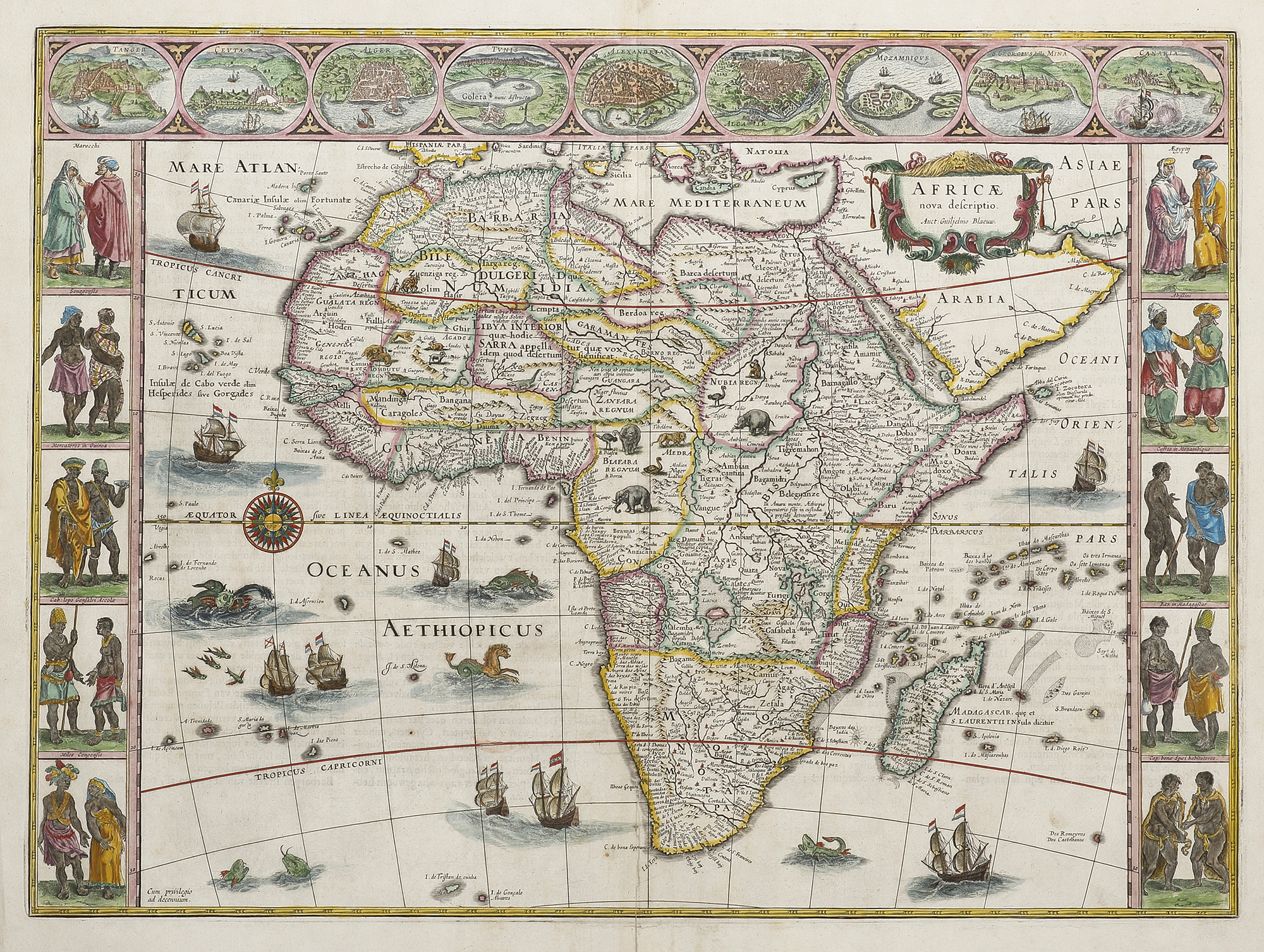
In 1633, Blaeu was appointed Hydrographer to the VOC, a position that formalised his role as the chief cartographic authority for the company’s global enterprises. His maps were not only functional but also deeply aesthetic, integrating decorative cartouches, allegorical figures, and finely drawn typography that elevated cartography to an art form. This synthesis of utility and beauty would find its fullest expression in his monumental Atlas Novus (1635). Conceived as a revision and expansion of earlier works by Mercator and Hondius, the Atlas Novus presented a vision of the known world that combined geographical precision with Baroque grandeur. It established a new standard for cartographic publishing in terms of both scientific accuracy and artistic accomplishment.
Blaeu’s intellectual outlook was deeply humanist, reflecting the cosmopolitan ethos of early c.17th Amsterdam. He viewed mapmaking as a moral and philosophical enterprise an effort to comprehend and represent divine order in the natural world. His publishing house became a centre of scholarly collaboration, employing skilled engravers, geographers, and craftsmen who shared his pursuit of perfection. Beyond maps and globes, Blaeu also published astronomical treatises, including his Beschrijvinghe van de Hemel (1617), and contributed to the broader dissemination of scientific knowledge in the Republic of Letters.
At the time of his death in 1638, Willem Janszoon Blaeu had elevated the art and science of cartography to an unprecedented level of sophistication. His work laid the foundations for the later achievements of his sons, Joan and Cornelis Blaeu, who would expand the Atlas Novus into the monumental Atlas Maior. Blaeu’s legacy endures not only in the enduring beauty of his maps but also in his unification of empirical precision, artistic mastery, and intellectual vision a synthesis that epitomises the spirit of Dutch humanism and the cartographic ideals of the seventeenth century.
View other items by Willem Janzoon Blaeu