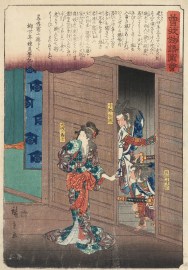
Utagawa Hiroshige (1797 - 1858)
Considered the last great master of Japanese ukiyo-e art.
Born in the Yayosu Quay district of Edo (modern Tokyo) into a samurai family. He was the great-grandson of Tanaka Tokuemon, an official in the service of the Tsugaru clan of Mutsu province. His grandfather, Mitsuemon, practised as an archery instructor under the name Sairyūken, while his father, Gen’emon, adopted into the family of Andō Jūemon, succeeded him as fire warden for the Yayosu Quay area. Following the death of his parents, Hiroshige then known as Tokutarō turned to painting at about the age of fourteen. He first sought training under Toyokuni of the Utagawa school, but, unable to gain entry, was instead introduced to Toyohiro, under whose guidance he began his studies. By 1812 he was permitted to sign his works, adopting the art name Hiroshige. His training also encompassed the traditions of the Kanō school, the literati style of nanga, the naturalism of the Shijō school, and, in addition, the perspective techniques of Western art and ukio-e.
In 1832 Hiroshige was invited to join an official procession to Kyoto, a journey that afforded him the chance to travel the Tōkaidō route linking the two capitals. Along the way he sketched the landscapes and, on his return to Edo, created the celebrated series The Fifty-three Stations of the Tōkaidō, which includes some of his most renowned designs.
In 1856, Hiroshige "retired from the world", becoming a Buddhist monk; this was the year he began his One Hundred Famous Views of Edo. He died aged 62 during the great Edo cholera epidemic of 1858 (whether the epidemic killed him is unknown) and was buried in a Zen Buddhist temple in Asakusa.
View other items by Utagawa Hiroshige


![Eitaibashi Tsukuda oki isaribune [Fishing Boats near Eitai Bridge in Tsukuda Bay] - Antique Print from 1847](https://antiqueprintmaproom.com/wp-content/uploads/2025/09/MG_0970web.jpg "Eitaibashi Tsukuda oki isaribune [Fishing Boats ne… Binjin, Kabuki, Landscapes etc")
![Eitaibashi Tsukuda oki isaribune [Fishing Boats near Eitai Bridge in Tsukuda Bay] - Antique Print from 1847](https://antiqueprintmaproom.com/wp-content/uploads/2020/04/guarantee_seal_update.svg "Eitaibashi Tsukuda oki isaribune [Fishing Boats ne… Binjin, Kabuki, Landscapes etc")