C1890

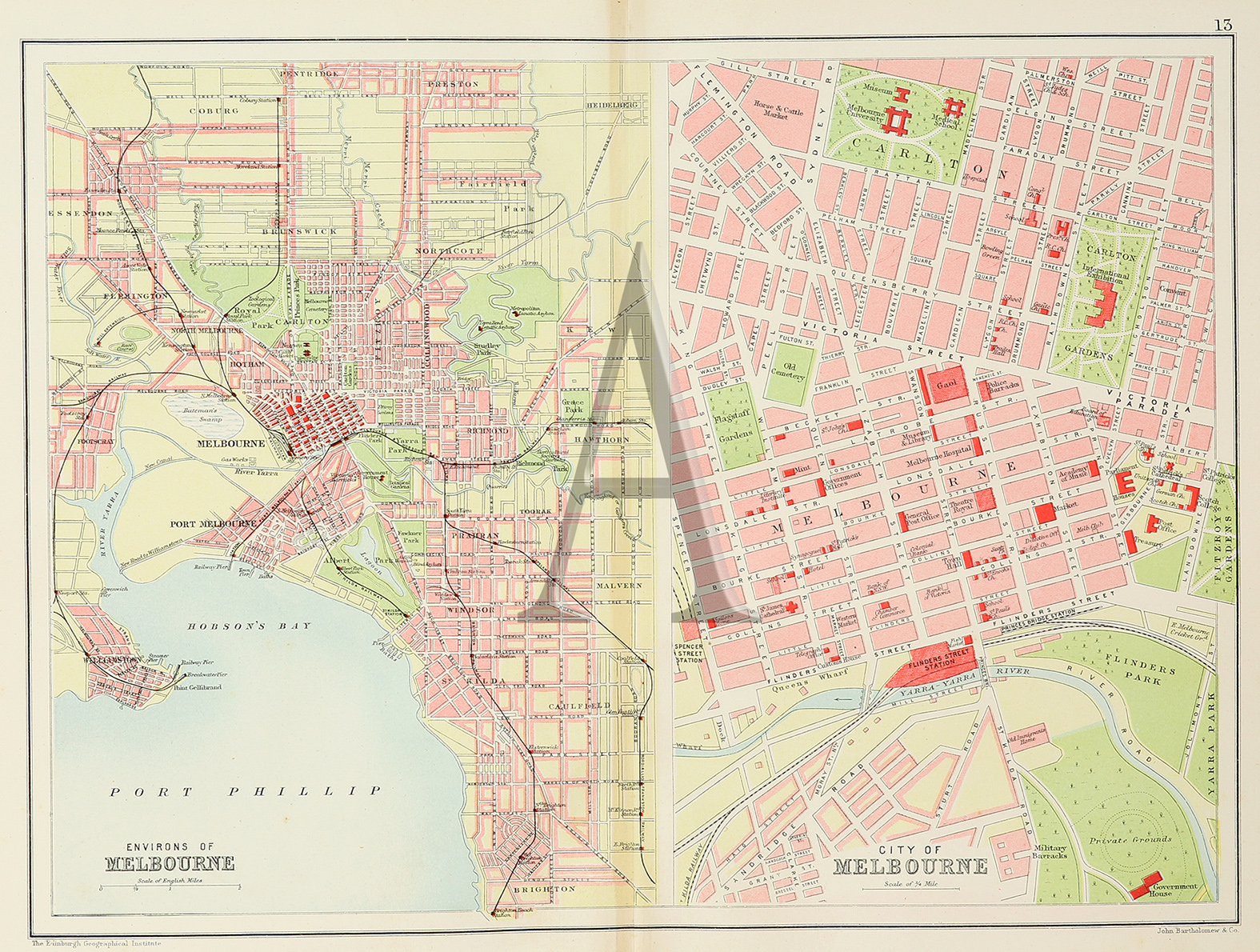
Environs of Melbourne City of Melbourne.

Detailed c.19th map and plan of Melbourne and Port Phillip. Colour printed c.19th map of Melbourne and its environs, arranged in two panels showing the city centre in detail and the broader metropolitan and coastal setting. The right panel presents … Read Full Description

$A 245

In stock

S/N: RAAG-013-TP-MELB–218628
(C027)
Free Shipping
Attempt to Shoot the Queen: Roderick Maclean Befor… Legal

Within Australia

All orders ship freewithin Australia

Attempt to Shoot the Queen: Roderick Maclean Befor… Legal

Rest of the World

Orders over A$300
ship free worldwide

See Shipping page for Terms & Conditions

Details

Full Title:

Environs of Melbourne City of Melbourne.

Date:

C1890

Condition:

In good condition, with centre fold as issued.

Technique:

Colour printed engraving.

Image Size: 

315mm 
x 235mm

Paper Size: 

3246mm 
x 267mm
AUTHENTICITY
Environs of Melbourne  City of Melbourne. - Antique Map from 1890

Genuine antique
dated:

1890

Description:

Detailed c.19th map and plan of Melbourne and Port Phillip.

Colour printed c.19th map of Melbourne and its environs, arranged in two panels showing the city centre in detail and the broader metropolitan and coastal setting. The right panel presents the City of Melbourne with its regular street grid, major thoroughfares, public buildings, railway lines, and the course of the Yarra River. Parks and reserves, including the Fitzroy and Carlton Gardens and the Domain areas, are tinted, while prominent civic and institutional structures are highlighted.

The left panel, titled Environs of Melbourne, extends the view to surrounding suburbs and Port Phillip, showing Hobson’s Bay, the developing bayside districts, road and rail connections, and the spread of suburban settlement beyond the central grid. Topography, waterways, and open land are clearly differentiated from built-up areas.


The map reflects Melbourne’s rapid growth as a commercial and administrative centre in the later colonial period, illustrating the integration of the central city with its expanding suburban and maritime landscape. Such maps were produced for reference and educational purposes, providing a concise visual summary of urban form, transport infrastructure, and regional geography at a time of significant metropolitan development.

References:
Ferguson, J. A. Bibliography of Australia Volumes 1-8, Canberra 1976 : 6759.

Collections:
State Library New South Wales: 991020909049702626
National Library Australia: Bib ID: 794411
State Library Victoria: The royal atlas & gazetteer of Australasia
State Library Queensland: 99820404702061
State Library South Australia: 912.94 B287

John Bartholomew (1831 - 1893)

Bartholomew was a Scottish cartographer born in Edinburgh. His father, also John Bartholomew, started the cartographical firm in Edinburg. He was subsequently assistant to the German geographer August Petermann, until in 1856 when he took over his father's firm. Bartholomew built up a reputation unsurpassed in Great Britain for the production of the finest cartographical work. Bartholomew was an in-house cartographer for George Philip. He is best known for the development of colour contouring (or hypsometric tints), the system of representing altitudes on a graduated colour scale, with areas of high altitude in shades of brown and areas of low altitude in shades of green. He first showcased his colour contouring system at the Paris Exhibition of 1878; although it initially met with scepticism, it went on to become standard cartographical practice. Among his numerous publications, particularly worthy of note is the series of maps of Great Britain reduced from the Ordnance Survey to scales of ½ inch and ¾ inch to 1 mile, with relief shown by contour lines and hypsometric tints. The ½ inch series is among the finest of its kind ever produced. Upon his retirement in 1888, John Bartholomew was succeeded in the firm by his son John George, who extended the ½ inch series, and applied its principles to many other works. For the last six years of his life Bartholomew was living at 32 Royal Terrace in Edinburgh. Bartholomew died in London on 29 March 1893.[2] He is buried with his mother and father in Grange Cemetery in Edinburgh, in the northwest section. His wife Annie MCGregor (1836–1872), whom he greatly outlived, is also buried there.

View other items by John Bartholomew

Related Products

Choose currency

Exchange rates are only indicative. All orders will be processed in Australian dollars. The actual amount charged may vary depending on the exchange rate and conversion fees applied by your credit card issuer.

Account Login

The List

Join our exclusive mailing list for first access to new acquisitions and special offers.