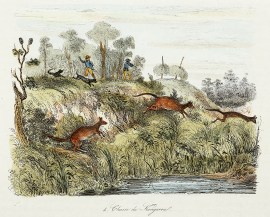
Rare, c.18th engraving of the first published illustration of a macropodid. Filander or Aroe rabbit later known as Le Bruin’s kangaroo (Macropus brunii).
Cornelius de Bruin, was an accomplished artist as well as a tireless traveller. Having published his Voyage to the Levant in 1695, Le Bruin subsequently visited the East Indies where in the menagerie of the Dutch governor-general in Batavia he found a colony of the litle Aru Island macropods. The animals were now so numerous-and so palatable-that, according to Le Bruin, whenever feasts were held the tables groaned under the weight of ‘Aroe rabbits’. Le Bruin adapted the Amboinese name for them, so that Pelandor Aroe became Filander, or Aroe rabbit.
Le Bruin’s account told how, at the governor-general’s country house, he saw ‘a certain animal called Filander, which is somewhat remarkable. Many individuals here enjoy full freedom, running with some rabbits which have their burrows under a little hillcock encircled by a fence. The Filander, which has hind limbs much longer than the fore, is nearly the size of, and possesses nearly the same form as, a large rabbit. The head resembles in form that of a fox, and the tail is pointed; but the most extraordinary circumstance is that the female has a bag-like opening in the belly into which the young enter, even when they have have attained a constrained size. They are often seen with head and neck thrust out of this bag; however, when the mother is running the young are not visible but keep to the bottom of the pouch since she leaps so freely.’
Le Bruin recorded the Filander’s general colour as pale yellowish-brown, with a brown strie up the forehead.
Modern common names: Dusky pademelon, Dusky wallaby, Aru Island wallaby
Modern binomial name: Thylogale brunii
First described: Schreber, 1778
Distribution: Aru and Kai islands, Trans-Fly savanna and grasslands of New Guinea.
From: Corneille Le Brun, Reizen over Moskovie door Persie en Indie …