C1575

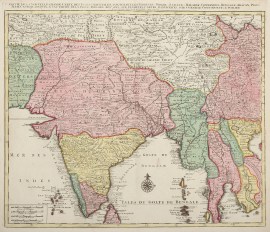
Indiae Orientalis Insularumque Adiacientium Typus.

An early edition (1575) of one of the earliest maps to focus on the East Indies, published in Ortelius’s Theatrum Orbis Terrarum, widely regarded as the first modern atlas for having all the maps in a similar size and format. … Read Full Description

Sold

Free Shipping
[ASIA-Carte Hydro-Geo-Graphique Des Indes Oriental… ASIA

Within Australia

All orders ship freewithin Australia

[ASIA-Carte Hydro-Geo-Graphique Des Indes Oriental… ASIA

Rest of the World

Orders over A$300
ship free worldwide

See Shipping page for Terms & Conditions

Details

Full Title:

Indiae Orientalis Insularumque Adiacientium Typus.

Date:

C1575

Condition:

In good condition, with centre fold as issued.

Technique:

Hand coloured copper engraving.

Image Size: 

495mm 
x 346mm

Paper Size: 

520mm 
x 400mm
AUTHENTICITY
Indiae Orientalis Insularumque Adiacientium Typus. - Antique Map from 1575

Genuine antique
dated:

1575

Description:

An early edition (1575) of one of the earliest maps to focus on the East Indies, published in Ortelius’s Theatrum Orbis Terrarum, widely regarded as the first modern atlas for having all the maps in a similar size and format.


Ortelius was the first to separate ancient and recent geographic knowledge in his maps and to indicate the changes from the old nomenclature to the new. Superbly embellished with a pair of frolicking mermaids, galleons, sea monsters, a crest and decorative strapwork title cartouche engraved by Frans Hogenberg (1539-1590). Ortelius’s map of the Indies improved upon the previous cartography of the Moluccas (Spice Islands) by Ramusio 1554, Gastaldi 1562, and Forlani 1565 using more recent Portuguese and Spanish sources. This map, along with Ortelius’s map of Asia are the first published works to chart the island of Formosa (Taiwan) and to identify it by that name. The Mollucas were visited by the Italian traveller Varthema who reached the island of Momoch (probably Ternate) in 1505, seven years prior to the Portuguese. In the account of his travels Itinerario de Ludouico de Varthema Bolognese, published in Rome in 1510, he wrote & “Here the cloves grow, and in many other neighbouring islands.” Ortelius correctly locates the islands of Ternate, Tidore, Machian and Bachan to the west of Gilolo and in doing so, provided for the first time a large-scale map published in sufficient numbers to make a substantial impact on the current knowledge of the East Indies. The land of Beach, the northern tip of Australia, is shown emerging from the lower margin and above it lies the mythical land of Java Major which, according to Marco Polo, was the largest island in the world. Polo’s Java Minor is seen here correctly named as the island of Sumatra.


1575L63 (small page number, 7 mm; last line, italic like the entire text, and centred like 2 lines above it: “Hispanica lingua edidit”.),


References:

Clancy, R. The Mapping of Terra Australia. Sydney 1995 : p.70 ill. map 5.16.

Cortazzi, H. Isles of Gold Antique Maps of Japan. Tokyo 1992 : p.20, ill.17 pp.80-81.

Kroght, P. Koeman’s Atlantes Neerlandici. Amsterdam 1997. Nine volumes : 31:013 (1575 Latin): 63 #63 Vol IIIB, p.126.

Parry, D. The Cartography of the East Indian Islands Insulae Indiae Orientalis. London 2005 : pp. 76-80, ill. plate 3.14.

Quirino, C. Philippine Cartography (1320-1899) Amsterdam 2010 Manila : p.96, ill.pp.86-87.

Suarez, T. Early Mapping of Southeast Asia. Singapore 1999 : p.164-168 ill.166-167.

Tooley, R.V. The Mapping of Australia. London 1979 : 937.

Walter, L. Japan a Cartographic Vision. New York 1994 : ill.11d, detail 11d.

Van Den Broecke, M. P. R. Ortelius Atlas Maps.1996 Netherlands : 166.


Collections:

National Library Australia: Bib ID 3421411 (1601)

National Library Singapore: 912.59 ORT (1598L)

State Library New South Wales: MMS ID  991000854859702626 (1584L)

University of Western Australia: MMS ID 9977643302101 (edition ?)


Abraham Ortelius (1527 - 1598)

Flemish cartographer, geographer, and publisher, born in Antwerp on 14 April 1527. He is celebrated as the creator of the Theatrum Orbis Terrarum (Theatre of the World), first published in 1570, widely regarded as the first modern atlas and one of the most influential cartographic works of the sixteenth century.

Trained as a map colourist and illuminator, Ortelius joined the Antwerp Guild of St Luke as a map illuminator in 1547, initially working in partnership with his sister, Anne. He began his career as a map and print dealer, trading in geographical materials and decorative prints across Europe. His extensive travels—to France, Germany, Italy, and notably to London where he met the English cartographer John Dee and the great mapmaker Gerardus Mercator—broadened his intellectual and professional network. Mercator’s work and ideas profoundly influenced Ortelius’s approach to geography and cosmography.

Ortelius’s Theatrum Orbis Terrarum was first issued in Antwerp in 1570 by the printer Gilles Coppens de Diest. Comprising seventy engraved maps with accompanying text, it presented a consistent format and unified design, with maps engraved chiefly by Frans Hogenberg. Each map was carefully attributed to its original source, a practice that reflected Ortelius’s scholarly integrity and established an early model for bibliographic citation in cartography. The Theatrum was an unprecedented success, appearing in more than forty editions and seven languages over the next four decades.

In 1573 Ortelius issued the Additamentum, the first supplement to the atlas, introducing new maps and expanding its global scope. Among his other important works were the Synonymia Geographica (1578), a geographical dictionary of ancient and modern place names, and Thesaurus Geographicus (1596), both significant contributions to Renaissance geographical scholarship.

Ortelius was also among the first to propose, in marginal notes to his maps, that the continents might once have been joined before drifting apart—an early precursor to modern theories of continental drift. His combination of scientific precision, humanist learning, and aesthetic refinement made him a central figure in the golden age of Netherlandish cartography.

He maintained close associations with leading scholars and artists of his time, including Justus Lipsius, Christopher Plantin, and the cartographers Gerard de Jode and Petrus Plancius. His friendship with Mercator remained of great importance throughout his life, and Mercator dedicated several works to him.

Ortelius was appointed Royal Geographer to King Philip II of Spain in 1575, in recognition of his contributions to geography and the prestige his atlas brought to the Spanish Netherlands. He continued to reside in Antwerp, where he also acted as a patron to younger scholars and artists.

Abraham Ortelius died in Antwerp on 28 June 1598 and was buried in the Church of St Michael’s Abbey. His epitaph reads Quietis cultor sine lite, uxore, prole—“A worshipper of tranquillity, without dispute, wife, or children.” His maps and atlases remain milestones in the history of cartography, bridging medieval cosmography and the emerging scientific geography of the early modern world.

View other items by Abraham Ortelius

Related Products

Choose currency

Exchange rates are only indicative. All orders will be processed in Australian dollars. The actual amount charged may vary depending on the exchange rate and conversion fees applied by your credit card issuer.

Account Login

The List

Join our exclusive mailing list for first access to new acquisitions and special offers.