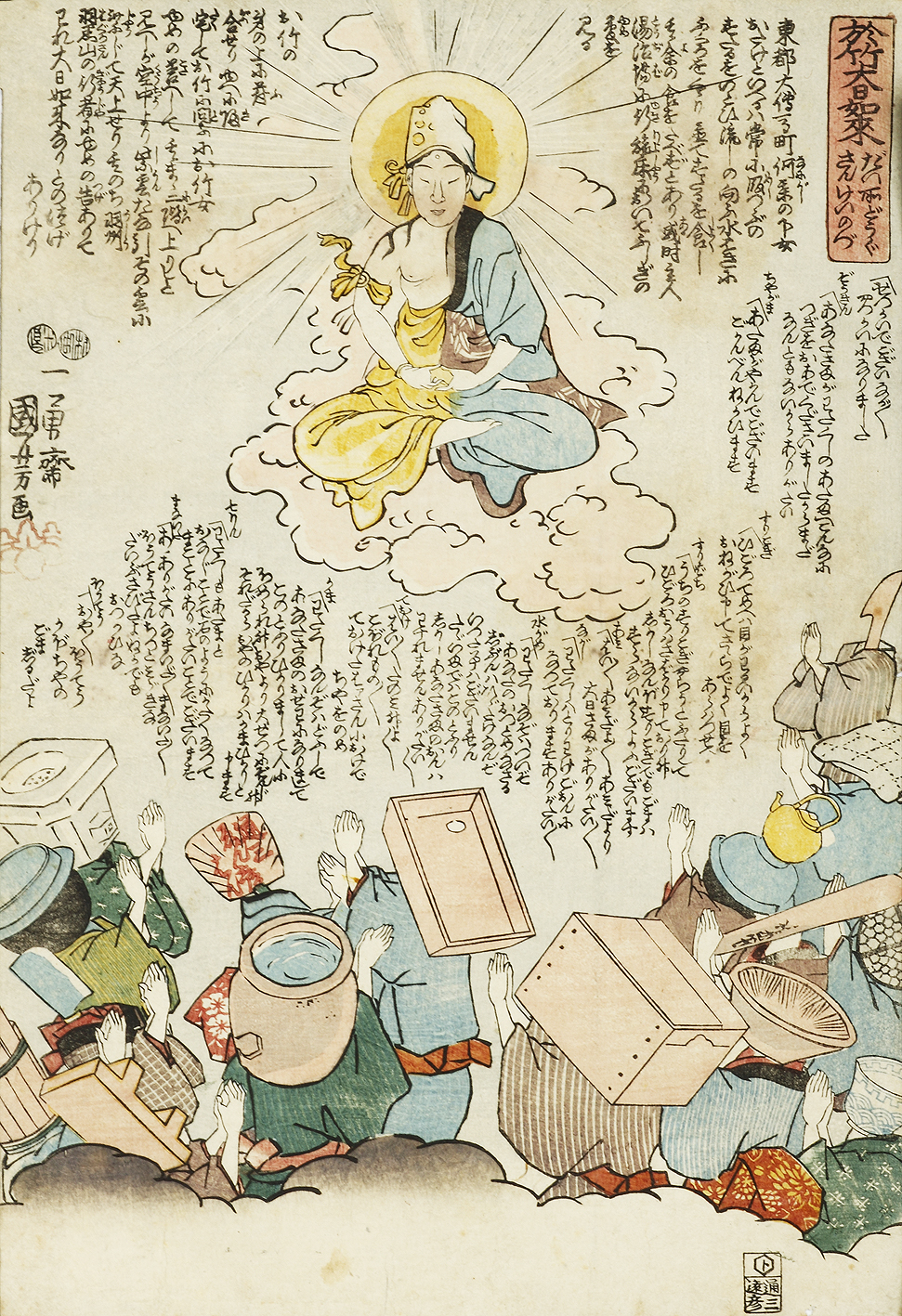
Rare, c.19th colour woodblock by Utagawa Kuniyoshi (1797-1861) from the Story of Dainichi Buddha Otake depicting kitchen implements praying to Otake, signed Ichiyūsai Kuniyoshi ga within the red gourd-shaped cartouche at left, with the artist’s Yoshi kiri (paulownia flower) seal.
Seated cross-legged on a cloud and encircled by a radiant halo, Otake holds the mallet of fortune (uchide no kozuchi), a potent emblem of wealth and plenty. Below, a throng of townspeople lift aloft their kitchenware, boxes, and utensils, offering them in petition to the deity. The accompanying inscriptions provide humorous invocations in which merchants and commoners pray for an abundance of rice, unbroken pots, prosperity in business, and safety in the household. The scene playfully merges religious imagery with comic exaggeration, reflecting Edo-period practices of everyday piety and Kuniyoshi’s distinctive wit. Kuniyoshi’s skill is evident in the lively figural group, the expressive gestures of the petitioners, and the inventive transformation of Daikokuten into a kitchen deity.
Otake (Otake Dainichi Nyorai) was a humble maidservant of the Sakuma family in Odenma-cho in Edo, who was known for the extreme diligence she brought to even the most menial chores. A group of mountain ascetics, who were searching for the reincarnation of the Nyorai Buddha, found her. When she bent down to pick up a few grains of rice that had fallen on the floor, a halo-like light surrounded her, convincing the ascetics that they had come upon a divine being. From April to October, 1849, the Ekôin temple in Ryôgoku held an exhibition of sacred objects related to Otake, called a degaichô. Otake is often portrayed with an object behind her head that resembles a halo, or with a shadow or reflection identifying her as a divine being.
Size: ōban tate-e
Date seals: 1849 (Kaei 2)
Publisher: Enshû-ya Hikobei
Censor seals: Double nanushi – IV Mera & Murata (between the 12th month of 1846 until 2nd month of 1852, two nanushi were ordered to approve prints.)
In 1790 the shogunate issued a new edict to control the print industry, it demanded that single-sheet prints with text were required to be checked by censors prior to publication. Further restrictive edicts for print publishers by the shogunate were issued over many years:
1796 – No images that named and depicted unlicensed prostitutes (who worked outside the Yoshiwara district)
1800 – Large head portraits of women or pictures of luxurious dresses were unacceptable
1804 – Named warriors dating from after 1573 were regarded as inappropriate
1842 – Banned prints of actors and beauties and only allowed prints focusing on loyalty and filial piety.
1842 – Restricted the use of colour to no eight and the price to 16 mon (equal to a bowl of noodles)
1868 – Removal of the ban of depicting contemporary events
![[Felix Pyat] non-Australia Portraits](https://antiqueprintmaproom.com/wp-content/uploads/2020/03/icon-aust-gold.svg "[Felix Pyat] non-Australia Portraits")
![[Felix Pyat] non-Australia Portraits](https://antiqueprintmaproom.com/wp-content/uploads/2020/03/icon-world-gg-2.svg "[Felix Pyat] non-Australia Portraits")