Within Australia
All orders ship freewithin Australia
Rest of the World
Orders over A$300
ship free worldwide
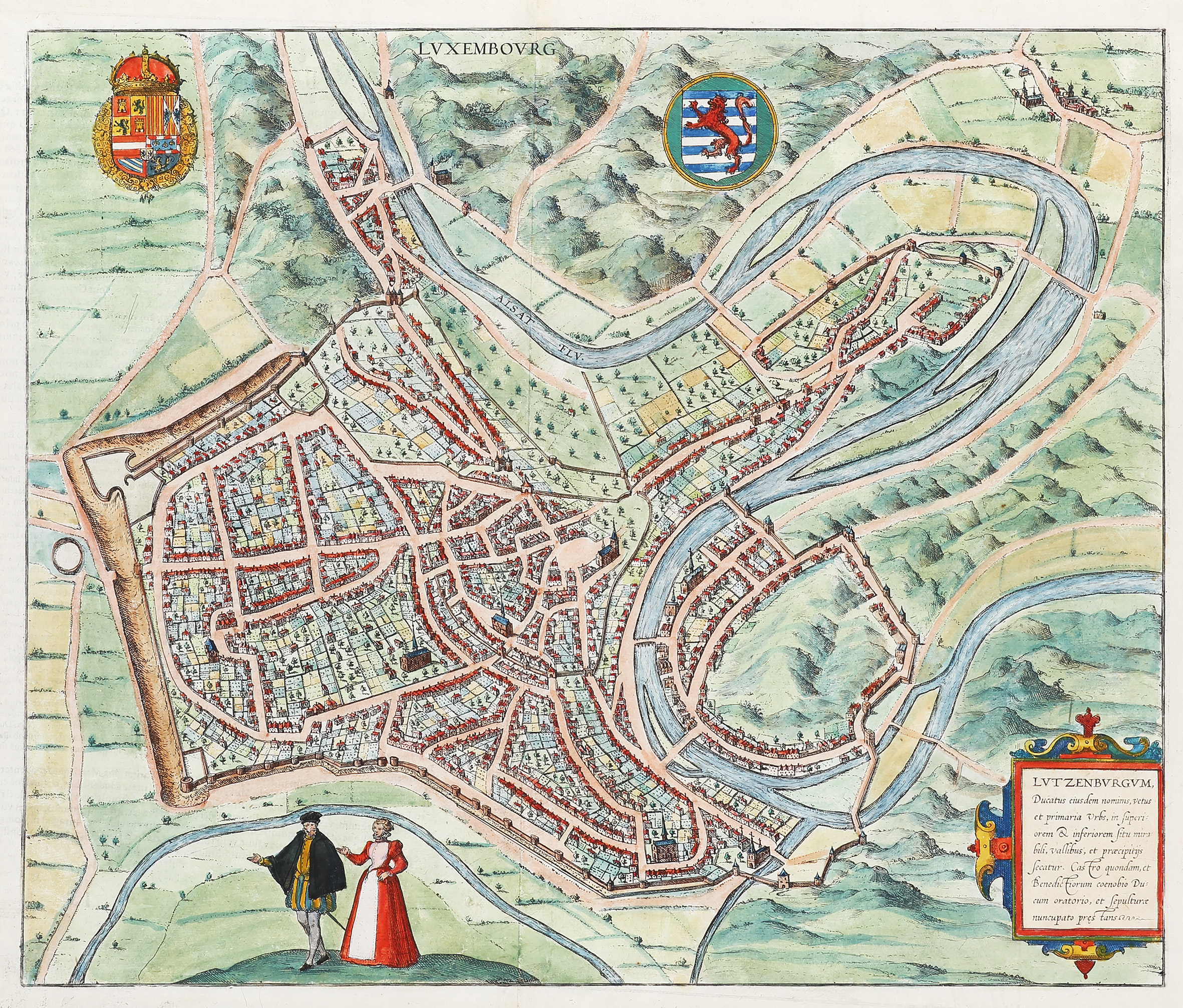
Scarce c.16th hand coloured early engraved map and town plan of Luxembourg (Lutzenburgum) by Georg Braun & Frans Hogenberg, depicting the principal city and capital of the Duchy of the same name. It depicts the fortified city dramatically sited atop … Read Full Description
$A 750
Within Australia
All orders ship freewithin Australia
Rest of the World
Orders over A$300
ship free worldwide
Full Title:
Date:
Condition:
Technique:
Image Size:
Paper Size:
Genuine antique
dated:
Description:
Scarce c.16th hand coloured early engraved map and town plan of Luxembourg (Lutzenburgum) by Georg Braun & Frans Hogenberg, depicting the principal city and capital of the Duchy of the same name. It depicts the fortified city dramatically sited atop its rocky promontory at the confluence of the Alzette and Pétrusse valleys, emphasising the formidable natural and engineered defences that earned Luxembourg its later reputation as the “Gibraltar of the North.” The engraving combines a detailed bird’s-eye view with cartographic elements, showing bastions, curtain walls, gates, bridges, churches, and principal civic structures within the dense urban fabric. Surrounding topography is carefully rendered, with steep escarpments, river courses, roads, cultivated fields, and scattered settlements situating the city within its wider ducal territory. Such views functioned both as practical topographical records and as statements of political and military importance, underscoring Luxembourg’s strategic role within the Spanish and later Austrian Netherlands and the contested borderlands of western Europe.
TRANSLATION OF CARTOUCHE TEXT: Luxembourg, the old capital of the duchy of the same name, […] it was once noteworthy on account of a fortress, a Benedictine monastery and a funerary chapel of the dukes.
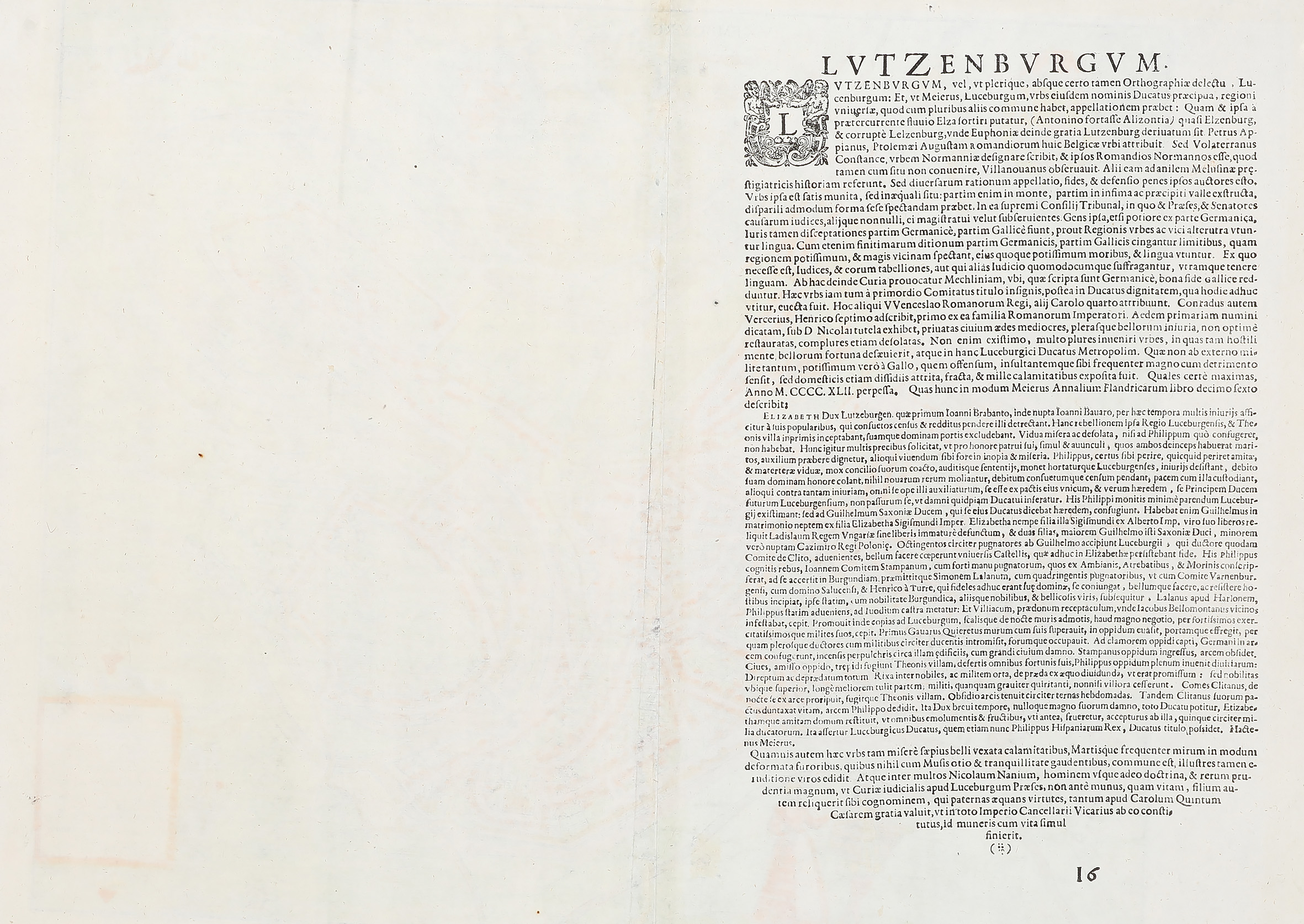
COMMENTARY BY BRAUN (on verso): “Although in Luxembourg a large part of the population is German, court proceedings are conducted partly in German and partly in French, according to whether the towns or villages use one language more than the other. Since Luxembourg borders France and Germany, people use the customs and language of whichever country is nearest. The townspeople’s houses are well kept, but those that were destroyed during numerous military conflicts have not always been rebuilt and remain partly deserted and empty. Luxembourg is fortified, but it lies in a hilly landscape, partly on top of the mountains, partly in relatively deep valleys, and hence has a very irregular appearance.” The bird’s-eye view from the south illustrates the city’s solid ramparts and its location on the River Alzette with its loop around the Bock rock. Lucilinburhuc castle was acquired in AD 963 by Count Sigefroi. In 987, the archbishop of Trier consecrated the castle chapel, which stood on the site today occupied by the church of Saint-Michel. In 1354 Luxembourg was elevated from a county to a duchy. It was captured by Burgundy in 1443 under Philip the Good. Under Louis XIV, the city was annexed to France (1684-1697) and transformed into one of the most formidable fortresses in Europe by the architect Sébastien Le Prestre Marquis de Vauban.
Franz Hogenberg (1541 - 1622)
Hogenberg was a Flemish and German painter, engraver, and mapmaker, born in Mechelen a. In 1568 he was banned from Antwerp by the Duke of Alva and travelled to London, where he stayed a few years before emigrating to Cologne. He is best known for his work on the monumental series of town views, Civitates orbis terrarium. Georg Braun (1541-1622) Braun was the principal editor of Civitates orbis terrarium, he acquired the tables, hired the artists, and wrote the texts.
View other items by Franz Hogenberg
Geogre Braun (154 - 1622)
Braun was the principal editor of Civitates orbis terrarium, he acquired the tables, hired the artists, and wrote the texts. Franz Hogenberg (1535–1590) Hogenberg was a Flemish and German painter, engraver, and mapmaker, born in Mechelen a. In 1568 he was banned from Antwerp by the Duke of Alva and travelled to London, where he stayed a few years before emigrating to Cologne. He is best known for his work on the monumental series of town views, Civitates orbis terrarium.
Exchange rates are only indicative. All orders will be processed in Australian dollars. The actual amount charged may vary depending on the exchange rate and conversion fees applied by your credit card issuer.
Join our exclusive mailing list for first access to new acquisitions and special offers.