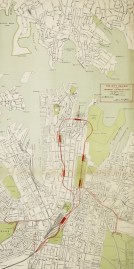
Rare and detailed c.19th hand coloured map of Sydney orientated north to the right showing the extent of development of Sydney in it’s first fifty years.
There are number of interesting notes such as the two places for bathing in the edge of the harbour, one in the Domain at Farm Cove, “Bathing House” and the other at the end of Erskine Street, Soldiers Point, “Military Bathing House”. The “Turnpike Gate” which was at the apex of Pitt and George Streets charged tolls for the maintenance of the roads. The gate keepers lodge was designed in Gothic style by the convict architect Francis Greenway in 1819. It was demolished in the 1850’s to make way for the “old round house”.
The map shows the town during its transition from penal settlement to organised colonial centre. The map centres on Sydney Cove and the shoreline of Port Jackson, with the street grid extending from the waterfront. Major thoroughfares including George, Pitt, and Elizabeth Streets structure the plan, supported by secondary streets, lanes, and surveyed allotments. Key public and institutional buildings are marked, commonly Government House, barracks, churches, hospitals, and administrative offices, reflecting Sydney’s role as colonial capital. Wharfage and jetties along Sydney Cove emphasise the maritime economy, while Darling Harbour, Woolloomooloo, and surrounding inlets place the town in its wider harbour context. Open ground and lightly developed margins indicate continuing expansion.
Executed in a clear survey-based engraving style, the plan reflects official colonial surveying during Governor Bourke’s administration, when land tenure, street alignment, and civic planning were being regularised. By the mid-1830s Sydney had a defined urban form, property structure, and active commercial waterfront. Such plans served officials, landowners, merchants, and settlers in property identification and navigation, while presenting Sydney as a permanent British colonial town. They remain important visual records of the city’s early urban layout and institutional landscape before the gold-rush era.
Superbly framed in European olive wood veneer with gilt matt and fillet.




![[Parramatta] Sydney](https://antiqueprintmaproom.com/wp-content/uploads/2025/07/MG_0301web-270x197.jpg "[Parramatta] Sydney")
![[Chester Hill] Sydney](https://antiqueprintmaproom.com/wp-content/uploads/2025/07/MG_0305web-270x198.jpg "[Chester Hill] Sydney")
