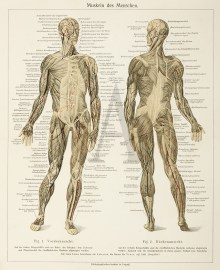
Very rare first edition, published Leyden 1747, of Jan Wandelaar (1690-1759) famous anatomy engraving, from Bernhard Siegfried Albinus (1697-1770), Tabulae sceleti et musculorum corporis humani. Note this is the first edition 1747 and not the much more common English edition … Read Full Description
Repaired tear at right hand margin not affecting the engraved area, otherwise in good condition
Technique:
Hand coloured copper engraving.
Image Size:
400mm
x 565mm
AUTHENTICITY
Genuine antique dated:
1747
Description:
Very rare first edition, published Leyden 1747, of Jan Wandelaar (1690-1759) famous anatomy engraving, from Bernhard Siegfried Albinus (1697-1770), Tabulae sceleti et musculorum corporis humani.
Note this is the first edition 1747 and not the much more common English edition of the engravings published by Paul Knapton, Titled, Tables of the skeleton and muscles of the human body, London 1749. The later English edition is identified by the following contained in the publication line at the bottom of each engraving : Londini:: Typis H. Woodfall. Impensis Johannis Et Pauli Knapton., M.DCC.XLIX.
Elephant folio size engraved plate from the largest and most sumptuous anatomical series ever made. The plates were designed and engraved by Jan Wandelaar (1690-1759) and are considered to be the most artistic and accurate representations of the human body that were ever made. Albinus and Wandelaar devised a method of increasing the accuracy of the illustrations by placing nets with square webbing at specific intervals between the artist and the anatomical specimen and copying the images using the grid patterns. Wandelaar worked on them from 1721, until his death.
Albinus, the celebrated professor of anatomy and surgery in Leiden, was one of the most renowned descriptive anatomist of his day and the pioneer of a new epoch in human anatomy. As well his own writings he edited the works of Eustachio, Fabricius and Harvey and collaborated with Herman Boerhaave editing a new edition of Vesalius, Opera omnia anatomica et chirurgica.
From: Albinus, Tabulae sceleti et musculorum corporis humani.
Collections: Met Museum New York: Object Number: 52.562.1 Huntington Library: 621844 Wellcome Collection: EPB/F/205.1
Artist:
Jan Wandelaar’s (1690–1759) Wandelaar was a pupil of Folkema, van der Gouwen and De Lairesse. His anatomical engravings (for Ruysch’ Opera and Albinus Tabulae) are the main base for his renown and highly esteemed. He died in Leyden. Bernhard Siegfried Albinus (born Weiss, 1697-1770) was a German-born Dutch anatomist. His father was professor of medicine in Frankfurt, but later transferred to Leyden. Albinus began his studies at age 12, under Boerhaave and Bidloo. He was then instructed by Sebastien Vaillant and Jacob Winslow in Paris, and afterwards wholly devoted himself to anatomy and botany.
Exchange rates are only indicative. All orders will be processed in Australian dollars. The actual amount charged may vary depending on the exchange rate and conversion fees applied by your credit card issuer.
Account Login
The List
Join our exclusive mailing list for first access to new acquisitions and special offers.




![[Plague] Map of the Parish of Ulmarra, County of C… TOWN PLANS](https://antiqueprintmaproom.com/wp-content/uploads/2020/07/mg_0670_copy-224x270.jpg "[Plague] Map of the Parish of Ulmarra, County of C… TOWN PLANS")
![[Skeleton-anterior view] Anatomical Various](https://antiqueprintmaproom.com/wp-content/uploads/2020/06/mg_7929_copy-213x270.jpg "[Skeleton-anterior view] Anatomical Various")