C1610
 (1613)

Typus Orbis Terrarum.

Ortelius’s third and last world map, published in his Theatrum Orbis Terrarum and inscribed on the lower right hand side of Terra Australis Nondum Cognita; Ortelius describ. cum privilegio decennali. 1587. This Dutch text edition of this map is often incorrectly … Read Full Description

$A 12,500

In stock

Free Shipping
The Kangaroo (Macropus) Australian - General

Within Australia

All orders ship free
within Australia
The Kangaroo (Macropus) Australian - General

Rest of the World

Orders over A$300
ship free worldwide

See Shipping page for Terms & Conditions

Details

Full Title:

Typus Orbis Terrarum.

Date:

C1610
 (1613)

Condition:

In good condition, with centre fold as issued. Wide margins.

Technique:

Hand coloured copper engraving.

Image Size: 

486mm 
x 354mm

Paper Size: 

575mm 
x 440mm
AUTHENTICITY
Typus Orbis Terrarum. - Antique Map from 1610

Genuine antique
dated:

1613

Description:

Ortelius’s third and last world map, published in his Theatrum Orbis Terrarum and inscribed on the lower right hand side of Terra Australis Nondum Cognita; Ortelius describ. cum privilegio decennali. 1587.

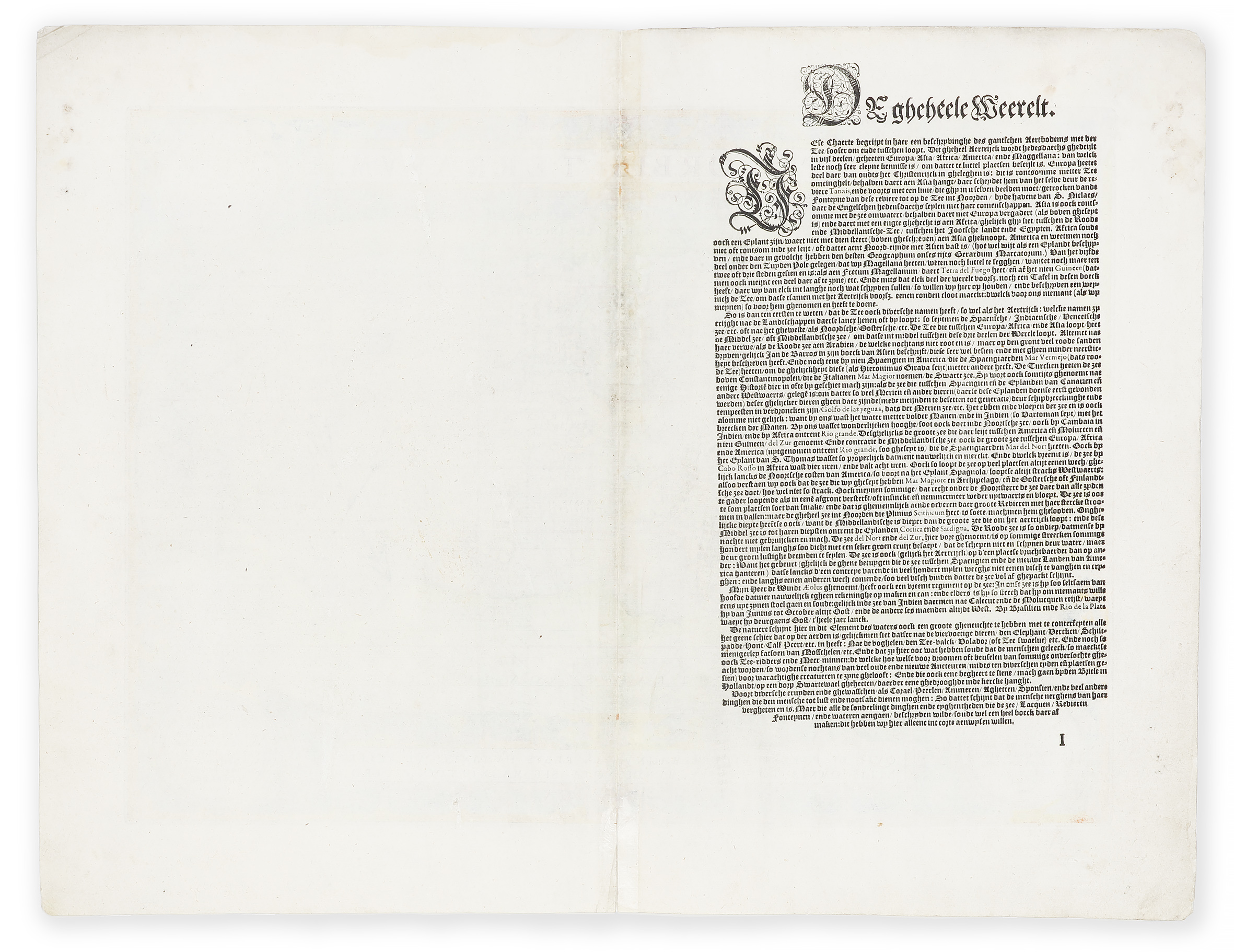
This Dutch text edition of this map is often incorrectly date as being 1589. Ortelius published numerous editions of his maps and atlases which required the text on the verso to be reformatted to accomodate the different word lengths of various languages. The dating of his maps is deduced primarily from the text on the verso which identifies the language, the page number and the alignment of the text on the sheet.

This Dutch text edition first appeared in the 1589 edition of the Theatrum with only twenty five copies printed. Ortelius then issued it again in 1610 and 1613 with any changes to the cartography. Additionally all three editions have the same details on the verso; page number 1 at lower right, Gothic text with the last line, centred like the 2 lines above it which reads; maken dit hebben wy hier alleene int corte aenwysen willen. Given that only 25 copies of the 1589 were printed and which most are accounted as being in institutional collections, it is probable that any example of this map is from either the 1610 or 1613 edition of the atlas. As a consequence we have dated the map accordingly.

Four medallions decorate each corner and feature quotes by the classical Roman statesmen Cicero and Seneca. The border of clouds included on Ortelius’s earlier world maps has been replaced by a more intricate and elegant lattice of strapwork and swag. Many of the new place names appearing along the North American west coast were provided to Ortelius by Richard Hakluyt on the basis of recent explorations. A bulge in South America which appeared in his previous world map, has now been corrected and the Solomon Islands are marked for the first time. The land of Beach is shown and above it lays the land of Java Major , the name given by Marco Polo to the island of Java. Like the influential mapmaker Plancius, Ortelius shows the landmass Terra Sept Emtrionalis Incognita at the north pole separated by narrow straits from the continents of Europe, Asia and North America. Plancius was the pre-eminent Dutch mapmaker of the period and a leading advocate of a northern passage to the East. He was to become the first VOC chartmaker in 1602. New Guinea is shown as an island, although Ortelius includes a note at lower left below the word Noua Guinea stating, ‘Noua Guinea nuper inuenta qu an sit insula an pars continentis Australis incertest’ [New Guinea, recently discovered. Whether this is an island or part of the Southern continent is uncertain]. In the lower right of the map in the provinces of Beach is written: ‘Vastiimas hic ee | regiones ex M Pauli Ven:et | Lud.Vartomann. scriptis pe: | regrationibus constat’. [These regions are very extended, as can be seen in the writings of Paulus Venetus and the travels of Ludovicus Vartomannus] (Varthema). Further towards the centre in Terra Australis Incognita, a note explains: Psitacorum regio | sic a Lusitanis appellata ob | incredibilem earum auium ibidem magnitudem. [This region is called ‘of the Psitaci’ by the Portuguese because of the incredible number of birds of the same size]. The Theatrum included a section called Catalogus Auctorum, which listed the thirty-three cartographers referred to by Ortelius and the eighty-seven geographers known to him at the time. The sources for this map were the world maps by Gastaldi 1561, Mercator 1569 and Gutierrez’s portolan map of the Atlantic 1562. Ortelius also mentions the world maps of Petrusab Aggere, Apianu, Sebastian Cabotus, Laurentius Fries, Gemma Frisius, Doco ab Hemminga Frisius, Jodocus Hondius, Orontius Finaeus and Petrus Planicus.

References:
Shirley, R. The Mapping of the World Early Printed World Maps 1472-1700. London 1987 :: Shirley 158, ill. pl.130 (unique state)..
Van Den Broecke, M. P. R. Ortelius Atlas Maps.1996 Netherlands :: 1598/1610/1613D.
McMahon, L & J. Exploring the South Land / Tasmania emerges from Terra Australis Incognita. 2006 Tasmania: vii, ill.vi.
Moreland, C. & Bannister, D. Antique Maps. London 1995 :: ill. pl.2.
Perry, T. The Discovery of Australia. Sydney 1982 :: p.18, ill.pp.18-19.
Kroght, P. Koeman's Atlantes Neerlandici. Amsterdam 1997. Nine volumes :: 31:122 (1) 1.


Abraham Ortelius (1527 - 1598)

Flemish cartographer, geographer, and publisher, born in Antwerp on 14 April 1527. He is celebrated as the creator of the Theatrum Orbis Terrarum (Theatre of the World), first published in 1570, widely regarded as the first modern atlas and one of the most influential cartographic works of the sixteenth century.

Trained as a map colourist and illuminator, Ortelius joined the Antwerp Guild of St Luke as a map illuminator in 1547, initially working in partnership with his sister, Anne. He began his career as a map and print dealer, trading in geographical materials and decorative prints across Europe. His extensive travels—to France, Germany, Italy, and notably to London where he met the English cartographer John Dee and the great mapmaker Gerardus Mercator—broadened his intellectual and professional network. Mercator’s work and ideas profoundly influenced Ortelius’s approach to geography and cosmography.

Ortelius’s Theatrum Orbis Terrarum was first issued in Antwerp in 1570 by the printer Gilles Coppens de Diest. Comprising seventy engraved maps with accompanying text, it presented a consistent format and unified design, with maps engraved chiefly by Frans Hogenberg. Each map was carefully attributed to its original source, a practice that reflected Ortelius’s scholarly integrity and established an early model for bibliographic citation in cartography. The Theatrum was an unprecedented success, appearing in more than forty editions and seven languages over the next four decades.

In 1573 Ortelius issued the Additamentum, the first supplement to the atlas, introducing new maps and expanding its global scope. Among his other important works were the Synonymia Geographica (1578), a geographical dictionary of ancient and modern place names, and Thesaurus Geographicus (1596), both significant contributions to Renaissance geographical scholarship.

Ortelius was also among the first to propose, in marginal notes to his maps, that the continents might once have been joined before drifting apart—an early precursor to modern theories of continental drift. His combination of scientific precision, humanist learning, and aesthetic refinement made him a central figure in the golden age of Netherlandish cartography.

He maintained close associations with leading scholars and artists of his time, including Justus Lipsius, Christopher Plantin, and the cartographers Gerard de Jode and Petrus Plancius. His friendship with Mercator remained of great importance throughout his life, and Mercator dedicated several works to him.

Ortelius was appointed Royal Geographer to King Philip II of Spain in 1575, in recognition of his contributions to geography and the prestige his atlas brought to the Spanish Netherlands. He continued to reside in Antwerp, where he also acted as a patron to younger scholars and artists.

Abraham Ortelius died in Antwerp on 28 June 1598 and was buried in the Church of St Michael’s Abbey. His epitaph reads Quietis cultor sine lite, uxore, prole—“A worshipper of tranquillity, without dispute, wife, or children.” His maps and atlases remain milestones in the history of cartography, bridging medieval cosmography and the emerging scientific geography of the early modern world.

View other items by Abraham Ortelius

Choose currency

Exchange rates are only indicative. All orders will be processed in Australian dollars. The actual amount charged may vary depending on the exchange rate and conversion fees applied by your credit card issuer.

Account Login

The List

Join our exclusive mailing list for first access to new acquisitions and special offers.