C1705

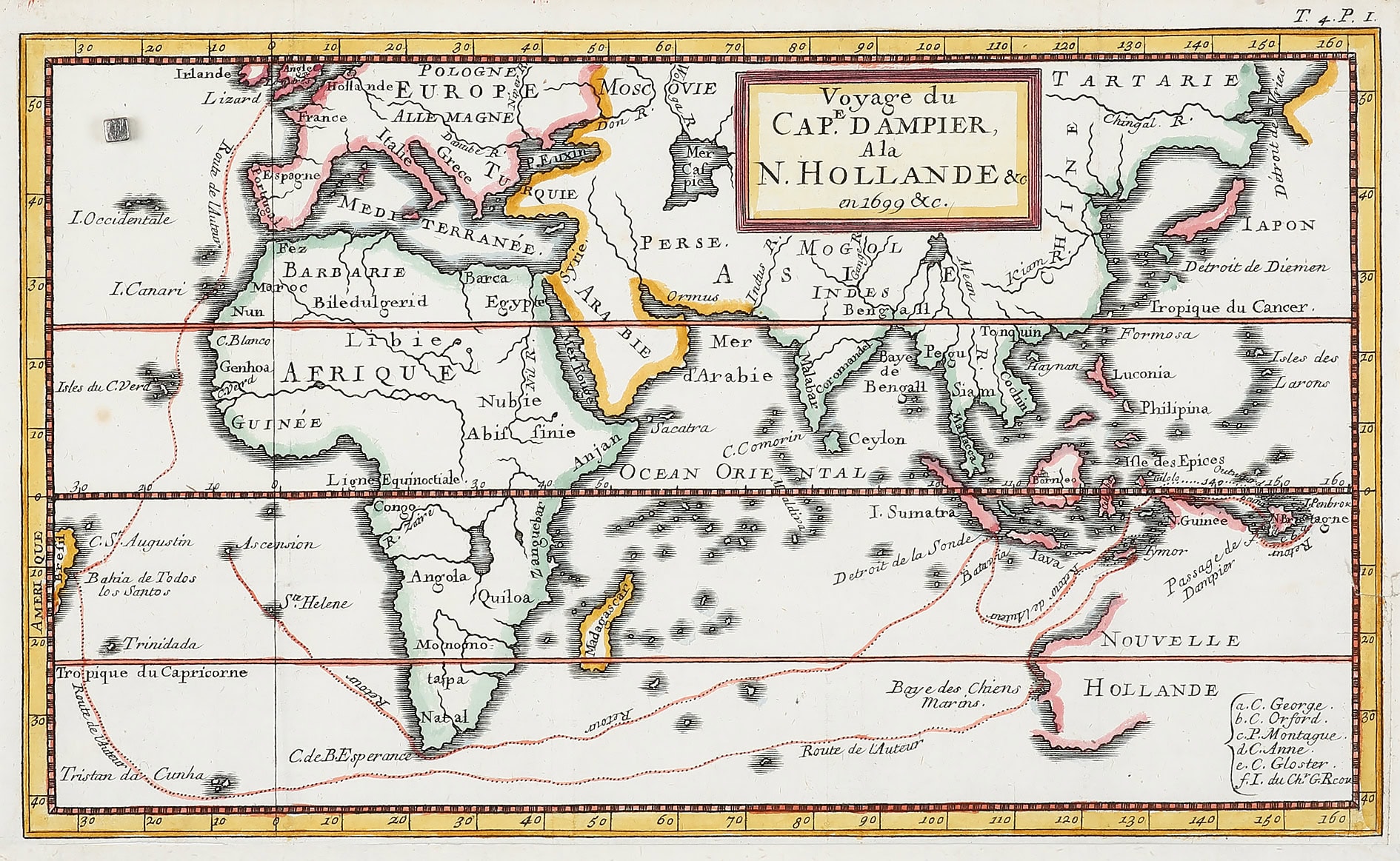
Voyage du Cape Dampier a la N.Hollande &c en 1…

Scarce c.18th hand coloured engraved map showing the tracks of William Dampier’s  voyage in the Roebuck expedition of 1699, by the eminent English cartographer Herman Moll. Moll had access to the latest data and observations from Dampier&#8217s voyages, allowing his … Read Full Description

$A 750

In stock

S/N: DNYADM-04001–297930
(C024)
Free Shipping
The Crested Porcupine. non-Australian

Within Australia

All orders ship freewithin Australia

The Crested Porcupine. non-Australian

Rest of the World

Orders over A$300
ship free worldwide

See Shipping page for Terms & Conditions

Details

Full Title:

Voyage du Cape Dampier a la N.Hollande &c en 1699 &c

Date:

C1705

Condition:

Narrow lower margin, otherwise in good condition.

Technique:

Hand coloured copper engraving.

Image Size: 

277mm 
x 163mm

Paper Size: 

289mm 
x 172mm
AUTHENTICITY
Voyage du Cape Dampier a la N.Hollande &c en 1699 &c - Antique Map from 1705

Genuine antique
dated:

1705

Description:

Scarce c.18th hand coloured engraved map showing the tracks of William Dampier’s  voyage in the Roebuck expedition of 1699, by the eminent English cartographer Herman Moll.

Moll had access to the latest data and observations from Dampier&#8217s voyages, allowing his maps to be the first to accurately portray the great ocean currents. Dampier was the first Englishman to explore parts of Australia and has been referred to as the first natural historian of Australia. In command of the HMS Roebuck, Dampier sailed to the west coast of Australia via the Cape of Good Hope, following the route to the Indies that Dutch ships had used since the discovery of the Roaring Forties by Hendrik Brouwer in 1611. Dampier arrived at Dirk Hartog island in July 1699, naming the surrounding harbour Shark Bay. After making a detailed record of the native flora and fauna, he proceeded north along the Western Australian coast to the Dampier Archipelago and Lagrange Bay before making his way to Timor. He charted a number of islands off the coast of New Guinea before setting sail for England. His return was met with some misfortune and the Roebuck’s crew were marooned on Ascension Island for several weeks before being rescued by an East Indiaman. Despite being produced in 1705, this map does not show the results of Tasman’s voyages of 1642-44, likely because it was chiefly made to highlight Dampier’s achievements. Various important spice trading regions are labelled including the Coromandel and Malabar coasts in India and Zanzibar in Eastern Africa. The Spice Islands are also labelled and the Sunda Strait which Linschoten suggested Dutch ships use to avoid the presence of the Portuguese in the Malacca Strait is also described.

From: Guillaume Dampier, Nouveau Voyage autour du Monde

References:
Hill, J. The Hill Collection of Pacific Voyages. San Diego 1974 :: pp. 75-78.
Sabin, J. A Dictionary of Books Relating to America, from its Discovery to the Present Time. New York. (1936) 1967 :: 18381.
Howgego, J. Encyclopedia of Exploration to 1800. Sydney 2011 :: D7.


Collections:
Bibliotheque Nationale de France: G-22370
National Library Australia: Bib ID: 2418141
Huntington Library: Call number 9845
State Library New South Wales: Call Number: RB/DS909.8A

William Dampier (1651 - 1751)

Born in Somerset, England, became renowned as a seaman and author. His maritime career included voyages in the Pacific and South Seas, where he explored the Philippines, Australia's west and north coasts, and engaged in trading across Southeast Asia. His writings, first published in 1697 and 1699, established him as an authority on the South Seas, leading the Admiralty to seek his advice on naval exploration. In 1699, he commanded an expedition on H.M.S. Roebuck, discovering Shark Bay and sighting New Britain. Despite his literary fame, Dampier faced challenges in leadership, as evidenced by a 1702 court martial declaring him unfit to command. Subsequent privateering expeditions and a global voyage from 1708 to 1711 under Captain Woodes Rogers followed. Dampier's detailed and factual descriptions in his works influenced travel literature and navigational science. He passed away in London in 1715, leaving a legacy that indirectly contributed to the exploration and settlement of eastern Australia.

View other items by William Dampier

Related Products

Choose currency

Exchange rates are only indicative. All orders will be processed in Australian dollars. The actual amount charged may vary depending on the exchange rate and conversion fees applied by your credit card issuer.

Account Login

The List

Join our exclusive mailing list for first access to new acquisitions and special offers.