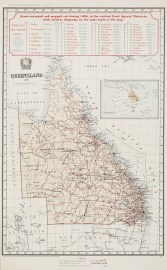
John Arrowsmith (1790 - 1873)
English mapmaker, the last of a family of map makers that produced maps during the period 1790 to 1870. His uncle Aaron (1750 - 1823) left the north of England and went to work in London as a land surveyor where he surveyed the Great Post Roads between London and Falmouth which was engraved and published by John Cary an engraver in 1782 (Verner, 1971, p.1). In the 1790s he decided to establish his own map making business. He published about 200 maps and achieved great eminence being appointed Hydrographer to the King in 1820.
John Arrowsmith, Aaron's nephew, who was born in Winston, county Durham, England (1790 - 1873) came to work for him in 1810. During the next thirteen years he learned from his uncle the art of map making, including engraving and printing. His two cousins, Aaron junior (1802-54) and Samuel (1805-39) (Verner, 1971, p.2) both worked in the business and inherited jointly the house, business, copper plates, presses etc. as stated in their father's will. By the time of his uncle's death John had established his own business which operated out of 33 East Street, Red Lion Square, although he still worked with his two cousins Aaron and Samuel. All three produced individual works, although Samuel was in charge of the business at 10 Soho Square. Aaron the younger, lost interest in map making and ceased producing maps in 1832 (Verner, 1971, p.2). In 1839 Samuel died and John bought the business including plates, MSS and copyrights at auction of December 1839 (Herbert, 1983) and continued operating from 10 Soho Square.
In 1834 he produced his magnum opus, The London Atlas of Universal Geography, which he continued to revise and reissue until the last 1858 edition. However his atlas contains maps of later dates into the 60s (Herbert, 1989).
He became a founding member of the Royal Geographical Society in London (1830) and a member of its council. He remained an active member for over forty years during which time he met many explorers and persons of influence who were instrumental in supplying him with information for his maps. In 1831 the society's Journal was established and Arrowsmith began producing maps for it from 1832 until 1870. He received the Gold medal of the Society in 1863 (Tooley, 1999).
After his death his plates were bought by Edward Stanford of London who continued to issue the atlas with the name of Stanford's London Atlas of Universal Geography. This atlas continued into the 1920s. (Dorothy Prescott, 2010-2015)
View other items by John Arrowsmith
![[Felix Pyat] non-Australia Portraits](https://antiqueprintmaproom.com/wp-content/uploads/2020/03/icon-aust-gold.svg "[Felix Pyat] non-Australia Portraits")
![[Felix Pyat] non-Australia Portraits](https://antiqueprintmaproom.com/wp-content/uploads/2020/03/icon-world-gg-2.svg "[Felix Pyat] non-Australia Portraits")