C1848

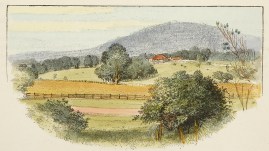
Valley of Jamberroo, Illawarra. sic (Jamberoo)

Rare early view of Jamberoo by Capt. Robert Westmacott ( 1801 – 1870 ), showing the Woodstock Saw Mills that opened in 1838 on the bank of the Minnamurra River to mill timber mainly cedar. Jamberoo was on the main … Read Full Description

$A 1,250

In stock

S/N: SIAU-NC-010–184034
(C002)
Free Shipping
[Felix Pyat] non-Australia Portraits

Within Australia

All orders ship freewithin Australia

[Felix Pyat] non-Australia Portraits

Rest of the World

Orders over A$300
ship free worldwide

See Shipping page for Terms & Conditions

Details

Full Title:

Valley of Jamberroo, Illawarra. sic (Jamberoo)

Date:

C1848

Engraver:

William Spreat 

Condition:

In good condition.

Technique:

Hand coloured lithograph, with one tint.

Image Size: 

265mm 
x 186mm

Paper Size: 

344mm 
x 262mm
AUTHENTICITY
Valley of Jamberroo, Illawarra. sic (Jamberoo) - Antique View from 1848

Genuine antique
dated:

1848

Description:

Rare early view of Jamberoo by Capt. Robert Westmacott ( 1801 – 1870 ), showing the Woodstock Saw Mills that opened in 1838 on the bank of the Minnamurra River to mill timber mainly cedar.

Jamberoo was on the main rail route from Sydney to Nowra and became a thriving town until it was bypassed in 1888.

Westmacott’s description; ‘The Valley of Jamberoo is well watered, and perhaps for its fertility cannot be surpassed. The valley extends some distance, bounded by lofty hills the soil to the summits is very rich the timber of gigantic size and variety. This extensive valley has at no very distant period been covered by the sea, as shells embedded in the rocks and clay are found in great quantities. The extremity of the valley is fifteen miles from the sea. Extensive Mills have been erected for sawing timber, grinding, &c., and within a short period a Brewery, proving of great benefit to the settler, who gets rid advantageously of his barley. The establishment cultivate their own hops, and as a proof of the good description of land, they grow upwards of twenty five feet high, and yield about thirteen hundred weight to the acre, and are said to be of superior quality there are however other extensive hop plantations in Illawarra.’

From Westmacott, R. Sketches in Australia.


References:
Ferguson, J. A. Bibliography of Australia Volumes 1-8, Canberra 1976 :: 4955.

Collections:
National Library Australia: Bib ID 142223
Wollongong Art Gallery: Accession Number 2014.035
State Library New South Wales: CALL NUMBER MRB/F981/W
State Library Victoria: RARELTF 769 W52

Capt. Robert Westmacott (1801 - 1870)

Artist and army officer born in England in 1801, a member of the noted Westmacott family of artists and sculptors. His uncle, Sir Richard Westmacott (1775–1856), was one of the leading British sculptors of the early nineteenth century, and the family circle included several artists of distinction. Robert pursued a military career, receiving a commission in the 4th (King’s Own) Regiment of Foot, in which he eventually attained the rank of captain.

Westmacott was posted to New South Wales in the mid-1830s, at a time when the colony was expanding rapidly and European settlement was spreading inland. He developed a talent for sketching, particularly landscapes and topographical views. During his residence in Australia he travelled through both New South Wales and Van Diemen’s Land (Tasmania), recording harbour scenes, townships, and surrounding countryside. His drawings capture Sydney Cove, Hobart Town, Parramatta, and other early colonial sites at a formative period in their development.

On his return to England, Westmacott arranged for a selection of his sketches to be published as lithographs. The resulting series, Views in Australia, appeared in London between 1838 and 1840, issued in several parts. Hand-coloured examples, marketed through subscription, presented to a British audience the landscapes, architecture, and life of the colonies. Although modest in number, these prints are regarded as significant both artistically and historically. They provide some of the earliest published pictorial records of colonial Sydney and Hobart, predating the wider circulation of works by Conrad Martens and others.

Westmacott’s work stands in the tradition of the soldier-artist, combining accurate observation with picturesque composition. His lithographs, often delicately coloured, were aimed at a metropolitan public curious about distant settlements. While not as prolific or technically refined as Martens, his views are valued for their rarity and their directness of vision. They remain important documentary sources for historians of early Australia.

Westmacott returned permanently to England after his Australian service. He does not appear to have pursued an extensive artistic career thereafter, though examples of his prints survive in major institutional collections, including the National Library of Australia and the State Library of New South Wales. He died in 1870.

View other items by Capt. Robert Westmacott

Related Products

Choose currency

Exchange rates are only indicative. All orders will be processed in Australian dollars. The actual amount charged may vary depending on the exchange rate and conversion fees applied by your credit card issuer.

Account Login

The List

Join our exclusive mailing list for first access to new acquisitions and special offers.