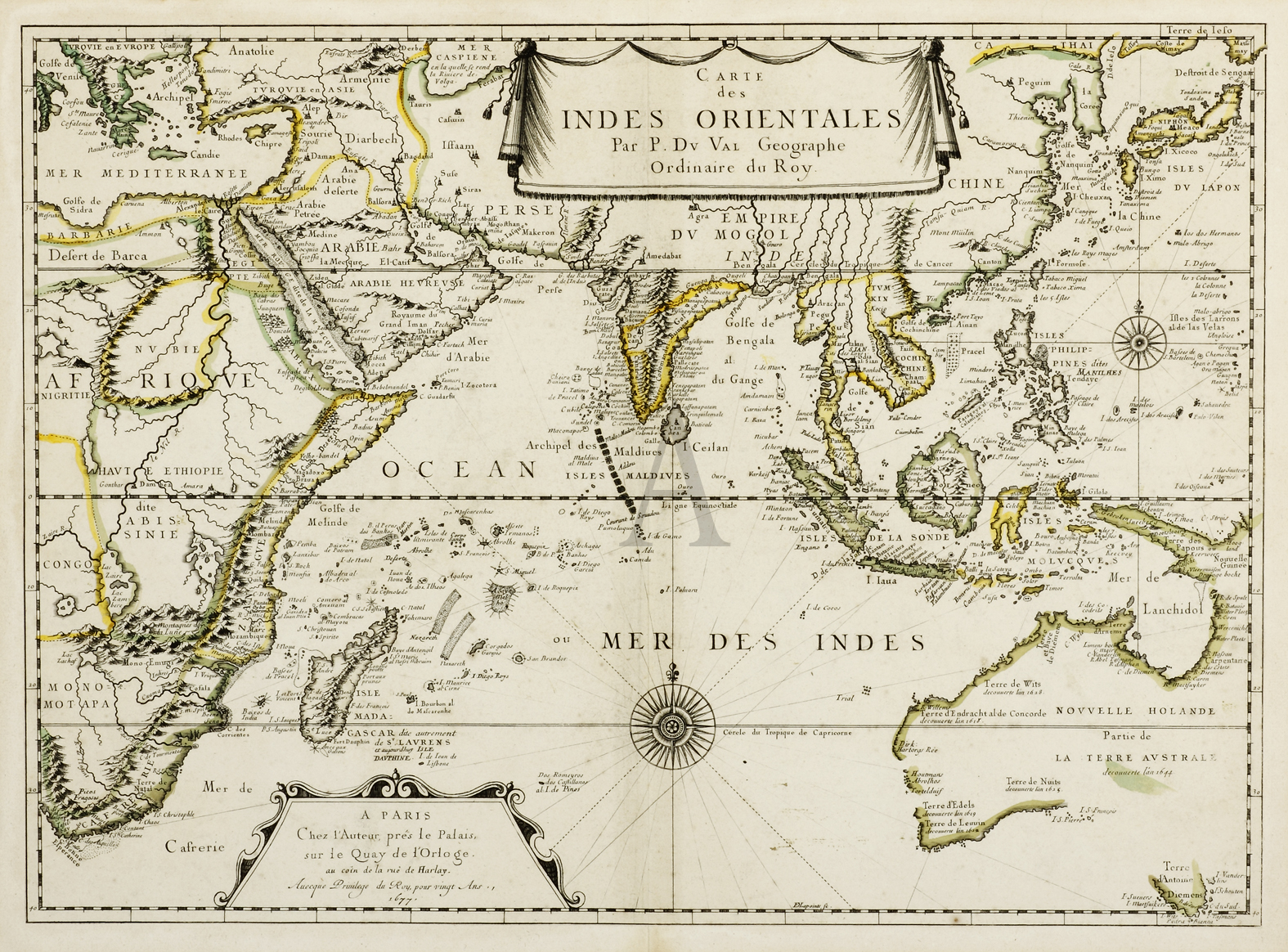
Superbly detailed map extending from Africa to Australia by the celebrated French mapmaker Pierre Duval, nephew of Nicholas Sanson, and one of the most influential and prolific Parisian mapmakers of the late seventeenth century.
The map is elegantly decorated with a scrolled title cartouche dedication panel, compass roses and rhumb lines.
The map records the following Dutch discoveries on the Australian coast:
1616 Hartog in the Eendracht
1619 Houtman in the Dordrecht and Amsterdam
1623 van Leeuwin
1623 Carstensz in the Leijden
1627 Nuyts in the Gulden Zeepaert (incorrectly dated 1625)
1628 de Wit in the Vianen
1642-3 Abel Tasman first voyage in the Heemskerck and Zeehaen 1642-3
1644 Abel Tasman second voyage in the Limmen, Zeemeeuw and the tender Braek
The map does not include the first recorded European discovery of Australia by Willem Jansz in the Duyfken on Cape York Peninsula on 26th February 1606. On 18 November 1605, the Duyfken had sailed from Bantam to the coast of western New Guinea. Although all records of the voyage have been lost, Janszoon’s departure was reported by Captain John Saris. He recorded that on 18 November 1605 “a small Dutch pinnace departed here for the discovery of the land called New Guinea, which, it is said, may yield a great amount of wealth”. The earliest recording of the Duyfken’s voyage to, “discover the great land Nova Guinea and other unknown east and south lands’ appears on the first edition of Janz Jasson (1588-1664) map, Indiae Orientalis Nova Descriptio, published in 1630. On that map appears Jansz’ naming of the southern coast of New Guinea as, Dufkens Eylandt.
The area between New Guinea and Cape York is shown as uncharted, although Luís Vaz de Torres had discovered the strait in 1606, just four months after Jansz’ discoveries of the eastern side of Cape York, although it is not known if he actually sighted the Australian coast. Spanish maps included the southern coast of New Guinea but Dutch maps were not to include the Strait until after Cook’ first voyage in 1770.
Also noted are the Trial Islands (Barrow/Montebello Islands, near present-day Dampier), named after the ship the Trial, which had sailed for Java using the new sea route to the Indies pioneered by Brouwer in 1611. The Trial had struck unknown rocks on the night of 25 May 1622, and was wrecked with only forty-six survivors including Captain Brookes. In his subsequent report to the VOC authorities in Batavia, Brookes stated that the rocks were well west of their true position in an attempt to avoid blame for his error. Soon after a Dutch ship, the t Wapen van Hoorn, ran aground in a storm in the area but managed to sail after the storm abated. Concerned for the viability of their trade route, Hessel Gerritz the official cartographer for the VOC issued an updated chart in 1627. Due to their incorrect placement on the Gerritsz chart, the Trial Rocks remained a mystery for a further two hundred years until Phillip Parker King, sailing in the Mermaid, investigated their position in 1820 and finally confirmed that ‘ remains no doubt in my mind but that Barrow Island … are the same Tryal Rocks’. A scarce map produced in small numbers.
From: Duval, P. Cartes de Geographie les plus nouvelles et les plus fideles.
References:
Clancy, R. The Mapping of Terra Australia. Sydney 1995 : 6.19 ill pg 86/87.
Clancy, R. & Richardson, A. So They Came South. Sydney 1988 108 ill pg106/107.
Tooley, R.V. The Mapping of Australia. London 1979 : 539.
Schilder, G. Australia Unveiled, The share of the Dutch navigators in the discovery of Australia. Amsterdam 1976 : 86.
Parry, D. The Cartography of the East Indian Islands Insulae Indiae Orientalis. London 2005 : p.149, ill.5.28.
Quirino, C. Philippine Cartography (1320-1899) Amsterdam 2010 Manila : p.109.
Clancy, R. & Richardson, A. So They Came South. Sydney 1988 pp. 106-107.
Schilder, G. Australia Unveiled, The share of the Dutch navigators in the discovery of Australia. Amsterdam 1976 : pp. 414-415.
Tooley, R. Tooley’s Dictionary of Mapmakers 1979 : pp. 202-203.
Kissajukian, L.P. Southland in Search of Spices Maps 1513-1811. Sydney 2013 : Map. 37, ill. p.39.
Collections:
National Library Australia: Bib ID: 534755
Bibliotheque Nationale de France: ark:/12148/btv1b8493351t
Australian National Maritime Museum: OBJECT NUMBER00000919
British Library London: Accession Number: D2018_000082_BL