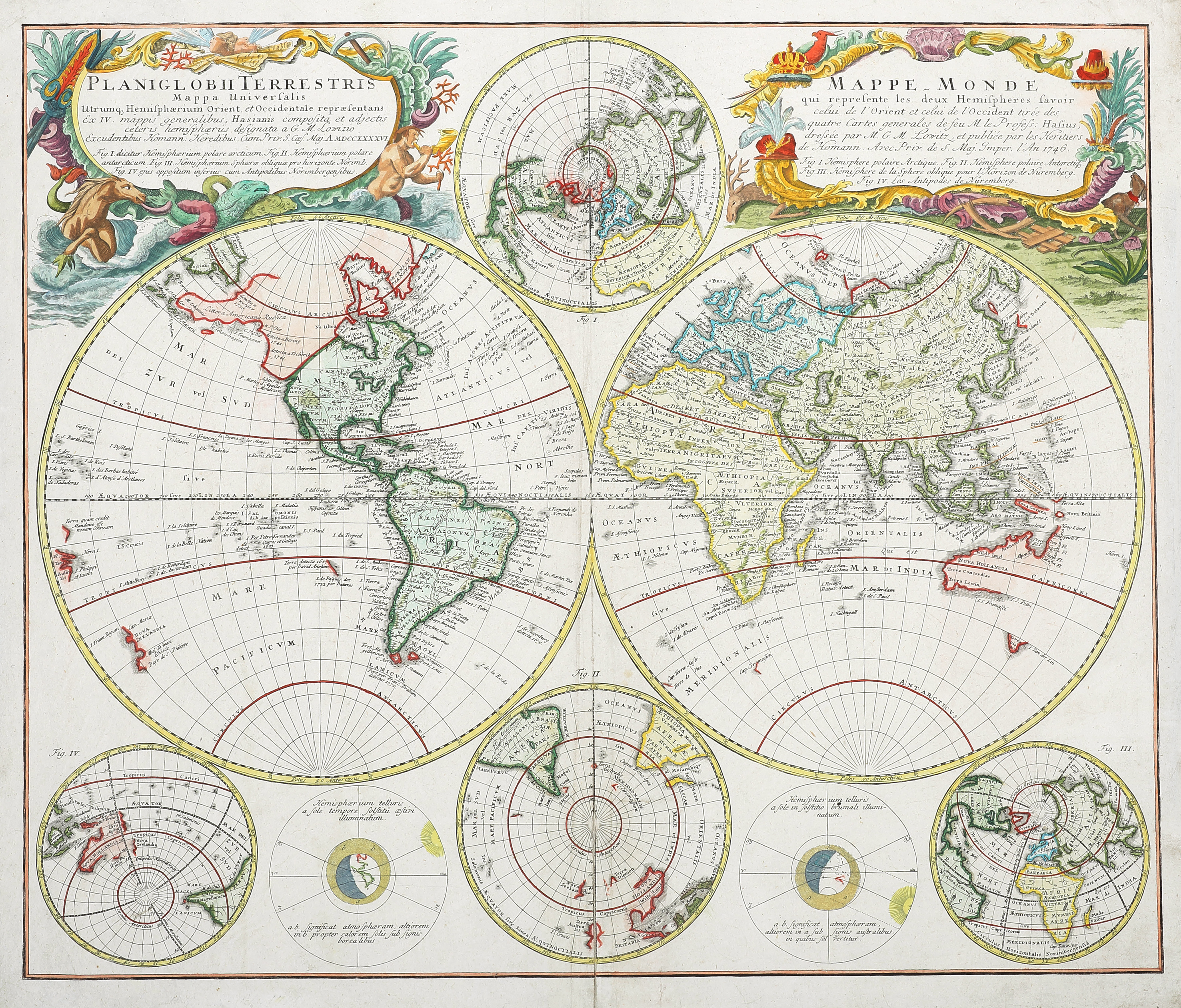
Scarce hand coloured engraved double-hemisphere c.18th world map, compiled by J.M. Haas, a professor of mathematics at Wittenburg. The map is superbly decorated with a pair of elaborate title cartouches at top, one in Latin and the other in French. … Read Full Description
Minor wear to lower centrefold, faint creasing and small repaired tears to sheet edge, otherwise in good condition.
Technique:
Hand coloured copper engraving.
Image Size:
545mm
x 460mm
Paper Size:
603mm
x 507mm
AUTHENTICITY
Genuine antique dated:
1746
Description:
Scarce hand coloured engraved double-hemisphere c.18th world map, compiled by J.M. Haas, a professor of mathematics at Wittenburg.
The map is superbly decorated with a pair of elaborate title cartouches at top, one in Latin and the other in French. Between the hemispheres, two circular insets show the world from the North and South Poles and four more circular diagrams feature along the bottom. Two sphere obliques appear in the corners, one showing the world centred on Nuremberg where Homann died in 1724 and the other showing its antipode. The two smaller circles are solar diagrams. The Latin title cartouche in the top left corner is decorated with the figure of Triton, son ofPoseidon and Amphitrite, the god and goddess of the sea. He is shown blowing on his conch shell which he used to calm and raise the ocean waves and to his left is his sea horse. The right title cartouche is a festoon, decorated with animals, a parrot and crowns. T
The cartography of Australia and New Zealand is shown according to the discoveries made by Abel Tasman on his first and second voyages 1642-44. Some of the earlier Dutch discoveries included are those of Hartog 1616, the van Leeuwin 1619, Nuyts 1627, de Wit 1628 and Tasman 1642-44. The northwest coast of America is uncharted and California is shown as a peninsula. An excellent example of the state of contemporary eighteenth-century knowledge in Europe prior to the great voyages of discovery made by the British and French.
From: Homann, Grosser Atlas ueber die ganze Welt.
References: Moreland, C. & Bannister, D. Antique Maps. London 1995 :: pp.84-85.. Wagner, H.R. Cartography of the Northwest Coast of America to the Year 1800. Amsterdam 1968 :: #556, p.332.
Collections: State Library New South Wales: 991001512249702626 State Library Victoria: 9911255653607636 David Rumsey Collection: 12138.004
Johann Baptist Homann (1663 - 1724)
Homann was the most important German cartographer of the 18th century. In 1715 the Holy Roman Emperor Charles the VI, appointed him Imperial Cartographer and in the same year he was also appointed a member of the Royal Academy of Sciences in Berlin. Upon his death, the business passed to his son Johann Christolph (1701-1730) and in 1730 the business was continued by the Heirs to Homann up until 1848.
Exchange rates are only indicative. All orders will be processed in Australian dollars. The actual amount charged may vary depending on the exchange rate and conversion fees applied by your credit card issuer.
Account Login
The List
Join our exclusive mailing list for first access to new acquisitions and special offers.