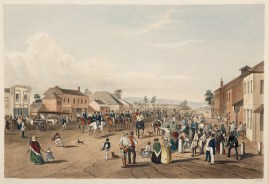
George French Angas (1822 - 1886)
Angas was a painter, lithographer, engraver and naturalist, fourth child and eldest son of George Fife Angas, a merchant and banker. As the eldest son he was expected to join his father's firm, but some months in a London counting house proved a disillusioning experience. In 1841 he took art lessons for four months from Benjamin Waterhouse Hawkins, a natural history painter and lithographer, and armed with this instruction set out to see the world. He began in the Mediterranean publishing, A Ramble in Malta and Sicily in the Autumn of 1841.......Illustrated with Sketches Taken on the Spot, and Drawn on the Stone by the Author, the following year.
Angas's father had established the South Australian Company in 1836 and had large areas of land as well as banking interests in the province. George French sailed for South Australia in 1843 in the Augustus, arriving in Adelaide on 1st January 1844. Within days he had joined an exploring party selecting runs for the South Australia Company. They traveled through the Mount Lofty Ranges to the Murray River and down to Lake Coorong and Angas sketched views of the countryside, native animals and the customs and dwellings of the Narrinyerri people. Later he drew scenes on his father's land - 28,000 acres in the Barossa Valley - and accompanied George Grey's expedition to the then unknown south-east as unofficial artist.
In July 1844 Angas visited New Zealand. Guided by two Maoris, he traveled on foot and by canoe through both islands, painting portraits of Maoris and views.
Angas's father died in 1879, leaving a vast estate from which George French received only a annuity of 1000 pounds. In 1884 he went to Dominica on a collecting expedition, finding shells, moths, butterflies and birds. Dogged by rheumatism and neuralgia during his last years, Angas died in London on 4 October 1886.
View other items by George French Angas
James William Giles (1801 - 1870)
Giles was a painter and lithographer born in Glasgow , the son of a designer at the local calico. The family moved to Aberdeen around 1805 where his father worked in a printing factory at Aberdeen and was an artist of some repute. His father's early death threw his son at an early age upon his own resources and at 13 he maintained himself, his mother and sister by painting, and before he was 20 was teaching private classes in Aberdeen. At 21 he married a widow Clementina Farquharson. He then became a member of the Royal Scottish Academy and elected to the council of the Spalding Club.
He first exhibited at the "Royal Institution for the Encouragement of the Fine Arts in Scotland", and in 1829 became an academician of the Royal Scottish Academy, and contributed numerous works to its exhibitions from that time until near the close of his career. He also exhibited frequently at the British Institution in London, and occasionally at the Royal Academy and the Society of British Artists.
View other items by James William Giles