Within Australia
All orders ship freewithin Australia
Rest of the World
Orders over A$300
ship free worldwide
Mapmaker:
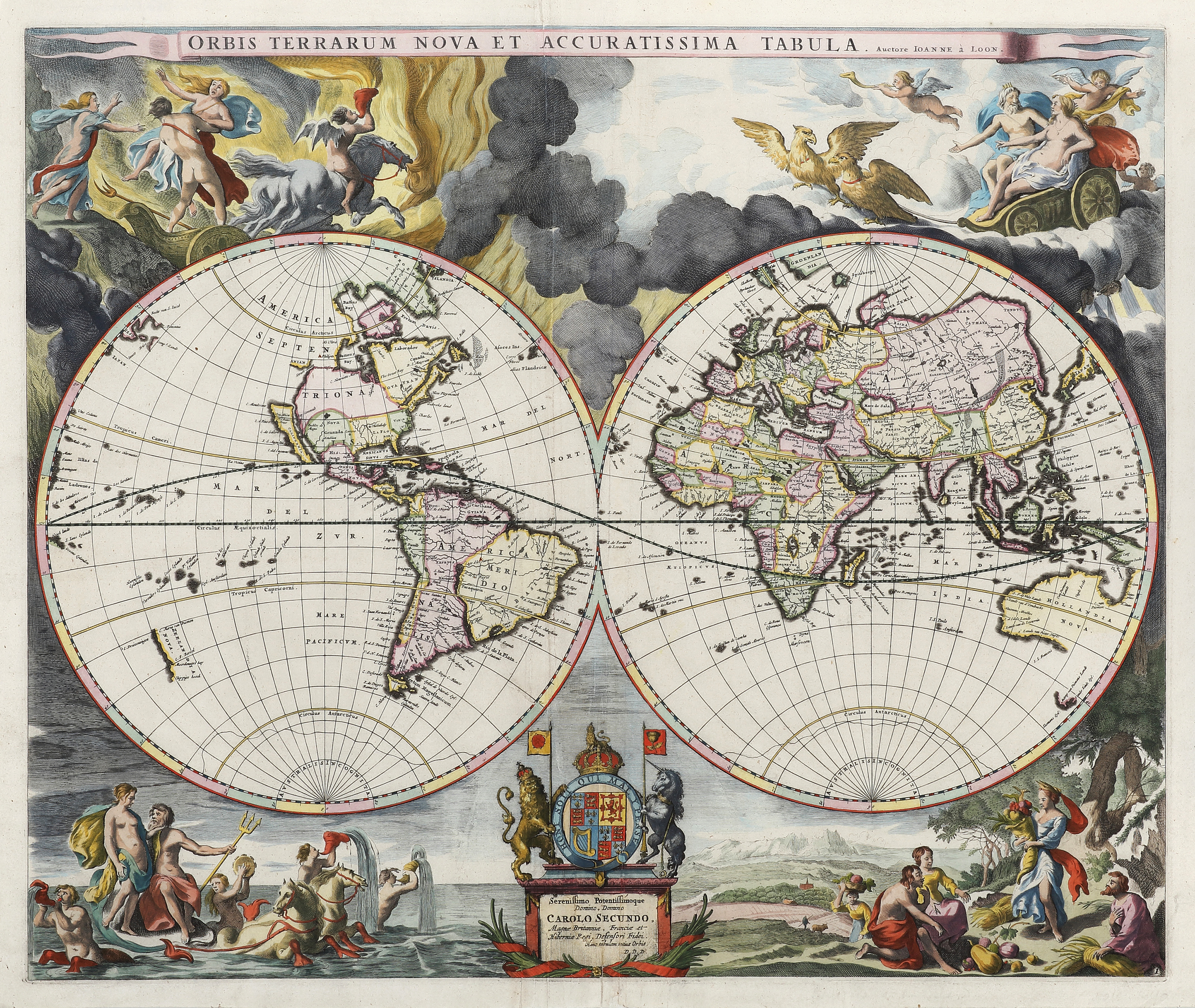
Second state of van Loon’s famous, rare double hemisphere map of the world first printed in Amsterdam 1666, issued with the additions of the dedication to Charles II and his coat-of-arms for Moses Pitt’s English Atlas. Van Loon’s Zee-Atlas … Read Full Description
$A 11,500
Within Australia
Rest of the World
Orders over A$300
ship free worldwide
Full Title:
Date:
Mapmaker:
Condition:
Technique:
Image Size:
Paper Size:
Genuine antique
dated:
Description:
Second state of van Loon’s famous, rare double hemisphere map of the world first printed in Amsterdam 1666, issued with the additions of the dedication to Charles II and his coat-of-arms for Moses Pitt’s English Atlas.
Van Loon’s Zee-Atlas was first published in 1661. In 1666 new plates were prepared at the expense of Jansson van Waesberge, which included a world map which has similarities with Visscher’s forerunner world map of 1658.
As noted by Rodney Shirley:. . . Visscher’s new world map in two hemispheres can be regarded as the master forerunner of a number of highly decorative Dutch world maps produced throughout the remainder of the century. Essentially based upon Blaeu’s [wall map of the World] of 1648 . . . the distinct attractiveness of many of the later seventeenth century Dutch world maps can be found in their border decorations . . . [in Visscher’s map], artist Nicolaes Berchem has introduced dramatic classical scenes representing the rape of Perephone, Zeus being carried across the heavens in an eagle-drawn chariot, Poseidon commanding his entourage, and Demeter receiving the fruits of the Earth.
Johannes Van Loon (1611 - 1686)
Dutch cartographer, engraver and mathematician active during the Dutch Golden Age of cartography. Trained in the intellectual and artistic circles of the c.17th the Dutch Republic, Van Loon emerged as a prominent figure in the production of both celestial and nautical charts. He was active in Amsterdam from 1632 until c.1680, before returning to his native Leeuwarden, where he lived until his death. Van Loon is best known for his work as an engraver on the celestial atlas by Andreas Cellarius, published by Johannes Janssonius. This lavishly illustrated atlas, combining scientific rigor with Baroque visual grandeur, remains one of the most celebrated celestial works of the early modern period. Van Loon’s contribution, in the form of finely executed plates, reflects his mastery of both astronomical understanding and decorative engraving. In 1661, Van Loon issued his own nautical atlas, Klaer-Lichtende Noort-Ster ofte Zee Atlas, a highly regarded sea atlas that underwent several expanded editions during his lifetime, growing from 35 to 50 charts by 1676. The work demonstrates Van Loon’s commitment to practical maritime navigation, while also exemplifying the aesthetic and technical standards of Dutch atlas production at its height. He also collaborated with a number of leading cartographers and publishers of his era, including Theunis Jacobsz, Jan Jansson, Johannes Janssonius van Waesbergen, and Robijn. His charts appeared in a variety of pilot books and composite atlases, contributing to the dissemination of Dutch maritime knowledge across Europe and beyond.
Exchange rates are only indicative. All orders will be processed in Australian dollars. The actual amount charged may vary depending on the exchange rate and conversion fees applied by your credit card issuer.
Join our exclusive mailing list for first access to new acquisitions and special offers.