German Jesuit priest, cartographer, and scholar, active in Munich during the late seventeenth century. Educated in philosophy and theology, he taught these subjects at Jesuit institutions before turning his attention to geography and cartography, disciplines he approached through the lens of religious and moral philosophy.
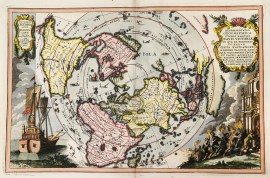
Scherer is best known for his Atlas Novus (1702–1710), a monumental seven-volume work that combined geographical knowledge with the Jesuit worldview. His maps are distinguished by elaborate baroque ornamentation and a distinctive integration of theology, geography, and politics, often depicting missionary routes, centers of Catholic influence, and global conversions.
Produced with the support of the Bavarian court, Scherer’s atlases are valued both for their artistry and for their insight into the intellectual and religious context of early modern Europe.