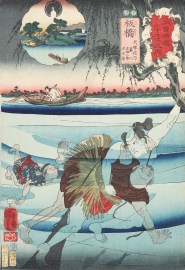
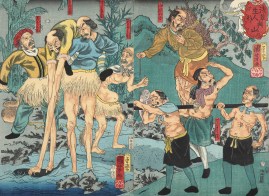
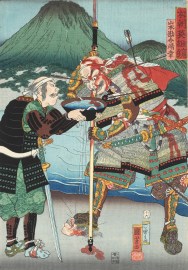
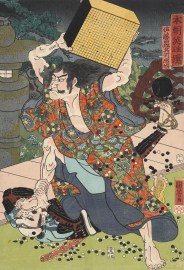
Born in Edo (present-day Tokyo) in 1797, Kuniyoshi was the son of a silk dyer, Yanagiya Kichiemon, and was given the childhood name Yoshisaburō. At the age of fourteen, he entered the Utagawa School of ukiyo-e under the direction of Utagawa Toyokuni I (1769–1825). It was Toyokuni who bestowed on him the name Utagawa Kuniyoshi, combining elements of “Toyokuni” and “Yoshisaburō.” Although Kuniyoshi is now universally known as Utagawa Kuniyoshi he also used the names: Ichiyûsai Kuniyoshi, Chô-ô-rô Kuniyoshi, Ikusa Kuniyoshi, and Saihôsa Kuniyoshi.
Kuniyoshi completed his apprenticeship in 1814 and began his career as an independent artist, initially producing actor portraits in the manner of his teacher, though with limited success. His breakthrough came in 1827 with the publication of the first six designs from The 108 Heroes of the Suikoden, inspired by a c.14th Chinese novel recounting the exploits of a band of 108 righteous bandits and rebels. The series established Kuniyoshi’s reputation and remains among his most celebrated works.
In 1843, he produced the famous triptych In Minamoto’s Residence the Earth Spider Appears as a Monster, a work widely understood as a satire of Mizuno Tadakuni, the shogun’s chief councillor and enforcer of strict censorship policies. Its immense popularity, evidenced by the multiple editions brought Kuniyoshi both acclaim and official censure, cementing his place as one of the most dynamic and politically engaged ukiyo-e masters of the c.19th.