C1839

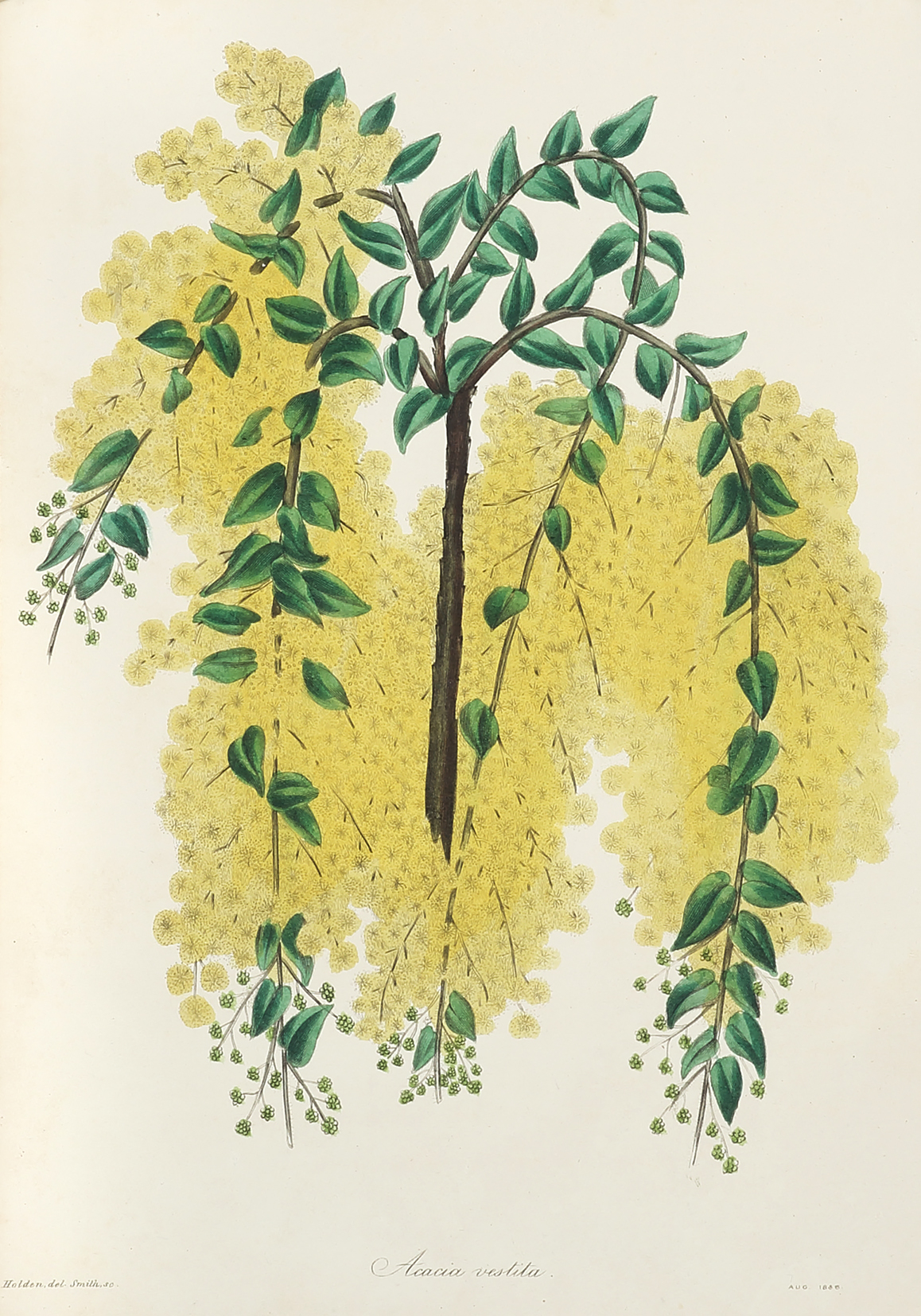
Acacia vestita.

Scarce c.19th hand coloured engraving of the Hairy wattle. Modern binomial name: Acacia vestita First scientific description: Ker Gawl Distribution: New South Wales From: Paxton,  Paxton’s Magazine of Botany, and Register of Flowering Plants. References: Sitwell, S. Great Flower Books 1700-1900. New … Read Full Description

$A 165

In stock

S/N: PMOB-BOT-AA-02171–486716
(C086/C087)
Free Shipping
Xerophila Leucopsis: Gould Australian

Within Australia

All orders ship freewithin Australia

Xerophila Leucopsis: Gould Australian

Rest of the World

Orders over A$300
ship free worldwide

See Shipping page for Terms & Conditions

Details

Full Title:

Acacia vestita.

Date:

C1839

Condition:

In good condition.

Technique:

Copper engraving with original hand colouring.

Image Size: 

145mm 
x 185mm

Paper Size: 

160mm 
x 228mm
AUTHENTICITY
Acacia vestita. - Antique Print from 1839

Genuine antique
dated:

1839

Description:

Scarce c.19th hand coloured engraving of the Hairy wattle.

Modern binomial name: Acacia vestita
First scientific description: Ker Gawl
Distribution: New South Wales

From: Paxton,  Paxton’s Magazine of Botany, and Register of Flowering Plants.

References:
Sitwell, S. Great Flower Books 1700-1900. New York 1990 : p. 161.
Nissen, C. Die Botanische Buchillustration. Stuttgart 1966 2351.

Collections:
National Library Australia: Bib ID: 3415237
Royal Collection Trust UK: RCIN 1057386
State Library New South Wales: RB/DS580.5/3 (SET)
State Library Victoria: RARES 580.5 P28
State Library South Australia: 580.5 P342
State Library Queensland: 1588742

Sir Joseph Paxton (1801 - 1865)

English landscape gardener, botanist and designer of hothouses, who was the architect of the Crystal Palace for the Great Exhibition of 1851 in London. He was originally a gardener employed by the duke of Devonshire. From 1826 he was superintendent of the gardens at Chatsworth, the duke’s Derbyshire estate; he built in iron and glass the famous conservatory there (1840) and the lily house for the duke’s rare Victoria regia (1850). Also in 1850, after a cumbersome design had been officially accepted by the Great Exhibition’s organizers, Paxton’s inspired plan for a building of prefabricated elements of sheet glass and iron was substituted. His design, based on his earlier glass structures, covered four times the area of St. Peter’s, Rome, and the grandeur of its conception was a challenge to mid-19th-century technology. Although it was built within six months and he was knighted for his efforts (1851), it was not until later that the structure was seen as a revolution in style.  Paxton was a member of Parliament for Coventry from 1854 until his death. 

View other items by Sir Joseph Paxton

Related Products

Choose currency

Exchange rates are only indicative. All orders will be processed in Australian dollars. The actual amount charged may vary depending on the exchange rate and conversion fees applied by your credit card issuer.

Account Login

The List

Join our exclusive mailing list for first access to new acquisitions and special offers.