Marcus Elieser Bloch (1723 - 1801)
German physician and naturalist, best known as one of the most important ichthyologists of the eighteenth century. Born in Ansbach in Bavaria, he received a traditional Jewish education before turning to secular studies, later qualifying in medicine and settling in Berlin as a practising doctor.
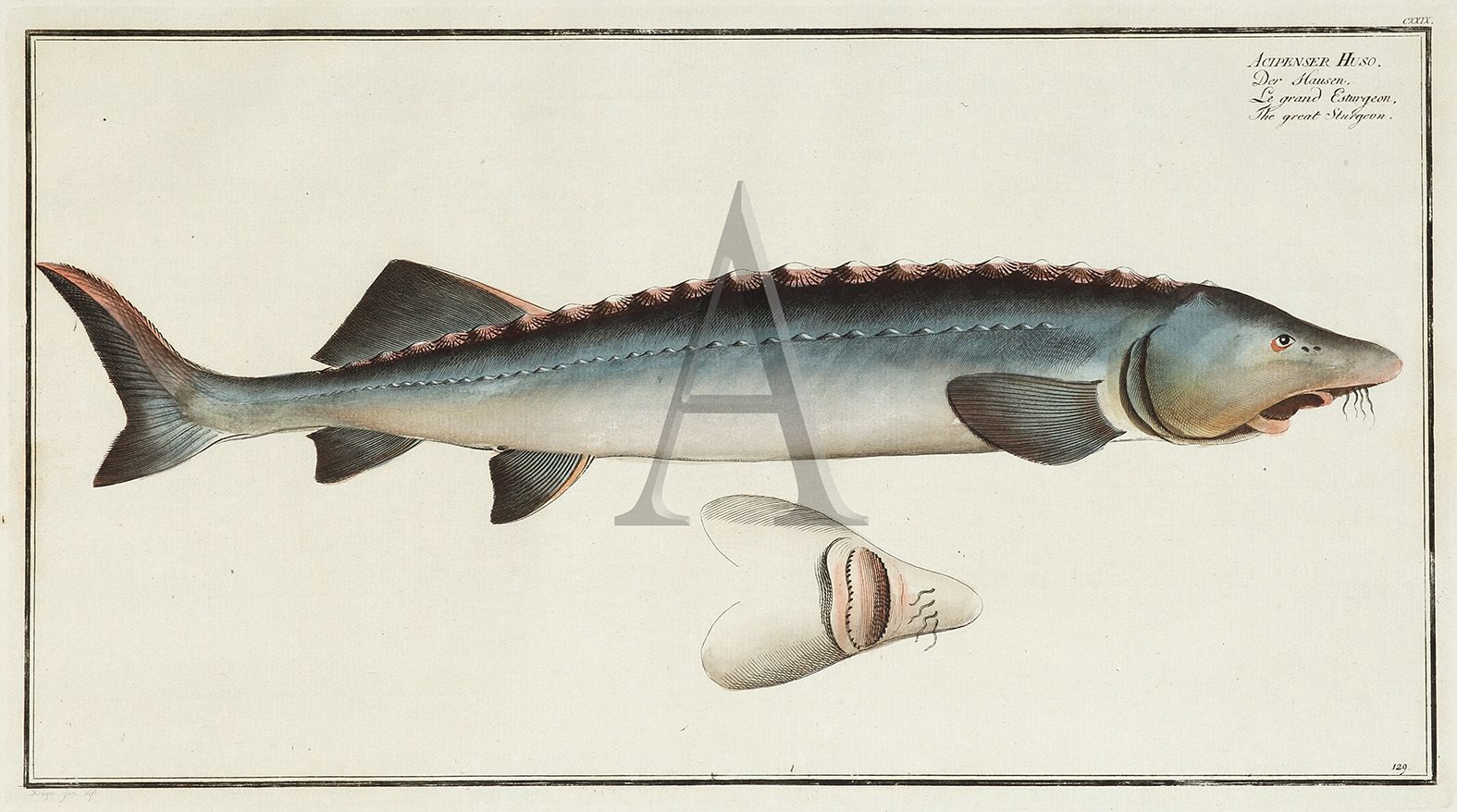
Bloch’s medical career provided financial stability and enabled him to pursue natural history as a serious scholarly endeavour. At a time when the scientific classification of fishes remained incomplete and scattered, he undertook the ambitious task of compiling a comprehensive, illustrated survey of known species. His principal achievement was the monumental Allgemeine Naturgeschichte der Fische (General Natural History of Fishes), issued in parts between 1782 and 1795. The work eventually comprised twelve volumes and nearly 450 finely engraved and hand-coloured plates.
The first volumes concentrated on the fishes of Germany and adjacent regions; later instalments expanded to exotic species from Asia, Africa and the Americas, reflecting the global reach of European trade and exploration. Bloch corresponded widely with collectors and naturalists, acquiring specimens through commercial and colonial networks. His descriptions combined Linnaean taxonomy with detailed anatomical and morphological observations, while the plates—engraved after drawings prepared under his supervision—set a new standard for clarity and aesthetic quality in ichthyological illustration.
Although some of Bloch’s classifications were later revised, his systematic approach significantly advanced ichthyology as a distinct scientific discipline. Many species he described remain valid, and his work influenced subsequent naturalists, including Georges Cuvier and later nineteenth-century ichthyologists.
Bloch assembled a substantial natural history collection in Berlin, particularly of fishes, which became one of the most important private collections in Europe. After his death in 1799, parts of his collection were acquired for public institutions, contributing to the development of museum-based zoological research in Germany.
View other items by Marcus Elieser Bloch




![[Brama Rayi / Ray’s Sea Bream.] Fish - McCoy's Zoology](https://antiqueprintmaproom.com/wp-content/uploads/2020/06/mg_9684_copy-270x183.jpg "[Brama Rayi / Ray’s Sea Bream.] Fish - McCoy's Zoology")
