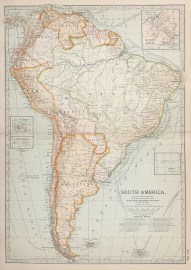
Very decorative c.18th map of the Americas, with the undiscovered north west left blank and California shown as a peninsula, by the most important German cartographer of the eighteenth century. The sumptuous decorative title cartouche has depictions of natives, plants … Read Full Description
Copper engraving with original hand colouring and with additional recent hand colouring to title cartouche.
Image Size:
525mm
x 460mm
Paper Size:
620mm
x 540mm
AUTHENTICITY
Genuine antique dated:
1752
Description:
Very decorative c.18th map of the Americas, with the undiscovered north west left blank and California shown as a peninsula, by the most important German cartographer of the eighteenth century.
The sumptuous decorative title cartouche has depictions of natives, plants and erupting volcanoes.
This is Homann’s second map of the America which he greatly updated with information obtained from the Jesuits of the interior. The north west coast of America and the north west passage shown as unknown. Quivira the the legendary land of gold and silver which was searched by Francisco de Coronado in 1540. He led a large expedition north from Mexico to search for wealth and the Seven Cities of Cibola. Instead of wealth, he found Indigenous farmers living in an array of communities and villages in what are today Arizona and New Mexico. These were the Hopi, Zuni, Rio Grande Pueblo, Apache, and Navajo peoples.
As Coronado arrived at the Rio Grande, he was disappointed by the lack of wealth among the Pueblo people, but he heard from a Plains Indian informant dubbed “The Turk” of a wealthy nation named Quivira far to the east, whose leader supposedly drank from golden cups hanging from the trees. Hearing of this, Coronado led an expedition of more than 1000 Spanish and Indigenous individuals onto the Great Plains in 1541. The Turk served as the expedition’s adviser. On his journey, Coronado traversed the Staked Plains, home to two Indigenous nations: the Querecho and Teya. He was heading southeast when the Teyas told him that the Turk was taking him in the wrong direction and that Quivira was to the north. It appears the Turk was luring the Spaniards away from New Mexico with tales of wealth in Quivira, hoping perhaps that they would get lost in the vastness of the Great Plains. Coronado sent most of his slow-moving expeditionary force back to New Mexico. With 30 mounted Spaniards, Indigenous persons, priests, the Turk and Teya captives forced into service, Coronado changed course northward in search of Quivira. After a march of more than 30 days, he found a large river, probably the Arkansas, and soon met several Indigenous bison hunters, who led him to Quivira. Before leaving Quivira, Coronado ordered the Turk executed by strangulation. The Coronado expedition had failed in its quest for gold.
From: Homann Erben: Maior Atlas scholasticus ex triginta sex generalibus et specialibus.…..
References: Wagner, H.R. Cartography of the Northwest Coast of America to the Year 1800. Amsterdam 1968 :: 1746. Phillips, Lowery Collection - A Descriptive List of Maps of the Spanish Possessions' of the United States. 1912 Washington:: 383. Phillips, P. A List of Geographical Atlases in the Library of Congress. Washington 1973 :: 4195.
Collections: New York Public Library: Map Div. 96-7695 [Levine] University of Edinburgh: E.B. FF .911 Hom.
Johann Baptist Homann (1663 - 1724)
Homann was the most important German cartographer of the 18th century. In 1715 the Holy Roman Emperor Charles the VI, appointed him Imperial Cartographer and in the same year he was also appointed a member of the Royal Academy of Sciences in Berlin. Upon his death, the business passed to his son Johann Christolph (1701-1730) and in 1730 the business was continued by the Heirs to Homann up until 1848.
Exchange rates are only indicative. All orders will be processed in Australian dollars. The actual amount charged may vary depending on the exchange rate and conversion fees applied by your credit card issuer.
Account Login
The List
Join our exclusive mailing list for first access to new acquisitions and special offers.