C1579

Angliae, Scotiae Et Hiberniae, Sive Britannicar: I…

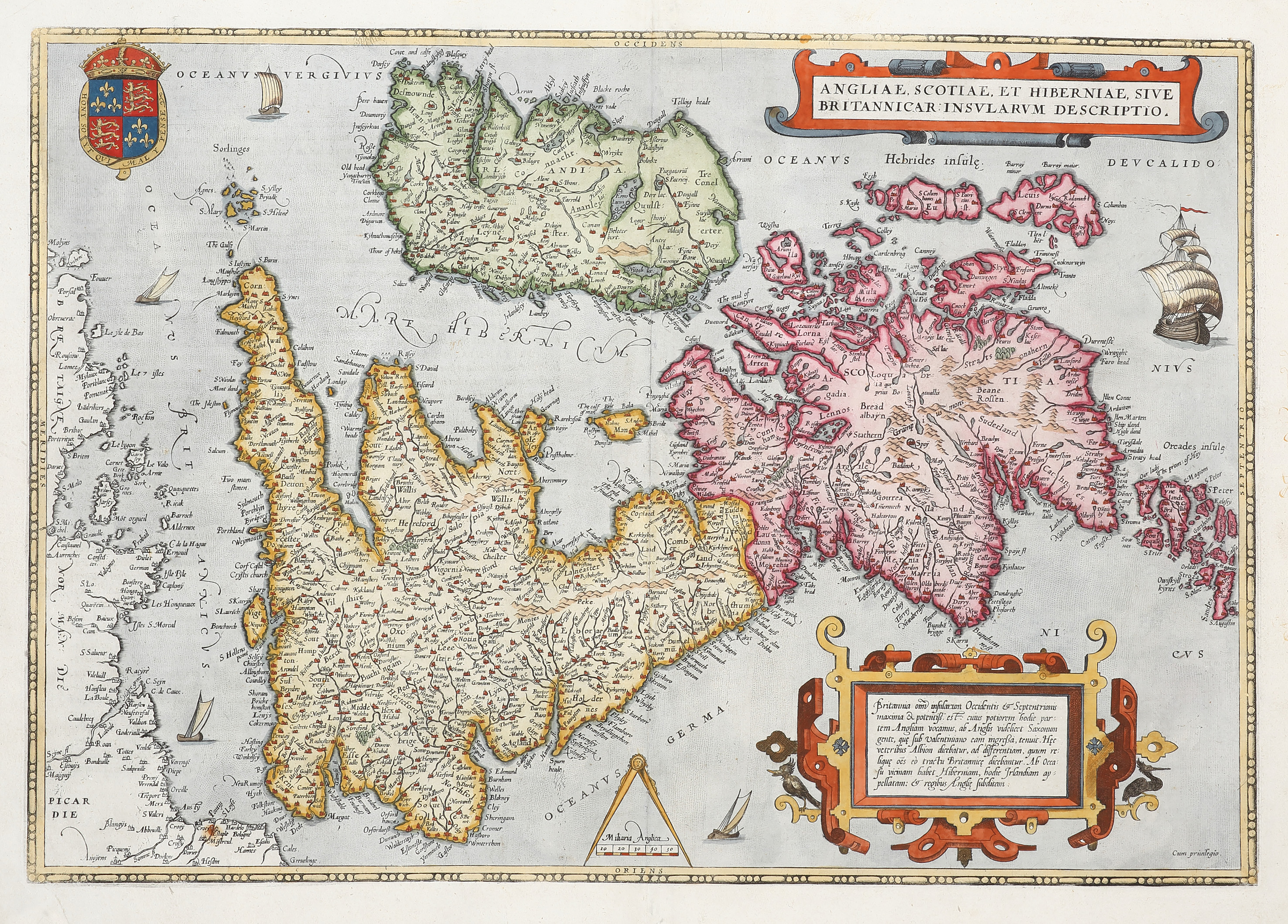
Early edition (1579) of Abraham Ortelius’s famous c.16th hand coloured engraved map of of the British Isles, Ortelius has oriented the map with west at the top. The map is superbly embellished with a decorative strapwork title at top right … Read Full Description

$A 1,350

In stock

S/N: ORTE-BI-016L-1579AP8–521253
(CBD 01)
Free Shipping
The Kaap Goldfields,…. AFRICA

Within Australia

All orders ship freewithin Australia

The Kaap Goldfields,…. AFRICA

Rest of the World

Orders over A$300
ship free worldwide

See Shipping page for Terms & Conditions

Details

Full Title:

Angliae, Scotiae Et Hiberniae, Sive Britannicar: Insularum Descriptio.

Date:

C1579

Condition:

Small rust spot at lower right corner, otherwise in good condition, with centre fold as issued.

Technique:

Hand coloured copper engraving.

Image Size: 

490mm 
x 340mm

Paper Size: 

534mm 
x 419mm
AUTHENTICITY
Angliae, Scotiae Et Hiberniae, Sive Britannicar: Insularum Descriptio. - Antique Map from 1579

Genuine antique
dated:

1579

Description:

Early edition (1579) of Abraham Ortelius’s famous c.16th hand coloured engraved map of of the British Isles,

Ortelius has oriented the map with west at the top. The map is superbly embellished with a decorative strapwork title at top right and a descriptive lower panel cartouche, engraved by Frans Hogenberg (1539-1590). A number of sailing vessels are shown in the seas and at top left are the coat of arms of Henry IV, who abandoned the attributed arms of King Edward the Confessor, and reduced the fleurs-de-lis to three, in imitation of Charles V of France and were in use from 1406-1554. From 1555 the arms were changed a number of times until Queen Elizabeth I, restored the arms of Henry IV in 1558 and these were in use until 1603.

The text within the lower strap work panel, reads; Brittannia is mightiest in the area of the Western and Northern islands. The most powerful part at this time we call Anglia, after the Saxon people or the Angles, who invaded and ruled over the island under Valentinianus. The ancients distinguished it as Albion; the remaining parts of this area were collectively called Britannica. In the West it has Hibernia as its neighbour, which is nowadays called Ireland, and which is subject to the rulers of Anglia.

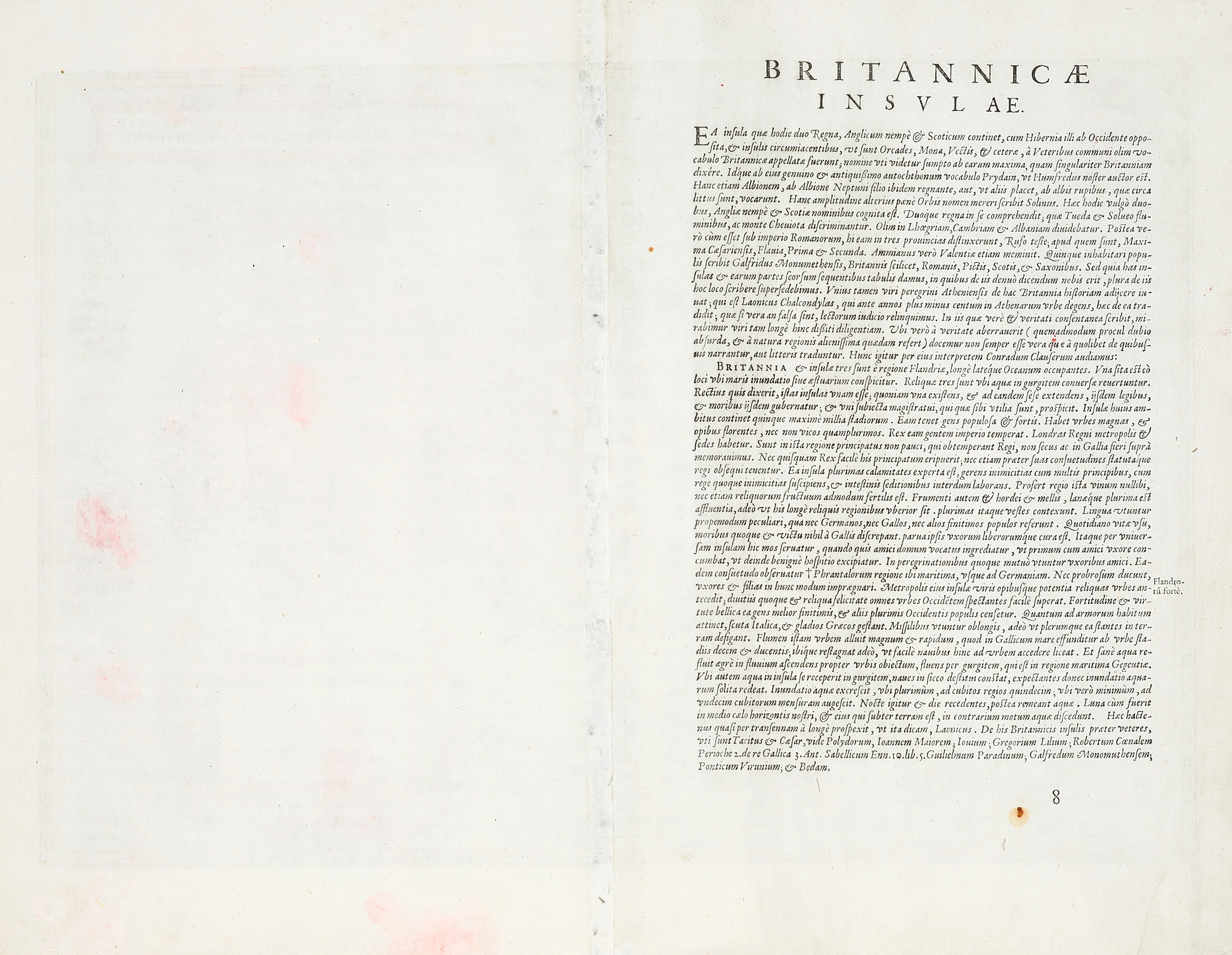
This was edition was published in 1579 with Latin text and the page number 8 on the verso. It is identifies as being from this edition by: last line, left aligned, in cursive writing like the entire text: “Ponticum Virunium;& Bedam”. last letter E of second title line below letter I of first title line.

Ortelius was the first to separate ancient and recent geographic knowledge in his maps and to indicate the changes from the old nomenclature to the new. 

Published in Ortelius’s Theatrum Orbis Terrarum, widely regarded as the first modern atlas for having all the maps in a similar size and format. 

References:
Kroght, P. Koeman’s Atlantes Neerlandici. Amsterdam 1997. Nine volumes : Van der Krogt III.A 31:041.
Koeman, C. Atlantes Neerlandici. Amsterdam 1967. Volumes I-V : Ort 29.

Collections:
Bibliotheque Nationale de France: 12148/btv1b55007367v (1584 edition)
National Library Scotland: EMW.X.009
Royal Geographic Society SA: (RGS) 912.19 O.77C++
Library of Congress Washington D.C.: G1006 .T5 1570b (1570 edition)
Bodleian Library, University of Oxford: Arch. B b.4 (1573 edition) Douce O subt. 15 (1606 edition)
National Library Australia: Bib ID: 132848 (1609 edition)
State Library New South Wales: Call Numbers F57/1 (1573 edition)

Abraham Ortelius (1527 - 1598)

Flemish cartographer, geographer, and publisher, born in Antwerp on 14 April 1527. He is celebrated as the creator of the Theatrum Orbis Terrarum (Theatre of the World), first published in 1570, widely regarded as the first modern atlas and one of the most influential cartographic works of the sixteenth century.

Trained as a map colourist and illuminator, Ortelius joined the Antwerp Guild of St Luke as a map illuminator in 1547, initially working in partnership with his sister, Anne. He began his career as a map and print dealer, trading in geographical materials and decorative prints across Europe. His extensive travels—to France, Germany, Italy, and notably to London where he met the English cartographer John Dee and the great mapmaker Gerardus Mercator—broadened his intellectual and professional network. Mercator’s work and ideas profoundly influenced Ortelius’s approach to geography and cosmography.

Ortelius’s Theatrum Orbis Terrarum was first issued in Antwerp in 1570 by the printer Gilles Coppens de Diest. Comprising seventy engraved maps with accompanying text, it presented a consistent format and unified design, with maps engraved chiefly by Frans Hogenberg. Each map was carefully attributed to its original source, a practice that reflected Ortelius’s scholarly integrity and established an early model for bibliographic citation in cartography. The Theatrum was an unprecedented success, appearing in more than forty editions and seven languages over the next four decades.

In 1573 Ortelius issued the Additamentum, the first supplement to the atlas, introducing new maps and expanding its global scope. Among his other important works were the Synonymia Geographica (1578), a geographical dictionary of ancient and modern place names, and Thesaurus Geographicus (1596), both significant contributions to Renaissance geographical scholarship.

Ortelius was also among the first to propose, in marginal notes to his maps, that the continents might once have been joined before drifting apart—an early precursor to modern theories of continental drift. His combination of scientific precision, humanist learning, and aesthetic refinement made him a central figure in the golden age of Netherlandish cartography.

He maintained close associations with leading scholars and artists of his time, including Justus Lipsius, Christopher Plantin, and the cartographers Gerard de Jode and Petrus Plancius. His friendship with Mercator remained of great importance throughout his life, and Mercator dedicated several works to him.

Ortelius was appointed Royal Geographer to King Philip II of Spain in 1575, in recognition of his contributions to geography and the prestige his atlas brought to the Spanish Netherlands. He continued to reside in Antwerp, where he also acted as a patron to younger scholars and artists.

Abraham Ortelius died in Antwerp on 28 June 1598 and was buried in the Church of St Michael’s Abbey. His epitaph reads Quietis cultor sine lite, uxore, prole—“A worshipper of tranquillity, without dispute, wife, or children.” His maps and atlases remain milestones in the history of cartography, bridging medieval cosmography and the emerging scientific geography of the early modern world.

View other items by Abraham Ortelius

Related Products

Choose currency

Exchange rates are only indicative. All orders will be processed in Australian dollars. The actual amount charged may vary depending on the exchange rate and conversion fees applied by your credit card issuer.

Account Login

The List

Join our exclusive mailing list for first access to new acquisitions and special offers.