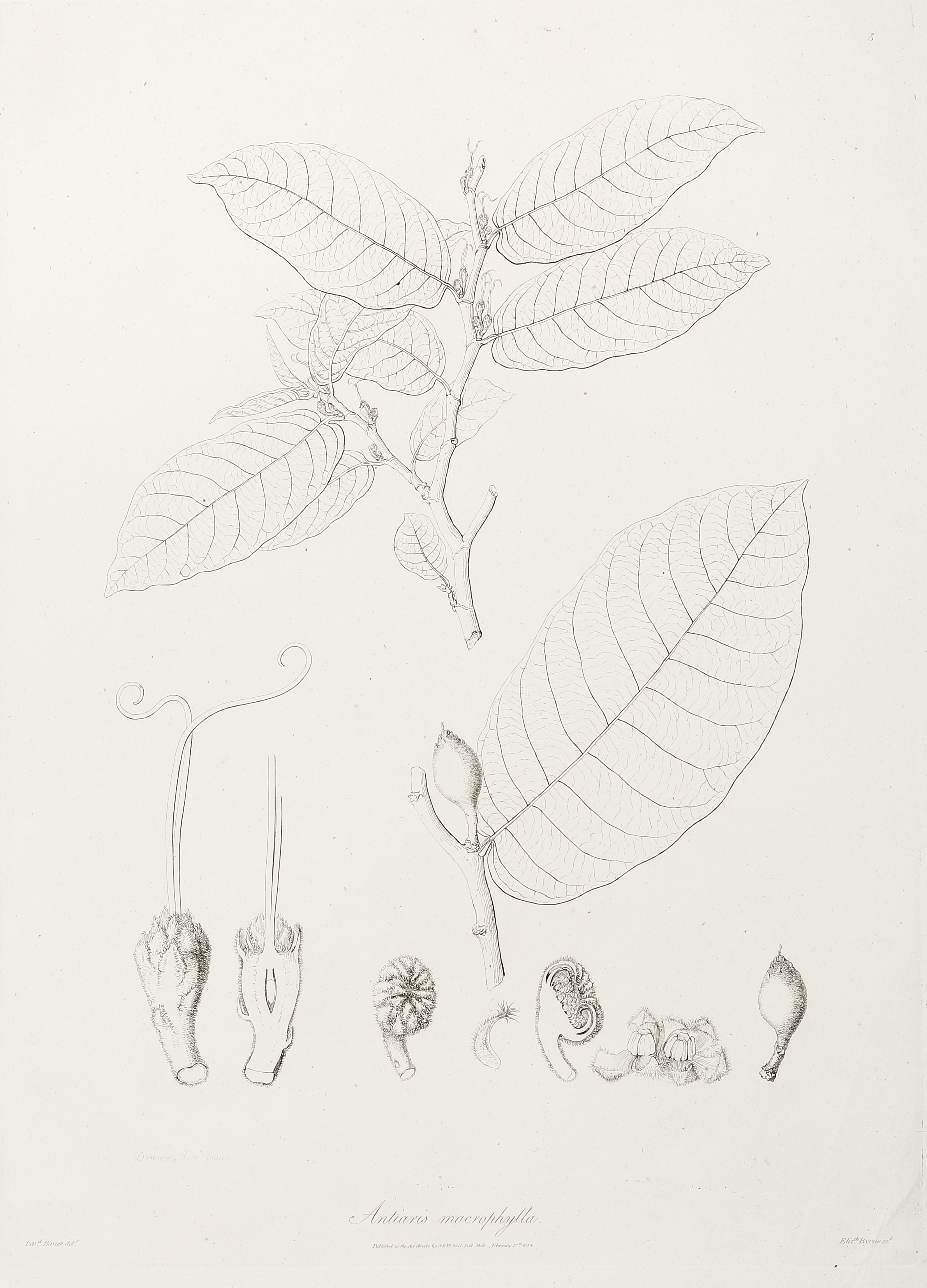
Exceptionally rare and historically important early c.19th botanical engraving of Antiaris by Ferdinand Lukas Bauer (1760-1826), collected and described by Robert Brown, artist and naturalist who had been personally selected by Joseph Banks to join Matthew Flinders monumental survey of the Australian coast.
This very large engraving is from the superior deluxe first edition of Matthew Flinders’s atlas, published in 1814, of which only one hundred and thirty-five copies were issued. Most of these are now held in institutional collections. In this format, the botanical illustrations were issued unfolded—unlike the standard issue of the atlas, where the plates are found folded multiple times to fit a reduced quarto size, and the margins are extensively trimmed.”
Bauer was the finest botanical artist ever to visit Australia while Brown the naturalist on the expedition can be called, ‘The Father of Australian botany’, for his effort in collecting over 3,900 specimens, of which 140 genera were new to science. In a letter to Banks from Port Jackson, dated 20 May 1802, Flinders offered this praise: “[It] was fortunate for science that two such men as Mr Brown and Mr Bauer have been selected, their application is beyond what I have been accustomed to see.” Writing to Banks ten days later, Brown reported that Bauer had made 350 plant sketches and 100 of animals, and had “indeed been indefatigable and . . . bestowed infinite pains on the dissections of the parts of fructification of the plants.” Bauer, intent on capturing accurately the tone and shading of his specimens, but unable to carry with him the range of colours needed, covered his preliminary sketches with colour numbers. Banks was intrigued by Bauer’s precision, and in January 1806 wrote that they “were prepared in such a manner by reference to a table of colours as to enable him to finish them at his leisure with perfect accuracy”.
Common: Antiaris (Aust.), Ipoh Tree (The town of Ipoh in Perak province, Malaysia is named after the tree & as used as poison for arrow tips)
Modern binomial name: Antiaris toxicaria subsp. macrophylla
First described: Robert Brown 1810 ‘In barren stony places, on the shores of Companys Islands, adjacent to Arnhems Land … in about 12S.lat. … February 1803‘
Distribution: Northern Territory, QLD, widespread in Asia and Pacific.
From: Flinders, M. A Voyage to Terra Australis; undertaken for the purpose of completing the discovery of that Vast Country, and prosecuted in the years 1801, 1802, and 1803, in His Majesty’s Ship the Investigator, and subsequently in the armed vessel Porpoise and Cumberland schooner. With an account of the shipwreck of the Porpoise, arrival of the Cumberland at Mauritius, and imprisonment of the commander during six years and a half in that island…
References:
Ferguson, J. A. Bibliography of Australia Volumes 1-8, Canberra 1976 : 756.
Tooley, R.V. The Mapping of Australia. London 1979 : pp. 77-79.
Perry, T. & Prescott, D. A guide to maps of Australia in books published 1780-1830. Canberra 1996 : 1814..
Ferguson, J. A. Bibliography of Australia Volumes 1-8, Canberra 1976 : 576.
Hill, J. The Hill Collection of Pacific Voyages. San Diego 1974 : 614.
Wantrup, J. Australian Rare Books. Sydney, 1987 : 67a.
Ingleton, G. Charting a Continent. Sydney 1944 : 6487.
Collections:
National Library Australia: Bib ID 589314
Royal Collection Trust UK: RCIN 1054637
Silent World Foundation, Sydney.: SKU SF000813
State Library Victoria: CCF 919.4 F64V