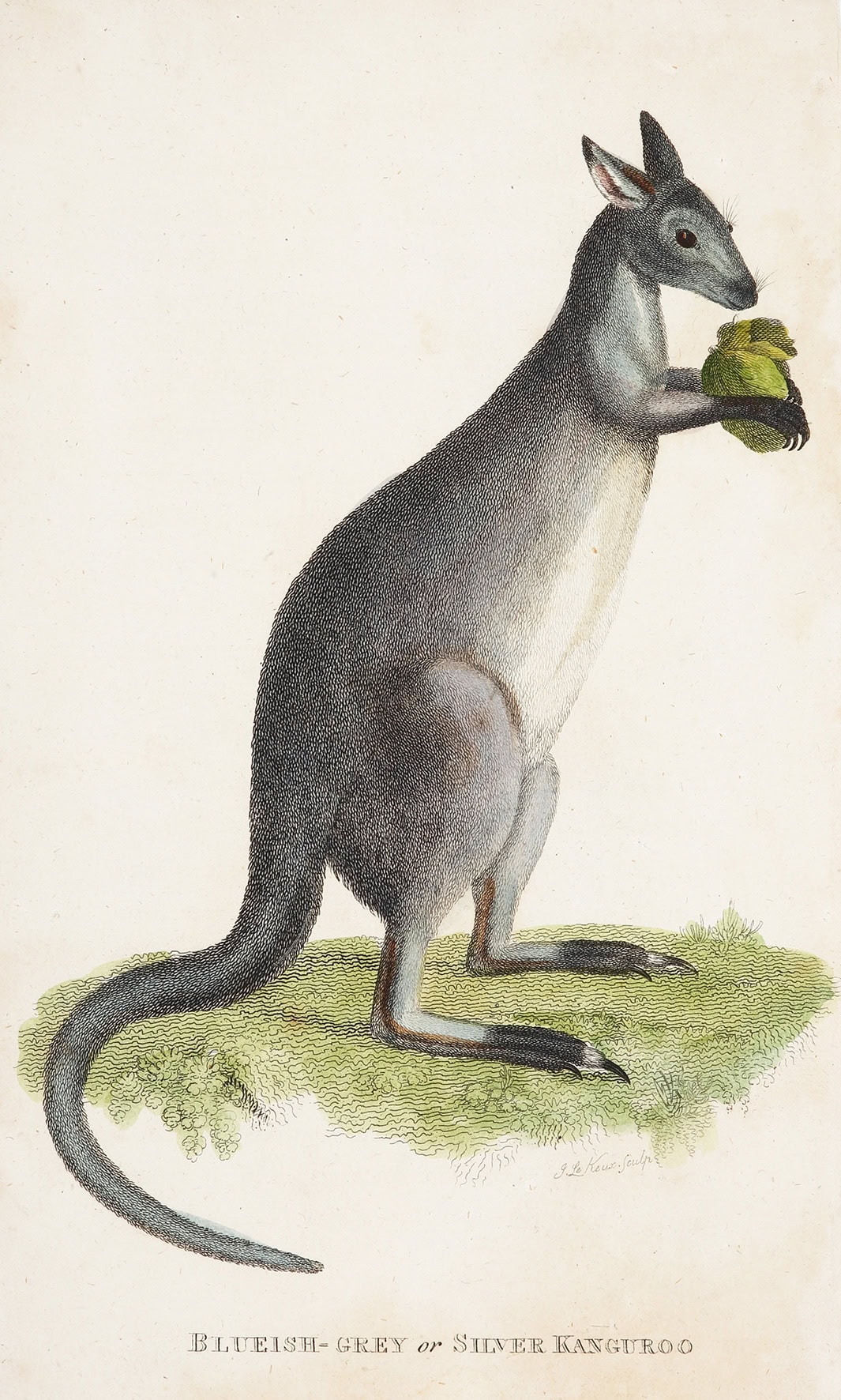
Scarce early c.19th hand coloured engraving of an Eastern grey kangaroo. Modern binomial name: Macropus giganteus First described: Shaw, 1790 Distribution: Eastern Australia S.A, VIC, TAS, NSW, QLD The first illustration of a the Kangaroo drawn from an Australian species, is acknowledged … Read Full Description
Some minor discolouration on edges, otherwise in good condition.
Technique:
Hand coloured copper engraving.
Image Size:
120mm
x 186mm
Paper Size:
130mm
x 217mm
AUTHENTICITY
Genuine antique dated:
1808
Description:
Scarce early c.19th hand coloured engraving of an Eastern grey kangaroo.
Modern binomial name: Macropus giganteus
First described: Shaw, 1790
Distribution: Eastern Australia S.A, VIC, TAS, NSW, QLD
The first illustration of a the Kangaroo drawn from an Australian species, is acknowledged as that drawn by George Stubb’s from a specimen collected at Endeavour River in 1770 by James Cook’s crew while the Endeavour was being careened. The subsequent engraving was published in 1773, in the official accounts of the voyage of the Endeavour. That iconic image captured the public’s imagination for over sixty years and was the first depiction of any Australian animal in western art. The first sighting of a kangaroo in fact was an earlier one, by Francis Pelsaert of ‘the teeming rats’ on 15th November, 1629 on the Abrolhos Islands where the Batavia had been wrecked. The first illustration of a Macropod was made prior to the Stubb’s illustration, titled ‘Kangaron’ and made on 15th November 1629 by Matthys Pool and described by Cornelis de Bruyn in ‘Reizen over Moskovie door Persie en Indie’, 1714 but the animal depicted was not an Australian species but Thylogale brunii (Dusky Pademelon), a Filander native to New Guinea.
From George Shaw’s, ‘General zoology or systematic natural history.
Frederick Polydore Nodder (1751 - 1800)
Nodder was an English natural history artist of plants, animals and fauna. He was botanical artist to Queen Charlotte and also worked for Joseph Banks on the monumental publication of the botanical specimens collected on James Cook's first voyage. Known as Banks' Florilegium, it was never printed during Bank's lifetime.
Exchange rates are only indicative. All orders will be processed in Australian dollars. The actual amount charged may vary depending on the exchange rate and conversion fees applied by your credit card issuer.
Account Login
The List
Join our exclusive mailing list for first access to new acquisitions and special offers.