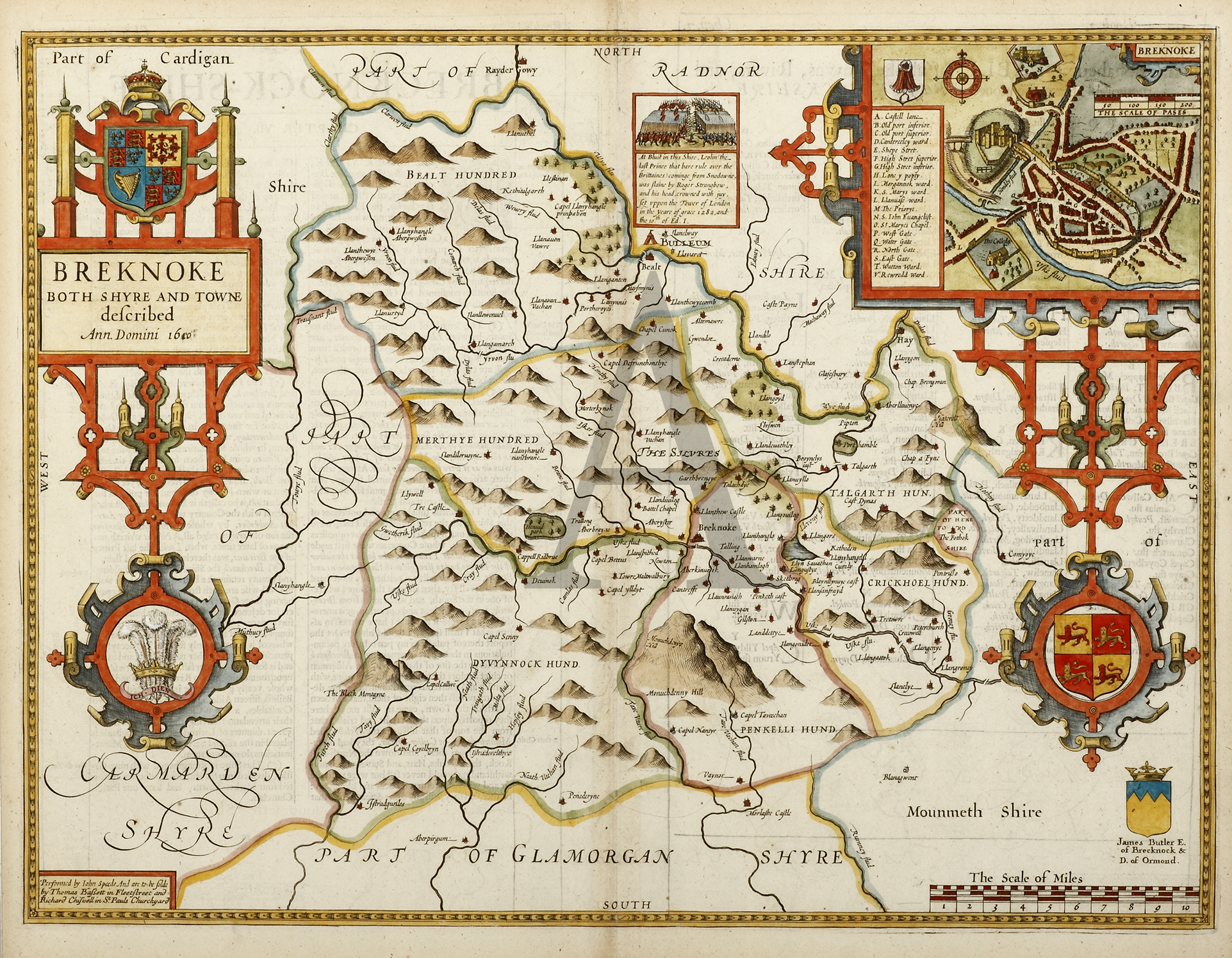
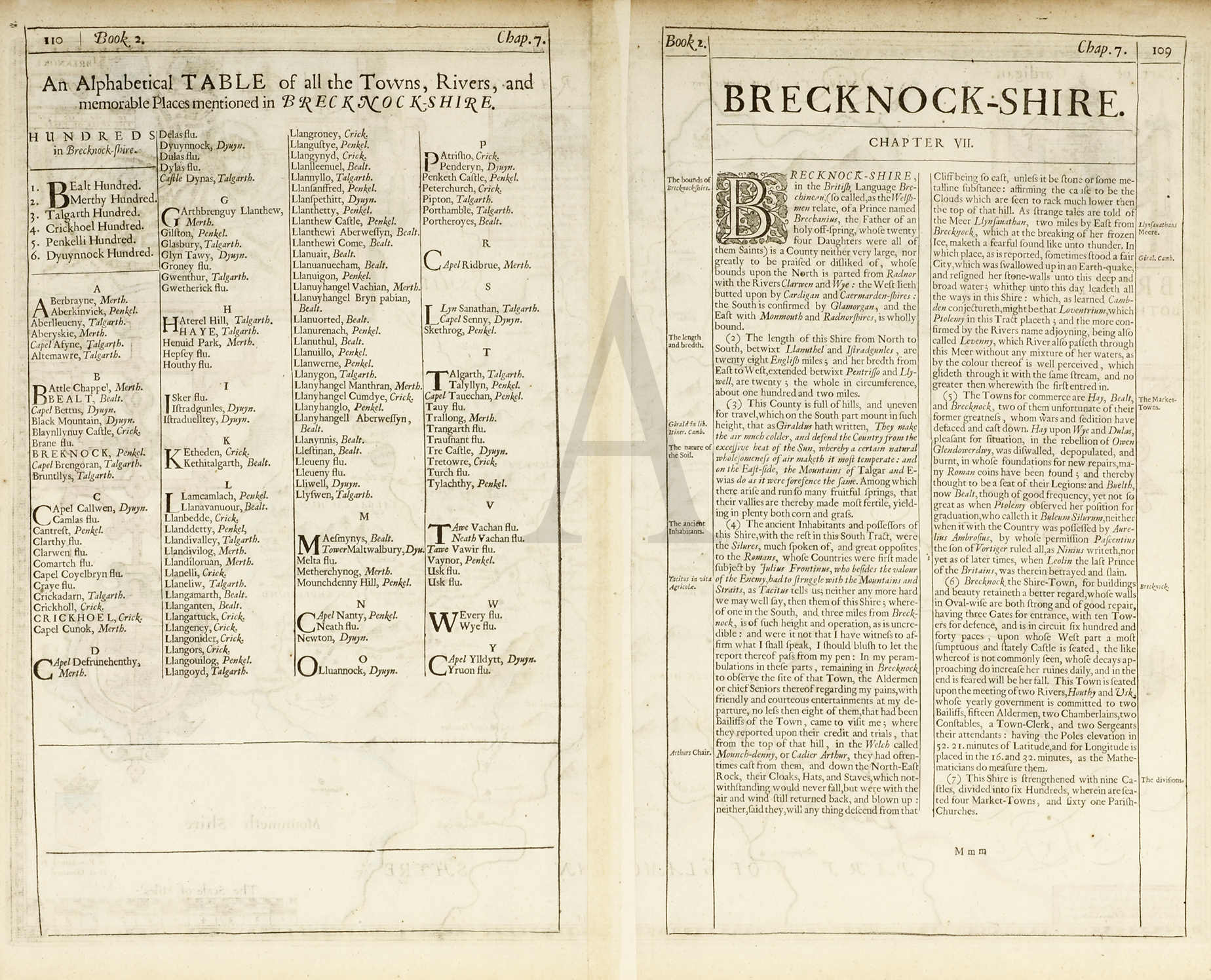
John Speed’s map of Breknoke, with the imprint, ‘Sold by Thomas Basset and Richard Chiswell’, lower left, which was only printed in 1676, with English text on verso. Distinctive and and famous decorative map by John Speed with inset of Carmarthen … Read Full Description
$A 1,150
Within Australia
All orders ship freewithin Australia
Rest of the World
Orders over A$300
ship free worldwide
Full Title:
Date:
Engraver:
Condition:
Technique:
Image Size:
Paper Size:
Genuine antique
dated:
Description:
John Speed’s map of Breknoke, with the imprint, ‘Sold by Thomas Basset and Richard Chiswell’, lower left, which was only printed in 1676, with English text on verso. Distinctive and and famous decorative map by John Speed with inset of Carmarthen (the oldest town in Wales), engraved by the important Dutch mapmaker Jodocus Hondius. Inset plan of Brecon and Prince of Wales feathers and royal lions in the two cartouches. The arms of James Butler E. of Brecknock & D. of Ormond’ are added. The map was also issued in 1680 but with the verso blank.
From John Speed’s ‘The Theatre Of The Empire Of Great Britaine’ /’The Second Booke Containing the Principalities of Wales.
References: Chubb, The Atlases of Great Britain and Ireland.. pp.39-40
Jodocus Hondius I (1563 - 1612)
Born into a Protestant family in the County of Flanders, an area marked by both economic prosperity and religious turmoil. The persecution of Protestants by Spanish authorities during the Eighty Years’ War forced Hondius to seek refuge in England around 1583. In London, he established himself as an engraver of remarkable skill, producing scientific instruments, maps, and portraits. Among his earliest and most notable works is the famous 1593 map of Francis Drake’s circumnavigation, Vera Totius Expeditionis Navticae Descriptio D. Francisci Draci, which commemorated English maritime triumphs and reflected the growing European fascination with global exploration. While in London, Hondius also collaborated with the polymath Edward Wright and other English navigators, acquiring expertise in mathematical cartography and navigation. His exposure to English maritime expansion driven by both national ambition and Protestant identity helped shape his later vision of cartography as an instrument of exploration, commerce, and cultural expression.
In 1593, Hondius returned to the Low Countries, settling in Amsterdam, which was rapidly emerging as the cartographic centre of Europe. The Dutch Republic’s political stability, maritime power, and printing industry created an ideal environment for innovation in mapmaking. He quickly established a publishing house that combined technical excellence with an acute sense of the market. His output included wall maps, globes, and atlases that catered to scholars, merchants, and navigators alike. One of Hondius’s earliest major undertakings in Amsterdam was the production of terrestrial and celestial globes, modelled on those of Mercator and improved through new data from Dutch voyages to the East Indies. These globes not only demonstrated his technical virtuosity as an engraver but also reflected the global ambitions of the Dutch Republic, whose overseas ventures were redefining European geography. The combination of artistic skill, empirical accuracy, and patriotic sentiment made Hondius’s workshop one of the most influential in c.17th Europe.
In 1604 he acquired the copper plates of Gerard Mercator’s Atlas ,from Mercator’s grandson. Recognising the potential of this monumental but commercially neglected work, Hondius reissued it in 1606 under the title Gerardi Mercatoris Atlas, sive Cosmographicae Meditationes de Fabrica Mundi et Fabricati Figura. Hondius added thirty-six new maps of his own design, bringing the total to 143, and introduced stylistic and decorative enhancements that appealed to a wider audience. While preserving Mercator’s scholarly vision, Hondius transformed the Atlas into a commercial and cultural phenomenon. His edition was richly ornamented, featuring elaborate cartouches, allegorical figures, and maritime scenes that celebrated navigation and discovery. These embellishments were not mere decoration: they articulated a distinctly Dutch worldview, linking cartographic knowledge to economic prosperity and divine providence. By coupling Mercator’s scientific authority with the aesthetic sensibilities of the Dutch Golden Age, Hondius effectively redefined the modern atlas. The success of the 1606 edition ensured the continuation of Mercator’s intellectual legacy and established Hondius as the preeminent map publisher of his generation. Subsequent editions produced in Latin, French, and German extended his influence across Europe and laid the groundwork for the celebrated Mercator–Hondius–Janssonius Atlas series, continued after his death by his widow and sons.
Beyond his role as a publisher, Hondius was a master engraver whose artistry elevated cartographic illustration to new heights. His portraits of explorers, scientists, and theologians combined technical precision with expressive realism. The most famous of these is his 1596 engraving of Francis Drake, which became the canonical likeness of the English navigator. Hondius’s maps reflect an equally sophisticated aesthetic. His decorative borders featuring mythological figures, sailing ships, and sea monsters functioned as visual commentaries on the human relationship to the world. They transformed maps from purely functional documents into symbolic artefacts, embodying the intersection of knowledge, power, and imagination. His ability to fuse geographic accuracy with artistic beauty anticipated the Baroque synthesis of science and art, a hallmark of the c.17th worldview.
Hondius’s success owed much to the vibrant intellectual and commercial networks of the Dutch Republic. He collaborated with leading geographers such as Petrus Plancius, who supplied new geographic data from voyages to Asia, and with mathematicians and engravers who refined the techniques of projection and measurement. The expansion of the Dutch East and West India Companies created a steady demand for reliable maps, charts, and globes. Hondius’s workshop thus served as both a scientific laboratory and a commercial enterprise, exemplifying the synergy between exploration, capitalism, and knowledge that characterised early modern globalization. The competition between Hondius’s Atlas and Ortelius’s Theatrum Orbis Terrarum further fuelled the rapid development of cartographic publishing. By the early c.17th, Amsterdam had become the capital of European mapmaking, and Hondius was at its centre his name synonymous with quality, innovation, and authority.
Jodocus Hondius died in Amsterdam in 1612, but his legacy endured through his family and successors. His widow, Coletta van den Keere, and his sons Jodocus II and Henricus Hondius continued the publishing enterprise, issuing expanded editions of the Atlas throughout the c.17th. The Mercator–Hondius Atlas evolved into the Atlas Novus, later completed by Jan Janssonius, further cementing its status as the definitive cartographic corpus of the early modern period.
Brotton, Jerry, A History of the World in Twelve Maps (London: Allen Lane, 2012). Crane, Nicholas, Mercator: The Man Who Mapped the Planet (London: Weidenfeld & Nicolson, 2002). Keuning, Johannes, “The History of the Mercator–Hondius Atlas,” Imago Mundi, 3 (1939), 69–93. Koeman, Cornelis, Atlantes Neerlandici: Bibliography of Terrestrial, Maritime and Celestial Atlases and Pilot Books, Published in the Netherlands up to 1880, Vol. 1 (Amsterdam: Theatrum Orbis Terrarum, 1967). Schilder, Günter, Monumenta Cartographica Neerlandica, Vol. 2 (Alphen aan den Rijn: Canaletto, 1981). Shirley, Rodney W., The Mapping of the World: Early Printed World Maps, 1472–1700 (London: Holland Press, 1983).
View other items by Jodocus Hondius I
John Speed (1563 - 1612)
John Speed (1563-1612) Speed was born at Cheshire, and went into his father’s tailoring business. While working in London, his knowledge of history led him into learned circles and he came to the attention of Sir Fulke Greville, who subsequently made him an allowance to enable him to devote his whole attention to research. As a reward for his earlier efforts, Queen Elizabeth granted Speed the use of a room in the Custom House. Speed began his Historie of Great Britaine, which was first published in 1611 and is an important record of the British towns depicted on his maps . In 1627 George Humble published the Prospect of the Most Famous Parts of the World, printed by John Dawson. This is the world map from this atlas with Speed’s name in the title, but not attributed to him. His atlas The Theatre of the Empire of Great Britaine was published in 1610-11, and contained the first series of individual county maps of England and Wales. It also included maps of Ireland and Scotland. In 1627, two years before his death, Speed published Prospect of the Most Famous Parts of the World which was the first world atlas produced by an Englishman. Like his other publications Speed used the Dutch map engraver Jodocus Hondius to engrave the plates. Speeds maps rightly hold a premier place in the cartography of Britain, with their superb embellishments and fine engraving made at the height of the Golden Age of map making.
Exchange rates are only indicative. All orders will be processed in Australian dollars. The actual amount charged may vary depending on the exchange rate and conversion fees applied by your credit card issuer.
Join our exclusive mailing list for first access to new acquisitions and special offers.