

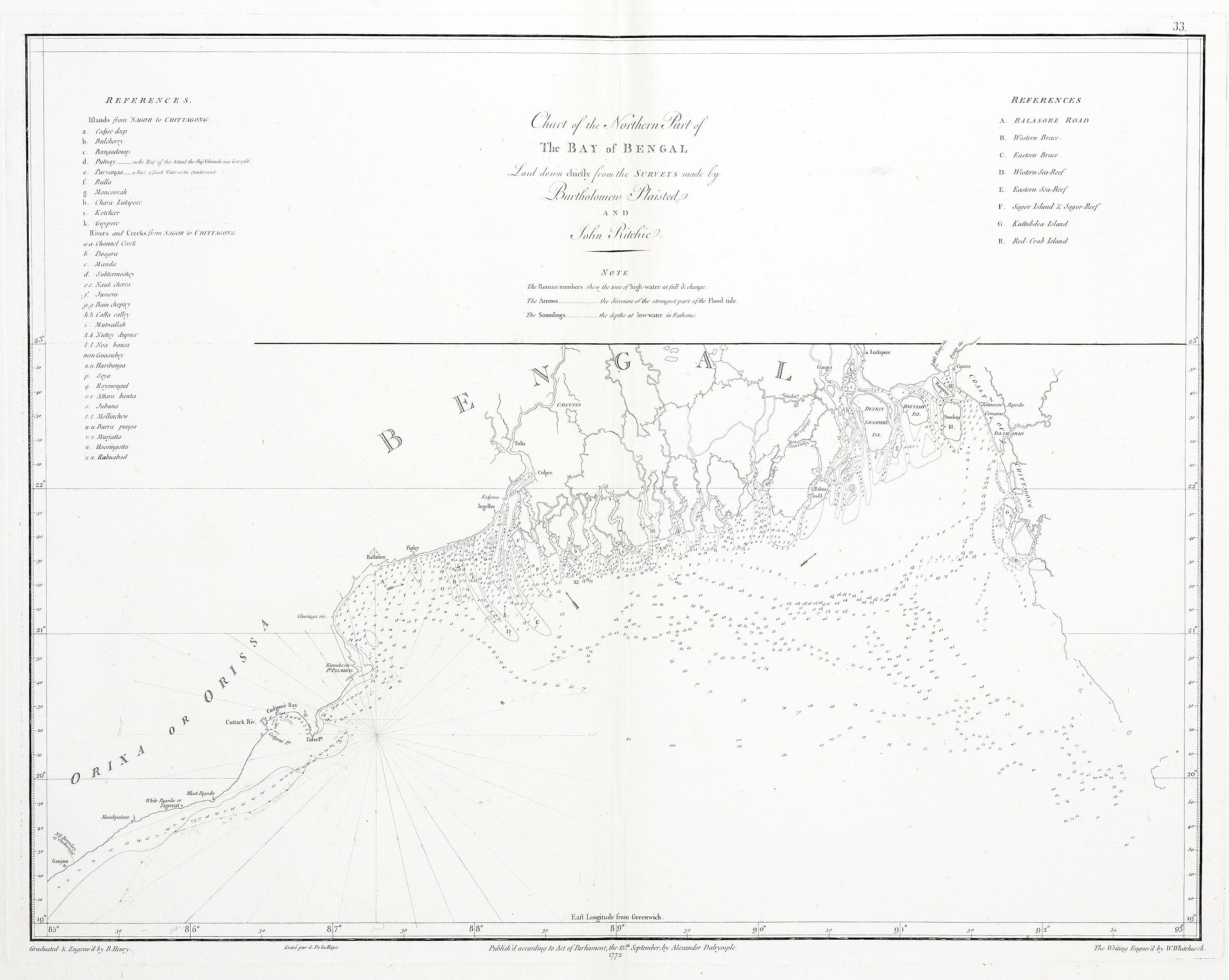
Chart of the Bay of Bengal (1772), published by Alexander Dalrymple (1737-1808), marks the first scientifically surveyed chart of the Sunderbans coast and the principal entrances to the Hooghly and Karnaphuli Rivers, approaches to Calcutta and Chittagong. Compiled from surveys … Read Full Description
$A 550
Within Australia
All orders ship freewithin Australia
Rest of the World
Orders over A$300
ship free worldwide
Full Title:
Date:
Condition:
Technique:
Image Size:
Paper Size:

Genuine antique
dated:
Description:
Chart of the Bay of Bengal (1772), published by Alexander Dalrymple (1737-1808), marks the first scientifically surveyed chart of the Sunderbans coast and the principal entrances to the Hooghly and Karnaphuli Rivers, approaches to Calcutta and Chittagong. Compiled from surveys by East India Company marine officers Bartholomew Plaisted and John Ritchie, it records soundings in fathoms, tidal directions, and sailing instructions for one of the most hazardous coasts in Asia.
Dalrymple, first Hydrographer to the Admiralty, noted that it was “extraordinary… that there is not hitherto a particular chart of the Bay of Bengal in any language.” His map replaced earlier speculative depictions—such as those by François Valentijn (1726) and Jacques-Nicolas Bellin (1746)—which had described the region as “unknown” or “dangerous.” Ritchie’s field notes vividly portray the uninhabited coastline and the salt-workers (“Mollingaho”) who provided assistance to shipwrecked crews. Dalrymple’s chart transformed European understanding of Bengal’s deltaic coast, establishing a model of empirical hydrography that shaped both East India Company navigation and subsequent Admiralty surveying practice.
The chart covers the northern part of the Bay of Bengal between Point Palmiras and the Aracan Shore: from the surveys made by Bartholomew Plaisted and John Ritchie, surveyors to the Honble. the East India Company, compared with those of Captain George Farmer, Captain Augustus Savage, and Benjamin Lacam: as also with the nautical observations of Captain John Hicks: to the Right Honorable the Commissioners for the controul of the British Affairs in the East Indies this chart is most respectfully dedicated by their most obedient and most humble servant Benjamin Lacam. Drawing on the surveying work done in different regions by Benjamin Lacam (Hooghly River), John Ritchie (Bay of Bengal), Bartholomew Plaisted (Indian coast), George Farmer (Ramree Island and the coast of Bangladesh), and Augustus Savage (Indian coast), the chart extends from Cuttack (“Cattack or Kutteck”) in the state of Odisha across the Bay of Bengal, encompassing the southern coast of Bangladesh, to the Rakhine coast of Myanmar to Ramree Island (“Broken Islands”). Lacam has again drawn on the hydrographic work of John Ritchie of the East India Company. Soundings, maritime obstacles, winds, tides, and topographical features on the land are given in great detail. The inner part of the Hooghly delta has been redrawn in red ink on an inset. Ten buoys are identified by name via an alphabetical key. On the left-hand side of the cart four vertically-oriented views show the appearance of parts of the eastern shore from the water. In the upper centre, a table of astronomical observations list those made by sailors from 1761 to 1779, including those “deduced from the observations of the Capt.n Savage, and Mr Lacam in 1775”. The upper right-hand corner of the chart contains an inset of “Chittigong River Surveyed by Bartho[lomew] Plaisted in 1761”. The city of Chittigong, or Islamabad as it was known in the Mughal era, is situated along the banks of the the Karnaphuli River, a name it has held for centuries but which is not included on the chart.
From: Depot Generale de la Marine and Apres de Mannevillette., Neptune Oriental.
Alexander Dalrymple (1737 - 1808)
Dalrymple was a hydrographer, naval commander and administrator. He was educated first by his father, then until he was 14 at the Haddington school, then went to London after his father's death and in 1752, through the influence of an uncle by marriage, General St Clair, was appointed a writer in the East India Co. He was first posted to Madras and while with the company Dalrymple became interested in the possibilities of trade with the East Indies and China, and went on to negotiate a treaty with the sultan of Sulu and visited Canton; in 1765 he returned to London where he was elected a fellow of the Royal Society. When translating some Spanish documents captured in the Philippines in 1762, Dalrymple found Torres testimony proving a passage south of New Guinea; he now showed Torres's route of 1606 on a chart in his An Account of the Discoveries Made in The South Pacifick Ocean, Previous to 1764 (London, 1767). In this work he declared his belief in the existence of a great southern continent, extending into low latitudes in the Pacific. In 1768 it was suggested that Dalrymple should lead the expedition being sent to the Pacific to observe the transit of Venus but his insistence that he should command the vessel was contrary to Admiralty regulations. However, his book provided James Cook with valuable knowledge for his successful navigation of Torres Strait. In his major work, An Historical Collection of the Several Voyages and Discoveries in the South Pacific Ocean (London, 1770), Dalrymple continued to insist that a great southern continent existed. By circumnavigating New Zealand, Cook on his first voyage had imposed severe limitations on this hypothesis, and on his second voyage in 1772-75, he completely disproved it; nevertheless Dalrymple's writings had done much to maintain official interest in Pacific exploration. In 1768 the East India Co. had offered Dalrymple management of a new factory it planned at Balambangan in Borneo, in line with the proposals he had earlier put forward and later expressed in A Plan for Extending the Commerce of this Kingdom and of the East-India-Company (London, 1769); but his demands were so extreme that in 1771 the company dismissed him. In 1775 he was again appointed to Madras; after only two years he was recalled. In 1779 he was appointed hydrographer to the company. He carried out valuable work in his prolific publication of charts. He was convinced that trade in this area would be profitable, arguing by analogy with India and China that the indigenous peoples would be found numerous and wealthy; In 1795 he was appointed hydrographer to the Admiralty, but again his difficult temperament proved his undoing. On 28 May 1808 he was dismissed; as a result, 'in the opinion of his medical attendants, he died of vexation' on 19 June. He made major contributions to marine cartography and his writings on mercantile and public affairs show the breadth of his interests.
View other items by Alexander Dalrymple
Jean-Baptiste de Mannevillette (1707 - 1780)
Mannevillette was a French mapmaker who had studied under the royal cartographer Guillaume de L’Isle and was one of the first to use the method of measuring distances from the sun and moon to determine latitude. He took part in numerous voyages to the East and was made director of the Depot des Cartes et Plans de la Navigation des Indes. All French ships navigating the Indian Ocean used these charts and as a consequence of this on board use, many are found in poor and damaged condition. References: Moreland p.134
Exchange rates are only indicative. All orders will be processed in Australian dollars. The actual amount charged may vary depending on the exchange rate and conversion fees applied by your credit card issuer.
Join our exclusive mailing list for first access to new acquisitions and special offers.


![[ASIA-BURMA] Bay of Bengal Asia (General)](https://antiqueprintmaproom.com/wp-content/uploads/2022/04/MG_5643-copy-270x185.jpg "[ASIA-BURMA] Bay of Bengal Asia (General)")