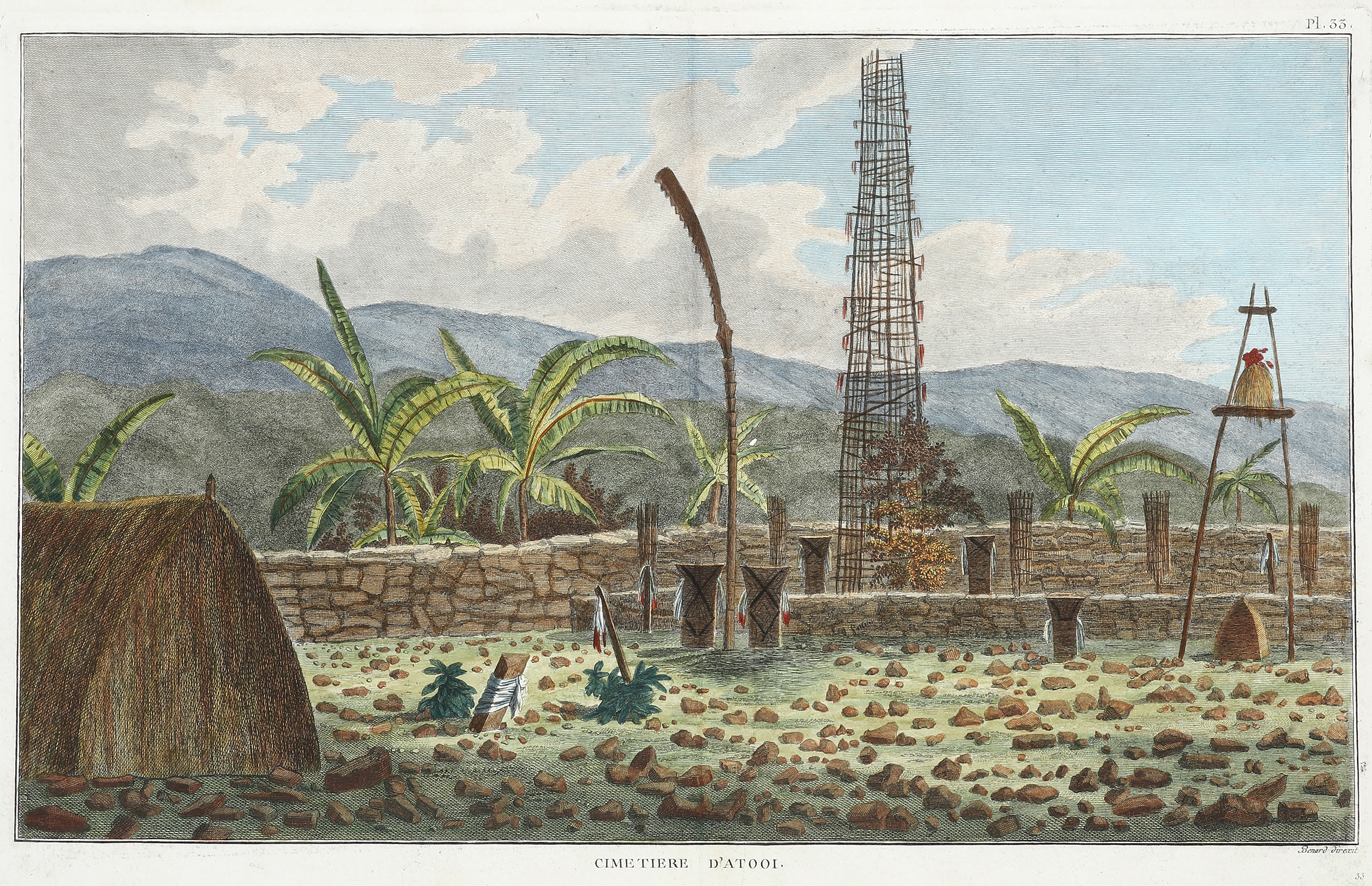
Rare c.18th hand coloured engraving from the French edition of the accounts of Cook’s third and final voyage.
Captain Cook arrived at Atooi (Kauai) on 19th January 1778 and stayed until 23rd January 1778.
On the 21st January, Cook accompanied by Webber, proceeded inland from their beach side anchorage to Waimea, on the south coast of Kauai. Their intention was to examine elevated objects visible from the ship. It proved to be a morai, or temple similar to ones they had seen in Tahiti and other South Pacific islands. This structure was nearly 20-feet high and covered in a thin, light-grey cloth, which likely had ceremonial significance. The temple rested on a platform and consisted of thousands of rough-edged lava rock piled in a tight, mortarless fashion. In the center is the spindly-legged oracle tower, where the priest (kahuna) might seek counsel or pray. Carved figures with tapa and leaf offerings are seen outside thatched huts topped with pili, the tall grass that grew throughout the lowlands. In his journal, Cook took particular note of several stone objects he had observed:
On 21 January 1778, Cook reported: “The Pyramid which they call Henananoo was erected at one end […] the four sides was built of small sticks and branches, in an open manner and the inside of the pyramid was hollow or open from bottom to top. Some part of it was, or had been covered with a very think light grey cloth, which seemed to be consecrated to religious and ceremonious purposes, as a good deal of it was about this morai and I had some of it forced upon me at my first landing. On each side and near the Pyrimid, stood erect some rude carved boards, exactly like those in the morais at Otaheite. At the foot of these were square places, a little sunk below the common level and inclosed with stone, these we understood were graves. About the middle of the morai were three of these places in line, where we were told three chiefs had been buried; before them was another that was oblong, this they called Tanga[ta] taboo and gave us clearly to understand that three human sacrifices has been buried there, that is one at the burial of each chief.” sic
From Hawkesworth, Cartes et Figures des Voyages Entrepris par Ordre de sa Majeste Britannique… Paris: Nyon and Merigot, 1774.
References:
Beddie, M. Bibliography of Captain James Cook, RN,FRS, Circumnavigator. Sydney 1970: 659.
Collections:
Bibliotheque Nationale de France: 4-P2-19
National Library Australia: Bib ID: 1319945
National Library New Zealand: NLNZ ALMA 9913312233502836
New York Public Library: KBF (Hawkesworth, J. Relation des voyages entrepris) v. 1-4
State Library New South Wales: 991013932229702626
State Library Victoria: RARELTF ; 910.41 H31R
State Library South Australia: 910.4 H395 b
State Library Queensland: LCCallNum: 05034855