Within Australia
All orders ship freewithin Australia
Rest of the World
Orders over A$300
ship free worldwide
Mapmaker:
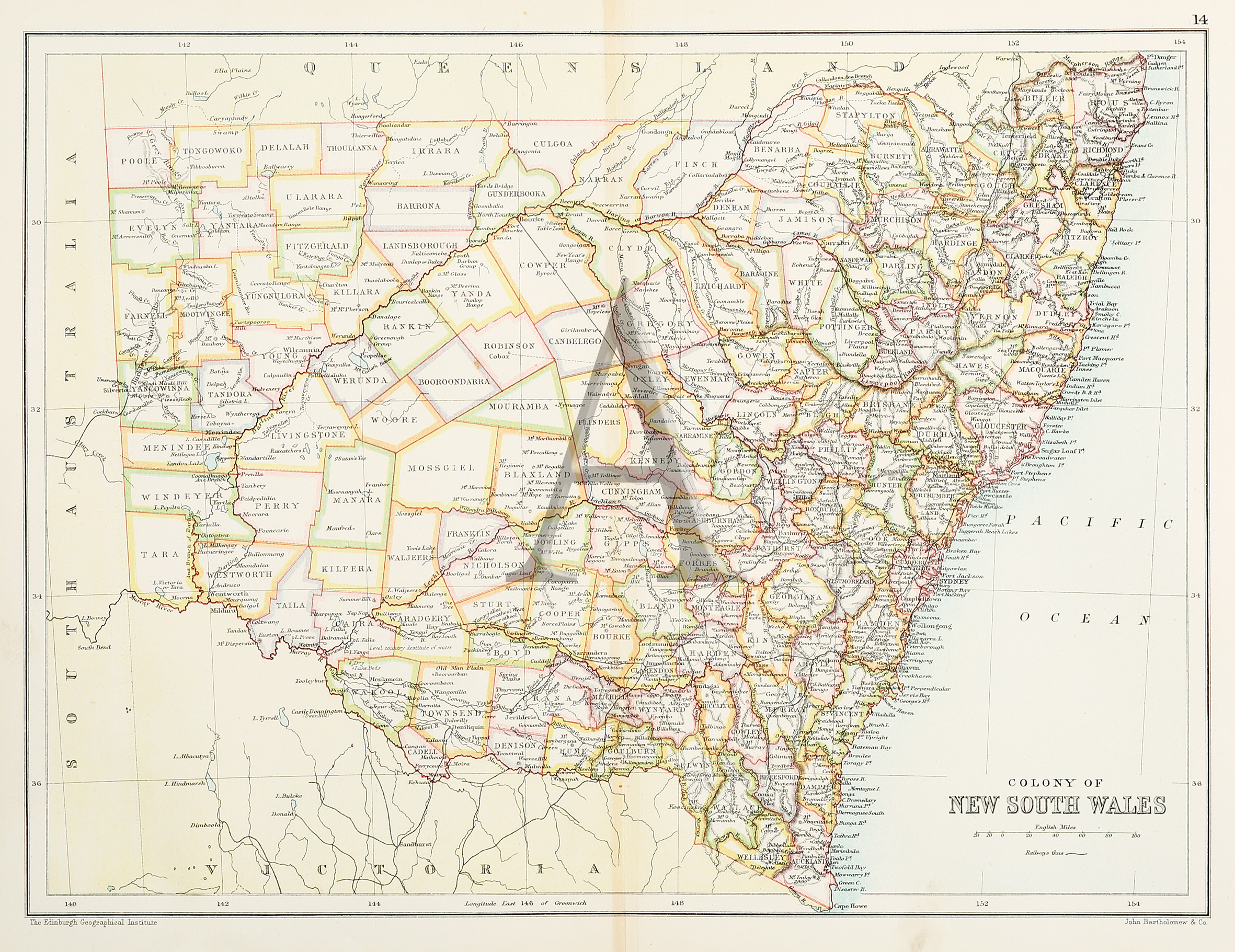
Detailed c.19th colour printed map of New South Wales, presenting the colony at a mature stage of administrative organisation and transport development. The map shows county and district boundaries, an extensive network of roads and railways, telegraph lines, rivers, mountain … Read Full Description
$A 110
Within Australia
All orders ship freewithin Australia
Rest of the World
Orders over A$300
ship free worldwide
Full Title:
Date:
Mapmaker:
Condition:
Technique:
Image Size:
Paper Size:
Genuine antique
dated:
Description:
Detailed c.19th colour printed map of New South Wales, presenting the colony at a mature stage of administrative organisation and transport development.
The map shows county and district boundaries, an extensive network of roads and railways, telegraph lines, rivers, mountain ranges, and principal towns, with Sydney clearly marked as the coastal capital. Coastal features and ports are carefully delineated, while inland settlement patterns extend along river systems and pastoral districts. Topographical elements, including the Great Dividing Range and associated highlands, are indicated through relief shading and drainage patterns, emphasising the relationship between terrain, communication routes, and settlement. The railway network forms a prominent visual feature, reflecting the economic integration of interior agricultural and pastoral regions with coastal markets and export points.
Produced during a period of rapid colonial growth, the map documents the consolidation of land tenure, infrastructure, and regional identity in New South Wales on the eve of Federation.
References:
Ferguson, J. A. Bibliography of Australia Volumes 1-8, Canberra 1976 : 6759.
Collections:
State Library New South Wales: 991020909049702626
National Library Australia: Bib ID: 794411
State Library Victoria: The royal atlas & gazetteer of Australasia
State Library Queensland: 99820404702061
State Library South Australia: 912.94 B287
John Bartholomew (1831 - 1893)
Bartholomew was a Scottish cartographer born in Edinburgh. His father, also John Bartholomew, started the cartographical firm in Edinburg. He was subsequently assistant to the German geographer August Petermann, until in 1856 when he took over his father's firm. Bartholomew built up a reputation unsurpassed in Great Britain for the production of the finest cartographical work. Bartholomew was an in-house cartographer for George Philip. He is best known for the development of colour contouring (or hypsometric tints), the system of representing altitudes on a graduated colour scale, with areas of high altitude in shades of brown and areas of low altitude in shades of green. He first showcased his colour contouring system at the Paris Exhibition of 1878; although it initially met with scepticism, it went on to become standard cartographical practice. Among his numerous publications, particularly worthy of note is the series of maps of Great Britain reduced from the Ordnance Survey to scales of ½ inch and ¾ inch to 1 mile, with relief shown by contour lines and hypsometric tints. The ½ inch series is among the finest of its kind ever produced. Upon his retirement in 1888, John Bartholomew was succeeded in the firm by his son John George, who extended the ½ inch series, and applied its principles to many other works. For the last six years of his life Bartholomew was living at 32 Royal Terrace in Edinburgh. Bartholomew died in London on 29 March 1893.[2] He is buried with his mother and father in Grange Cemetery in Edinburgh, in the northwest section. His wife Annie MCGregor (1836–1872), whom he greatly outlived, is also buried there.
Exchange rates are only indicative. All orders will be processed in Australian dollars. The actual amount charged may vary depending on the exchange rate and conversion fees applied by your credit card issuer.
Join our exclusive mailing list for first access to new acquisitions and special offers.