Within Australia
All orders ship freewithin Australia
Rest of the World
Orders over A$300
ship free worldwide
Artist:
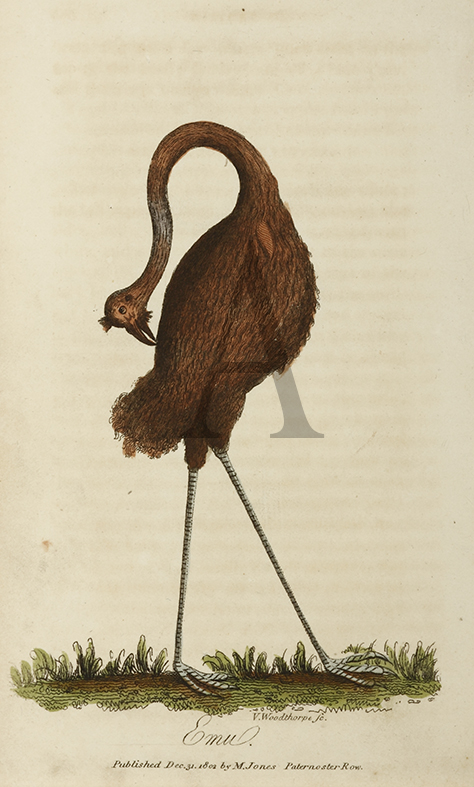
This iconic image was probably based on Hunter’s earlier watercolour painted in 1793 and first issued as an engraving in David Collins account of the colony in 1798. Both the Collin’s engraving and Woodthorpe’s, depict the bird with long thin … Read Full Description
$A 595
Within Australia
All orders ship freewithin Australia
Rest of the World
Orders over A$300
ship free worldwide
Full Title:
Date:
Artist:
Condition:
Technique:
Image Size:
Frame Size:
Genuine antique
dated:
Description:
This iconic image was probably based on Hunter’s earlier watercolour painted in 1793 and first issued as an engraving in David Collins account of the colony in 1798. Both the Collin’s engraving and Woodthorpe’s, depict the bird with long thin legs and a long neck. This engraving is a mirror image of Hunter’s and Woodthorpe has depicted the bird with its neck turned down preening itself, possibly to accommodate the smaller sheet size.
The first sighting of an Emu had occurred on 21st January 1788 by surgeon Arthur Bowes, in Port Jackson and described and drawn in his diary on the transport ship Lady Penrhyn. His diary entry describes his observations;
“The animals we saw during our stay in New Holland……-a bird of a new genus, as large and high as a Ostrich”.
Modern binomial name: Dromaius novaehollandiae
First described: Latham, 1790
Distribution: Australia wide (not including Tasmania)
References:
Ferguson, J. A. Bibliography of Australia Volumes 1-8, Canberra 1976 : 345
Abbey, J.R. Travel in Aquatint and Lithography 1770-1860. London 1972: 565
Collections:
National Library Australia: Bib ID: 531817
State Library New South Wales: Record Identifier 74Vv7J3Nx6BA
State Library Victoria: RARELT 994.402 B27H
State Library South Australia: 994.402 B276
Vincent Woodthorpe (1764 - 1822)
English engraver, artist and copperplate printer whose work is chiefly remembered for its role in shaping early European visual impressions of Australia. He was born in Stepney, London, around 1764, the son of a victualler. In 1778 he was apprenticed to a tinplate worker, a trade that likely gave him the technical grounding later useful in engraving and printing. By the 1790s Woodthorpe was established in London as a professional engraver and printer, working mainly from premises in Fetter Lane. He produced maps, views and decorative prints, often hand-coloured, and was active as both engraver and publisher. His most significant work dates from the early years of the nineteenth century, when he engraved a series of plates illustrating New South Wales for publications associated with Georges Barrington. These images included views of Sydney and its surroundings, depictions of Aboriginal people, native animals and colonial life.
Woodthorpe never visited Australia, and his engravings were based on sketches and descriptions supplied by others. As a result, many of his scenes are imaginative or exaggerated rather than strictly accurate. Despite this, they were among the earliest widely circulated images of the Australian colony and played an important role in shaping how Britain and Europe imagined the new settlement.
Vincent Woodthorpe died in London on 22 September 1822.
Exchange rates are only indicative. All orders will be processed in Australian dollars. The actual amount charged may vary depending on the exchange rate and conversion fees applied by your credit card issuer.
Join our exclusive mailing list for first access to new acquisitions and special offers.