C1637

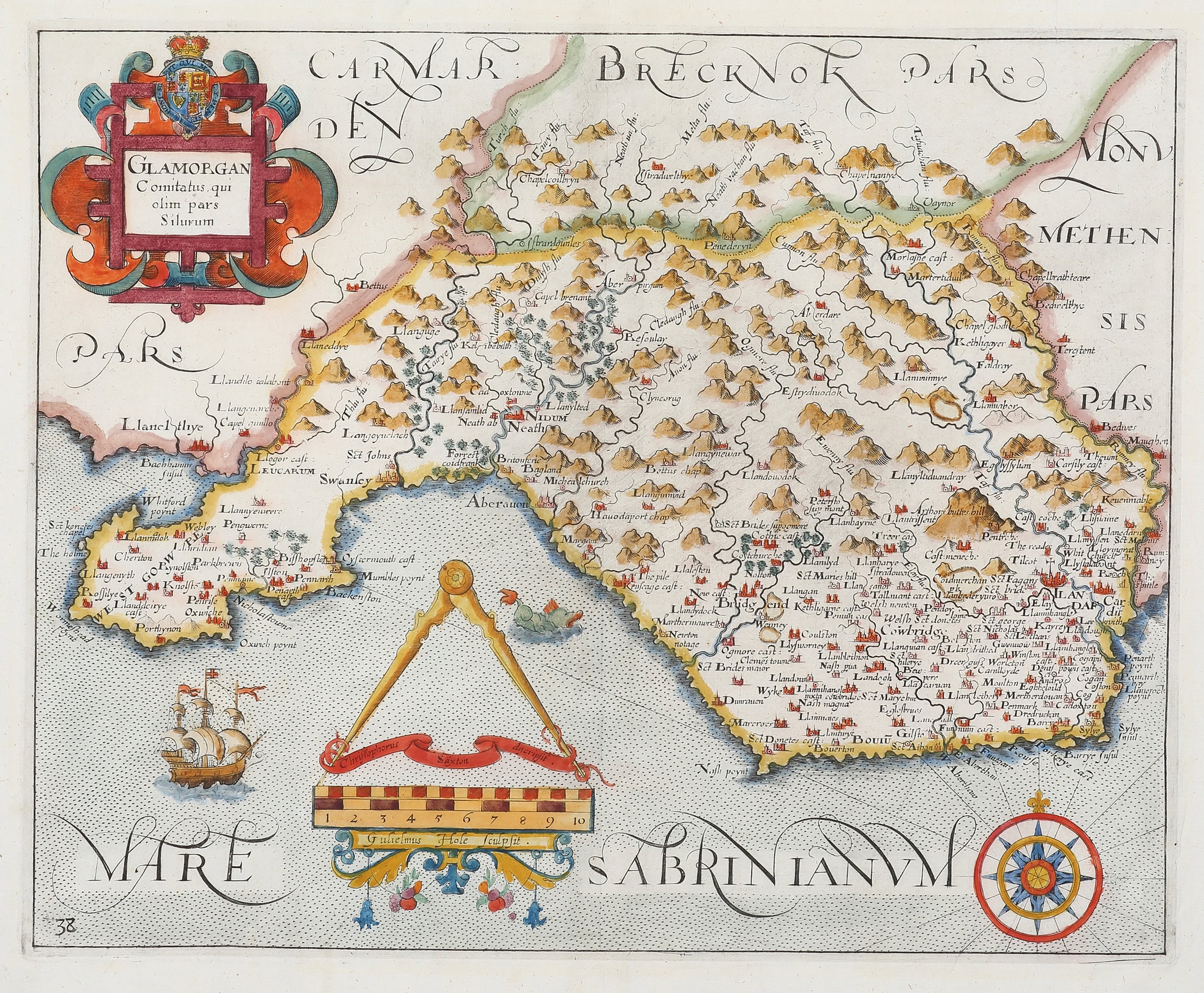
Glamorgan Comitatus qui olim pars Silurum

Rare c.17th hand coloured engraved map of Glamorgan Three editions of the Kip and Hole maps may be found; the first is identifiable by Latin verso text, the second (1610) lacks text while the third (1637) displays an engraved plate … Read Full Description

$A 175

In stock

S/N: CBSFR-BI-038–510823
(F9)
Free Shipping
The Peacock Australian

Within Australia

All orders ship free
within Australia
The Peacock Australian

Rest of the World

Orders over A$300
ship free worldwide

See Shipping page for Terms & Conditions

Details

Full Title:

Glamorgan Comitatus qui olim pars Silurum

Date:

C1637

Condition:

In good condition, with centre fold as issued.

Technique:

Hand coloured copper engraving.

Image Size: 

336mm 
x 272mm

Paper Size: 

410mm 
x 324mm
AUTHENTICITY
Glamorgan Comitatus qui olim pars Silurum - Antique Map from 1637

Genuine antique
dated:

1637

Description:

Rare c.17th hand coloured engraved map of Glamorgan

Three editions of the Kip and Hole maps may be found; the first is identifiable by Latin verso text, the second (1610) lacks text while the third (1637) displays an engraved plate number.

This is from an edition of William Camden’s ‘Britannia’ first published in 1586. It was the last to be published in his lifetime and the first to be illustrated with county maps although this had been contemplated since at least 1589. Camden (1551-1623) was an antiquary and historian. An academic by profession he would become the headmaster of Westminster School in 1593. He spent much of his time travelling and collecting material for his highly respected ‘Britannia’. This map of Glamorgan in South Wales engraved by William Hole is from the third fully illustrated edition of William Camden’s classic work. A fine impression of the second state.

From: Camden, W. Britannia, sive florentissimorum regnorum Angliae, Scotiae, Hiberniae, et insularum adiacentium ex intima antiquitate chorographica descriptio.

Evans (1964) MCC no. 13 p. 6; Shirley BL T.Camd 1e; Skelton 5; STC 4508; Taylor ‘Late Tudor and Early Stuart Geography’ pp. 9- 13.

Chubb XVIII; Lowndes p. 356; Skelton 5; STC 4508.

References:
Chubb, T. The Printed Maps in the Atlases of Great Britain and Ireland ..1579-1870. Folkestone 1977 :: 18.
Shirley, R. Maps in the Atlases of The British Library. London 2004 :: BL T.Camd 1e.
Skelton, R.A. County Atlases of the British Isles 1579-1703.London 1970 :: 5; STC 4508.


John Waring Saxton (1806 - 1866)

English-born journalist, editor, and newspaper proprietor whose career contributed significantly to the early development of colonial journalism in South Australia. Born in England in 1806, Saxton was educated in a milieu shaped by the intellectual and political currents of the early nineteenth century, including liberal reformism and the growing importance of the press as an instrument of civic discourse. Saxton emigrated to South Australia during the formative years of the colony, when its institutions and social fabric were still being shaped. Settling in Adelaide, he became associated with the early colonial press, at a time when newspapers served not only as vehicles of news but also as arenas for debate on governance, land policy, and the moral direction of the new settlement. He is best known for his role as editor of the South Australian Register, the colony’s principal newspaper and a key platform for public opinion and political advocacy. Under Saxton’s editorial influence, the Register maintained a reputation for integrity, measured argument, and an independent stance toward government authority—qualities that distinguished it from many contemporary colonial papers. His writing reflected a commitment to liberal values, the rule of law, and the advancement of public education and civic virtue. He was deeply engaged in questions of political reform, including the debates surrounding responsible government and the establishment of representative institutions in South Australia. Beyond journalism, Saxton was active in intellectual and civic circles, contributing to discussions on literature, science, and the moral responsibilities of colonial life. His editorial judgment and moderation earned him respect among settlers of varying political sympathies. John Waring Saxton died in 1866, leaving a legacy as one of South Australia’s early and most thoughtful newspaper editors. His work exemplified the role of the colonial press in fostering public discourse, social reform, and the intellectual independence of the young Australian colonies.

View other items by John Waring Saxton

Choose currency

Exchange rates are only indicative. All orders will be processed in Australian dollars. The actual amount charged may vary depending on the exchange rate and conversion fees applied by your credit card issuer.

Account Login

The List

Join our exclusive mailing list for first access to new acquisitions and special offers.