C1690

Hiberniæ Regni in Ultoniam, Connacham, Lageniam, M…

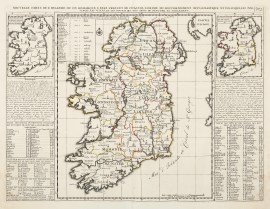
Rare first state (1690) of Carel Allard’s separately issued map of Ireland, one of the most striking maps of its time, with two richly decorated and symbolic cartouches. No altas consisting of Allard maps alone is extant, although they are … Read Full Description

$A 3,500

In stock

S/N: BI-IRE-ALLARD-050B–501918
(CBD 01)
Free Shipping
[ASIA-Carte Hydro-Geo-Graphique Des Indes Oriental… ASIA

Within Australia

All orders ship freewithin Australia

[ASIA-Carte Hydro-Geo-Graphique Des Indes Oriental… ASIA

Rest of the World

Orders over A$300
ship free worldwide

See Shipping page for Terms & Conditions

Details

Full Title:

Hiberniæ Regni in Ultoniam, Connacham, Lageniam, M…

Date:

C1690

Condition:

In good condition, with centre fold as issued. With wide margins.

Technique:

Copper engraving.

Image Size: 

500mm 
x 590mm

Paper Size: 

535mm 
x 636mm
AUTHENTICITY
Hiberniæ Regni in Ultoniam, Connacham, Lageniam, Moniamq divisi Tabula axxuratissima editore Carolo Allard Amstelo-Batavo. - Antique Map from 1690

Genuine antique
dated:

1690

Description:

Rare first state (1690) of Carel Allard’s separately issued map of Ireland, one of the most striking maps of its time, with two richly decorated and symbolic cartouches. No altas consisting of Allard maps alone is extant, although they are sometimes found separately issued or included in other mapmakers composite atlases. As a consequence many of Allard maps are often misdated. One means of ascertaining a publication date is the appearance of his ‘privilege’ granted by the States General on October 1683 which allowed legal protection and exclusive rights to publish his own maps and prints.

This first state is identified by the lines of text at lower left indicating Carel Allard’s privilege: op den Dam, met Privilegie yande Edele Groot Mogende Heeren Staten van Holland en Wesvriesland, without the engravers name, “S. Scherm” (1695) or Covens and Mortier (1730) which appear in later editions.

At top left a sumptous Baroque title panel has the Royal Coat of Arms and mythological scene depicing, the twelfth and final labour of Heracles, in which he descends into the underworld to seize Cerberus, the three-headed guard dog of Hades. Heracles stands at the centre, unmistakable with his lion skin headdress and club, symbolic of his earlier conquest over the Nemean Lion. Having slain Cerberus and beneath Heracles’ feet lies the severed head of Medusa, her serpent hair still writhing. To the left, the figure of Theseus, whom Heracles is said to have rescued from Hades, reaches out imploringly. The backdrop of craggy rock and dark recesses evokes the shadowed depths of the underworld. At lower right is another elaborate cartouche depicting the Muses with a harp, the Greek goddess Demeter, who is associated with agriculture, harvest, and grain, holding a sheaf of wheat while at lower left is the Roman god Neptune, holding a trident in his left hand with a large fish at his feet, spouting water.


Carel Allard (1648 - 1709)

Born and baptised in Amsterdam on 19 January 1648, Carel Allard was the eldest son of Hugo (Huich) Allard (1627–1684), a distinguished cartographer, engraver, and map seller whose business was located on Dam Square. Following his father’s death, Carel inherited the enterprise along with its extensive collection of engraved plates. Active as an engraver, publisher, and art dealer, Carel Allard belonged to a prominent lineage of Dutch mapmakers. He published a wide range of material including maps, topographical views, news prints, and ethnographic scenes, frequently reusing and adapting plates inherited from his father or acquired from other contemporary sources. In October 1683, Allard obtained a 15-year privilege from the States of Holland and West Friesland, securing exclusive rights to produce and sell maps, town plans, portraits, and prints—offering him both legal protection and a competitive commercial edge in a saturated publishing market. Among his most notable works are the Atlas Minor (1697) and the Atlas Major (c. 1705), both comprising finely engraved copperplate maps with original outline colouring. His cartographic output includes highly decorative and scientifically styled works such as the Planisphærium Terrestre, a world map surrounded by inset hemispheres, as well as separate continental maps of America, Asia, Africa, and Europe. These works were admired for their visual refinement and contributed to the stylistic and intellectual development of cartography during the Enlightenment.

View other items by Carel Allard

Related Products

Choose currency

Exchange rates are only indicative. All orders will be processed in Australian dollars. The actual amount charged may vary depending on the exchange rate and conversion fees applied by your credit card issuer.

Account Login

The List

Join our exclusive mailing list for first access to new acquisitions and special offers.