![[Young Woman] PRINTS & PHOTOGRAPHS](https://antiqueprintmaproom.com/wp-content/uploads/2020/03/icon-aust-gold.svg "[Young Woman] PRINTS & PHOTOGRAPHS")
![[Young Woman] PRINTS & PHOTOGRAPHS](https://antiqueprintmaproom.com/wp-content/uploads/2020/03/icon-world-gg-2.svg "[Young Woman] PRINTS & PHOTOGRAPHS")
Mapmaker:
The earliest obtainable map showing the results of Maerten van Delft (?-1705) voyage of exploration to the Southland. The only extant documents of the expedition are; an anonymous manuscript chart and a report of the voyage by two Councillors of … Read Full Description
$A 3,250
Within Australia
All orders ship freewithin Australia
Rest of the World
Orders over A$300
ship free worldwide
Full Title:
Date:
Mapmaker:
Condition:
Technique:
Image Size:
Paper Size:

Genuine antique
dated:
Description:
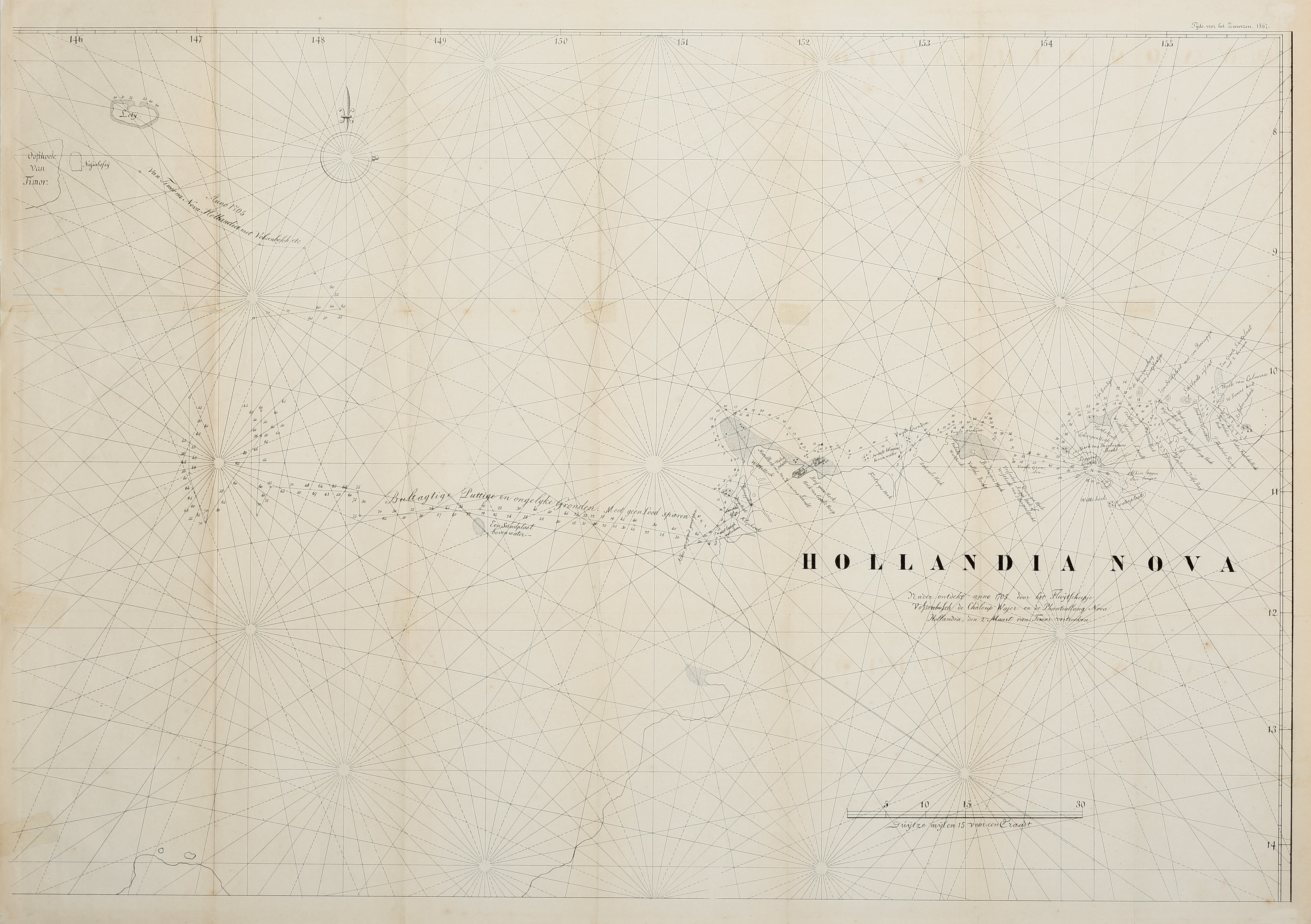
The earliest obtainable map showing the results of Maerten van Delft (?-1705) voyage of exploration to the Southland.
The only extant documents of the expedition are; an anonymous manuscript chart and a report of the voyage by two Councillors of the VOC in Batavia. The original manuscript chart is held by the Netherland’s Nationaal Archief, in The Hague. This lithograph was published in 1867 by Pieter Arend Leupe who was the h istorical geographer and functionary at the Nationaal Archief.
Leupe wrote:
Up until now it has not been possible to find the journals of this voyage, but the National Archive is in possession of the map of the coast of New-Holland, which was sailed by these
ships, with the title: ‘Hollandia-Nova discovered in 1705, by the little Fluyt Vossenbosch…” (Leupe, 1868, p. 198)
The chart covers the north coast of Australia; showing Bathurst Island, Melville Islands and the Coburg Peninsula. Delft’s track are marked, including detailed coastlines, depth soundings, toponyms and appellations. This chart holds importance, not just as a record of early Dutch discovery of Australia, but also due to the numerous toponyms recorded along the coastlines, giving insight in the processes and details deemed important in the creation of VOC Dutch charts.
As stated by Jan Tent (2021):
Van Delft’s chart made during his three month voyage can be considered quite detailed and accurate for its time; certainly more than any preceding chart of the Southland made by the Dutch. It compares quite favourably with the charts made by Flinders in 1803 and P.P. King in 1818. Van Delft’s voyage bestowed more than twice as many toponyms on the Southland than any other Dutch explorer. Jan Tent (2021)
References:
Jan Tent (2021) The 1705 van Delft expedition to northern Australia: a toponymic perspective, International Journal of Cartography, 7:1, 6-37, DOI: 10.1080/23729333.2019.1699679 https://openresearch-repository.anu.edu.au/server/api/core/bitstreams/26c2720d-37ad-4716-8484-6fec083df136/content
P.A. Leupe (1868). De reizen der Nederlanders : naar het Zuidland of Nieuw-Holland in de 17e en 18e eeuw (The travels of the Dutch: to the Southland or New Holland in the 17th and 18th centuries.) G. Hulst van Keulen..
KITLV, R. (1856). Report on a trip to the north coast of New Holland, in 1705. Report on a trip to the north coast of New Holland, in 1705 .(1)
Very little is known of van Delft himself. What is known is that he came from Middelburg (province of Zeeland, Netherlands), that he joined the Zeeland chapter of the VOC (Vereenigde Oostindische Compagnie ‘United Dutch East India Company’) on 14 June, 1703 as an upper steersman (first mate), departed on 14 June aboard the Kattendijk bound for Batavia, where he arrived on 29 February, 1704. He died on 8 August, 1705 (Openarchives). The publication of William Dampier’s A New Voyage Round the World in 1697 prompted the British Admiralty to send Dampier two years later on a mission, via Cape Horn, to explore the east coast of New Holland. However, when the expedition left, it was too late in the season to attempt a passage via this route, so Dampier went around the Cape of Good Hope instead. This resulted in his reaching the west coast of the continent and the subsequent exploration of part of its western coastline from Dirk Hartog Island (Shark Bay) to Roebuck Bay (named after his ship). His account of the expedition was published as A Voyage to New Holland in 1703. Although the result of expedition was disappointing, the publication of the book made the managers of the VOC apprehensive that the British Government would send out further exploratory expeditions to the region. The VOC therefore resolved to send out an expedition to survey the north coast of New Holland and the Bay of Hollandia Nova (i.e. the Gulf of Carpentaria) to try and forestall possible British competition or colonisation. To this end, they sent out three ships, the fluyt Vossenbosch, 3 the phantiallang~patsjalling Nova Hollandia, 4 and the chaloupe (sloop) Waijer~Wajer~Waaier, under the overall command of van Delft. They were to sail from Batavia to Van Diemensland (so named by Pieter Pieterszoon in 1636) and thence follow the north coast eastwards to Arnhem Land and into the Bay of Nova Hollandia. He was to follow the coastline surveyed by Tasman in 1644, and up the west coast of what was then known as Carpentaria, then skirting the western extreme of Torres Strait up to the south coast of New Guinea, which he was to follow all the way to its western extremity, before heading back to Batavia.
All the while van Delft was instructed to make an accurate survey of the coasts, islands, their inhabitants and products (see Leupe, 1868, pp. 186–189; Heeres, 1899, pp. 87–88; and Robert, 1973, pp.134–137). The expedition never ventured further east than the west coast of Croker Island due to overwhelming sickness suffered by the ships’ crews because of the lack of adequate water and food supplies. Many men died, including van Delft who perished on the homeward journey. 2. The Swaardecroon & Chastelijn report The Swaardecroon and Chastelijn report outlines the discoveries made and notable occurrences during the expedition. It notes the three vessels weighed anchor from Batavia on the 23 January 1705, and arrived on 12 February at Kupang (Timor) where, due to inclement weather they were forced to remain for 20 days, until 2 March. A month later, on 2 April, they arrived off the west coast of present-day Bathurst Island and explored the same. Until 12 July the bays, headlands, islands, rivers, etc., were explored according to instructions. However, when many men began to die from sickness, principally fever and dropsy (i.e. oedema), the expedition was abandoned and the ships headed to Banda and Makassar. According to accounts of the surviving officers they were only able to explore and chart about sixty miles of coastline, including a small portion of a great bay. Daily courses, winds, currents, depth soundings, reefs, and variations of the compass readings, etc., were recorded in the journals of the officers. The rest of the report principally follows the logbooks of van Delft and that of the under steersman Andries Rooseboom of the Waijer. The report chronologically follows the tracks of the three vessels, detailing encounters with the Indigenous people, reporting on bays, headlands, islands and rivers, along with names bestowed on some of them.5 Descriptions of the Indigenous people were characteristically Eurocentric and unflattering—not unusual for the times (cf. Dampier’s infamous damning description of the people of the Dampier Peninsula in his 1697 journal A New Voyage Around The World). Table 1, lists, in chronological order, the names bestowed on 18 geographic features as reported in the verbal reports of returned officers and the journals of van Delft and Rooseboom (Swaardecroon & Chastelijn, 1856 [1705]; van Dijk, 1859, §7, pp. 48–52; Leupe, 1868, pp. 196–210).
Maerten van Delft ( - 1705)
Maerten van Delft, also known as Maarten van Delft (Middelburg, ? – Makassar, August 8, 1705), was a skipper in the service of the Dutch East India Company (VOC). In 1705, he led an expedition to the north coast of New Holland, present-day Australia. Unfortunately, he fell ill during the voyage and died four days after returning to Makassar. Van Delft joined the VOC in Middelburg on June 14, 1703, at the Chamber of Zeeland. He then sailed as the first mate on the ship Kattendijk to Batavia, arriving on February 29, 1704. The expedition achieved cartographic success, but despite encountering the local inhabitants, no trading opportunities were found, and there was a significant loss of life. Consequently, the expedition's outcome was disappointing for the VOC, which then lost interest in New Holland. It took more than 50 years before the VOC sent another expedition to Australia.
Exchange rates are only indicative. All orders will be processed in Australian dollars. The actual amount charged may vary depending on the exchange rate and conversion fees applied by your credit card issuer.
Join our exclusive mailing list for first access to new acquisitions and special offers.
![[Chester Hill] Australia (General)](https://antiqueprintmaproom.com/wp-content/uploads/2025/07/MG_0305web-270x198.jpg "[Chester Hill] Australia (General)")


