Within Australia
All orders ship freewithin Australia
Rest of the World
Orders over A$300
ship free worldwide
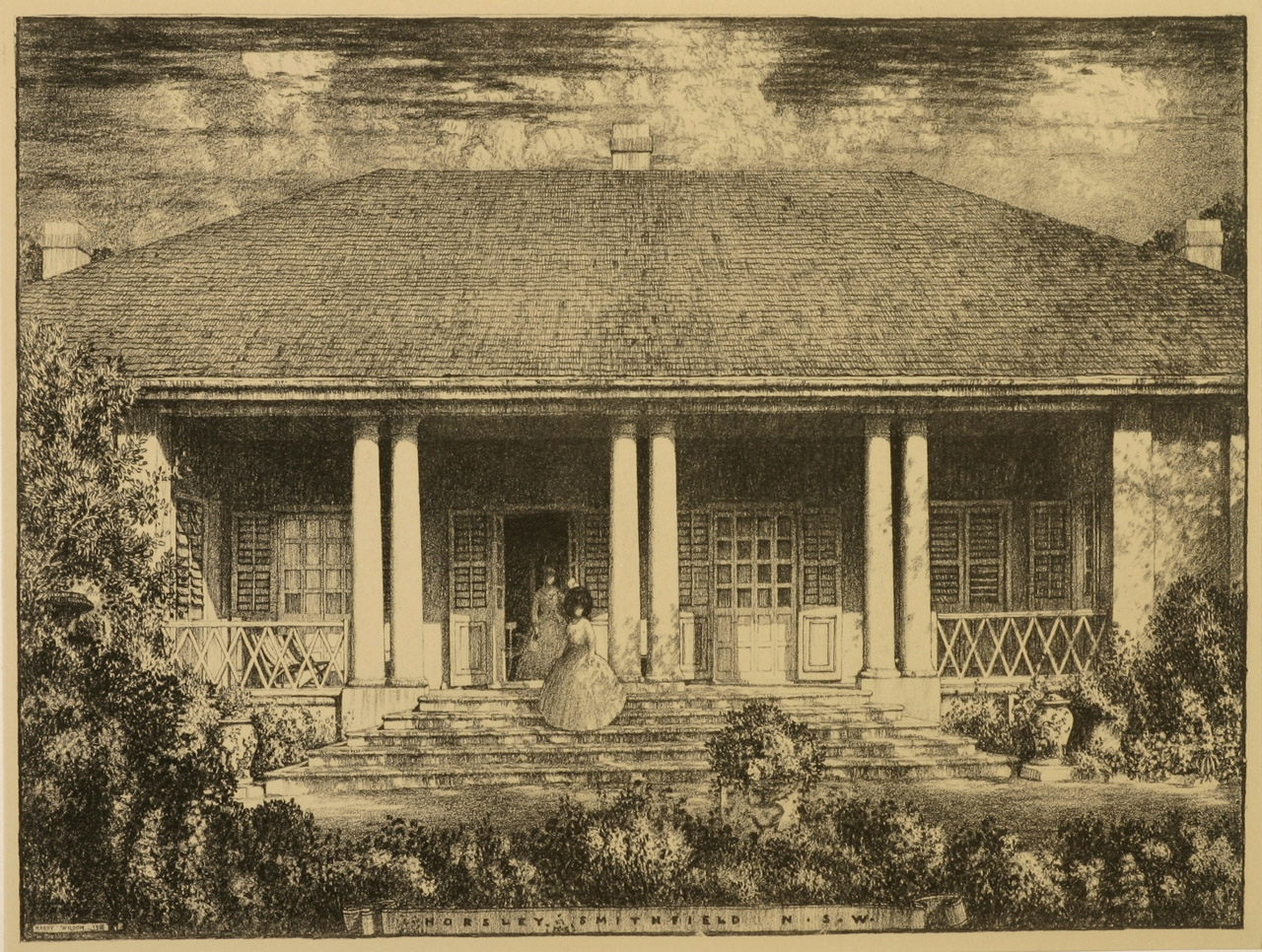
Scarce, c.20th collotype of Horsley Homestead, by William Hardy Wilson (1881-1955) “regarded as one of the most outstanding Australian architects of the twentieth century“. Wilson named it his favourite house. The Horsley Homestead is a heritage-listed rural estate at 52–58 … Read Full Description
$A 275
Within Australia
All orders ship freewithin Australia
Rest of the World
Orders over A$300
ship free worldwide
Full Title:
Date:
Condition:
Technique:
Image Size:
Paper Size:
Guaranteed Vintage Item
dated:
Description:
Scarce, c.20th collotype of Horsley Homestead, by William Hardy Wilson (1881-1955) “regarded as one of the most outstanding Australian architects of the twentieth century“.
Wilson named it his favourite house.
The Horsley Homestead is a heritage-listed rural estate at 52–58 Jamieson Close, Horsley Park, New South Wales. It was built from 1805 to 1832, with uses as a vineyard, orchard, horse and livestock breeding farm.
In 1922 Wilson finished his drawings for his series Old Colonial Architecture, sold his house Purulia and went to England and Europe where he sought the best printmakers and printers. The plates were executed by Max Jaffe in Vienna.
From: Hardy Wilson, Old Colonial Architecture in New South Wales and Tasmania.
Collections:
National Library Australia: Bib ID: 1730050
State Library New South Wales: Call Numbers: Z/X720.99/3
State Library Victoria: Record ID 994776583607636
State Library Queensland: Recor ID 99501954702061
State Library South Australia: Special Collection: 724 W754 d
State Library of Western Australia: Call number: EF0191
National Gallery Australia: Legacy id 157373
Getty Museum Los Angeles: ID/Accession Number 85-B9906
William Hardy Wilson (1881 - 1951)
Hardy Wilson, architect, was the second of four surviving sons of William Joshua Wilson, agent, and his wife Jessie Elizabeth. Living with his parents at Burwood, Wilson attended Newington College (1893-98) and passed the junior public examination. From 1899 to 1904 he was articled to Harry Kent of Kent and Budden, architects, and attended Sydney Technical College at night. He qualified in 1904 and was president of the Architectural Students' Society. Wilson designed mainly homes and small commercial buildings. Having been impressed by the Colonial Revival style in the US, he sought to do something similar in Australia. He is regarded as a key practitioner of the Inter-War Georgian Revival style Regarded as one of the great Australian architects. William Hardy Wilson was born at Campbelltown, in 1881, the great grandson of early NSW colonist Caleb Wilson. He attended Newington College, where he captained the First XV Rugby team and was awarded the School Drawing Prize. He went on to study at the Sydney Technical College. After early work with architects Kent and Budden, Wilson embarked on a long period abroad in 1905 during which he developed his artistic technique. He travelled extensively in Italy and the United States, and when he returned in Sydney in 1910, he was primed to embark on his architectural career proper. Wilson completed a string of houses in Sydney over the coming years, including Merion, for artist Lionel Lindsay, in Wahroonga (1911); Eryldene, also on the upper North Shore in Gordon for the linguist, literary scholar and camelia enthusiast E.B. Waterhouse (1913); and his own house, Purulia, Wahroonga (1916). In 1912, Wilson began a decade-long project to record the early colonial architecture of Australia, which would eventually culminate in the publication of Old Colonial Architecture in New South Wales and Tasmania in 1924.
Exchange rates are only indicative. All orders will be processed in Australian dollars. The actual amount charged may vary depending on the exchange rate and conversion fees applied by your credit card issuer.
Join our exclusive mailing list for first access to new acquisitions and special offers.