
C1875

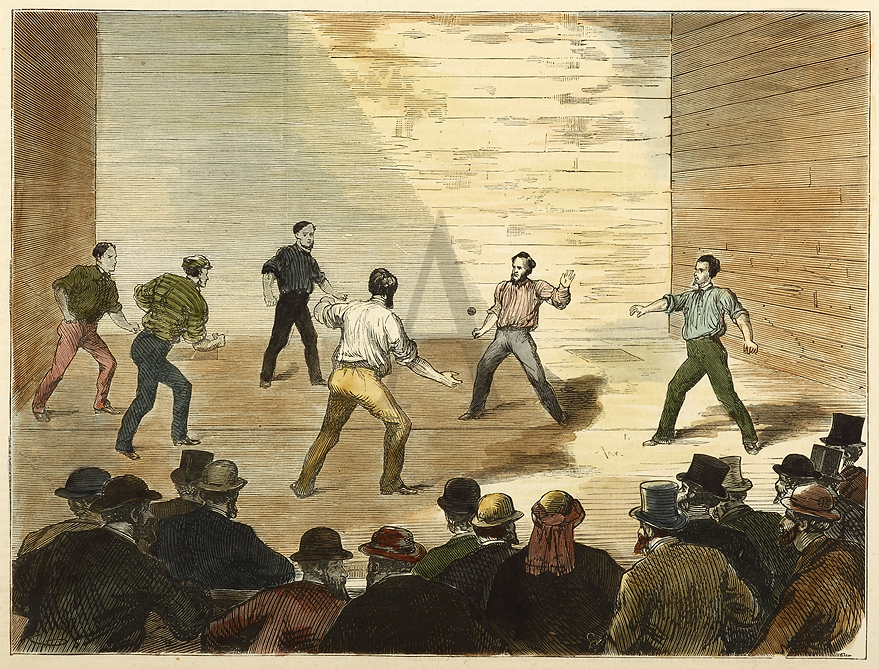
Intercolonial Handball Match at Sydney.

This rare engraving is from the original edition of  the Illustrated Australian News published by The Age , an illustrated newspaper which was published in Melbourne from 1876-1889. It was issued on a monthly basis and included a number of … Read Full Description

$A 145

In stock

S/N: TIAN-SP-750324045–215984
(C064)
Categories:
Free Shipping
Our Birds RARE BOOKS

Within Australia

All orders ship freewithin Australia

Our Birds RARE BOOKS

Rest of the World

Orders over A$300
ship free worldwide

See Shipping page for Terms & Conditions

Details

Full Title:

Intercolonial Handball Match at Sydney.

Date:

C1875

Condition:

In good condition.

Technique:

Hand coloured engraving.

Image Size: 

228mm 
x 170mm
AUTHENTICITY
Intercolonial Handball Match at Sydney. - Antique Print from 1875

Genuine antique
dated:

1875

Description:

This rare engraving is from the original edition of  the Illustrated Australian News published by The Age
, an illustrated newspaper which was published in Melbourne from
1876-1889. It was issued on a monthly basis and included a number of
high quality engravings to illustrate the news and article. The reason
it was issued on a monthly basis was due to the time consuming process
of engraving the  illustrations which would take one engraver between
one and two weeks to make each engraving. This is also coincided with
the monthly shipping of mail to England.

The engravings provided a unique glimpse into colonial life, often
depicting situations or scenes that were less than flattering, in
contrast to the majority of sanctioned views that provided a sanitized
portrayal of life in Australia. Increasingly expensive to produce, the
few illustrated newspapers that made use of original engravings for
their illustrations, and that survived the economic collapse of the late
1880’s found themselves competing against the new technology of
photographically produced half-tone and lino type processes. By the turn
of the century most had disappeared. Many famous Australian colonial
artists were employed such as Julian Ashton, Albert Cooke, Oswald Rose
Campbell, Alfred James Daplyn, Samuel Calvert and Elizier Levi
Montefiore.

 Many famous Australian colonial artists were employed such as Julian
Ashton, Albert Cooke, Oswald Rose Campbell, Alfred James Daplyn, Samuel
Calvert and Elizier Levi Montefiore.

Due to their ephemeral nature few have survived.

Samuel Calvert (1828 - 1913)

British born in England in 1828, Calvert trained in the demanding craft of wood engraving, a medium essential to nineteenth-century illustrated books and newspapers.

He emigrated to Australia during the great period of colonial expansion and settled in Melbourne, where a growing press and publishing industry created strong demand for skilled reproductive artists capable of translating drawings into printable blocks.

By the 1850s and 1860s Calvert had established himself as a leading engraver in Victoria. He worked for major colonial publications, most notably the Illustrated Australian News and other illustrated papers that documented civic ceremonies, public buildings, exhibitions, shipping, exploration, and social life. His engravings helped shape the visual record of early Melbourne and the Australian colonies, rendering architecture, landscapes, and historical events with clarity and technical assurance.

Calvert was particularly associated with large commemorative and documentary projects, including views connected with Melbourne’s international exhibitions and other displays of colonial progress. His work bridged art and reportage: while based on artists’ drawings, his engravings required interpretive skill to convey depth, texture, and atmosphere within the linear language of the wood block. Through this process he played a central role in transforming colonial events into widely circulated images.

In addition to his professional practice, Calvert was active in artistic circles in Victoria and contributed to the establishment of professional standards in the graphic arts. He also trained or influenced younger engravers, helping to localise a craft that had previously depended heavily on British production.

Samuel Calvert died in 1913, leaving a substantial body of work that today serves as an important visual archive of nineteenth-century Australia. His engravings are represented in major Australian libraries and collections and remain valued for both their artistic quality and their documentary significance.
View other items by Samuel Calvert

Related Products

Choose currency

Exchange rates are only indicative. All orders will be processed in Australian dollars. The actual amount charged may vary depending on the exchange rate and conversion fees applied by your credit card issuer.

Account Login

The List

Join our exclusive mailing list for first access to new acquisitions and special offers.