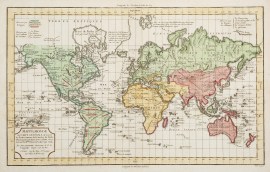
Rare c.18th hand coloured double hemisphere world map dated 1795 at lower left showing Australia with the discoveries made by James Cook on his first voyage which included New Zealand and the east coast of Australia. Van Diemen’s land is shown attached to the mainland and the southern coast is marked as imaginary.
Note: There is a much smaller (330mmx 510mm) and more common chart with a similar title, dated 1789 by von Reilly.
Australia is name Ulimaroa which first appeared on the first Swedish map of Australia by Djurberg in 1780 (Tooley 446. p.58). He applied the name Ulimaroa to the Australian mainland, propagating its use by various mapmakers well into the 19th century.
Djurberg’s use of the name was derived from Cook’s account of his time in New Zealand ‘the large island Ulimaroa, which in old geographies is known as New Holland. On page 436 of Hawkesworth’s rendition of Cook’s first voyage, Ulimaroa is mentioned as the biggest island in the world. I should give a reason for this name. This land is called New Holland in a lot of maps, but for what reason I do not know; there is no similarity between Holland in Europe and this land, neither in size nor in the area’s character. You find in the account of the famous English sailor Cook’s journeys that when he was on the northern coast of New Zealand, he asked the inhabitants there if they knew any other country, to which they replied that to the north-west of their home, a quite large land was located, which they called Ulimaroa. I have decided to maintain this name as given to this land by its neighbours; besides it is better than New Holland.’
The two passages in the published account of James Cook’s first voyage, by Hawkesworth in 1773, relating to Ulimaroa are:
Saturday 5 February 1769, Volume 2, page 372:
‘This place we concluded to be the land difcovered by Tafman, which he called CAPE MARIA VAN DIEMEN, and finding thefe people fo intelligent, we inquired farther, if they knew of any country befides their own: they anfwered, that they never had vifisted any other, but that their anceftors had told them, that to the N.W. by N., or N.N.W. there was a country of great extent, called Ulimaroa, which people had failed in a very large canoe…’
Monday 5 February 1770, Volume 2, page 402:
‘When we were under fail, our old man aTopaa came on board to take his leave of us, and as we were ftill defirous of making farther enquiries whether any memory of Tafman had been preferved among thefe people, Tupia was directed to afk him whether he had ever heard that fuch a veffel as ours had vifited the country. To this he replied in the negative, but faid, that his anceftors had told him there had once come to this place a fmall veffel, from a distant country, called Ulimaroa, in which were four men, who, upon coming on fhore, were all killed: upon being afked where this diftant land lay, he pointed to the northward. Of Ulimaroa we had heard fome-thing before, from people about the Bay of Iflands, who faid that their anceftors had vifisted it; and Tupia had alfo talked to us of Ulimaroa….’ sic
From: Reilly, Franz Johann Joseph. tro