C1685

L’Amerique Meridionale Divisee en ses Princi…

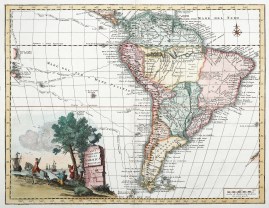
Rare, large and influential c.17th hand coloured French engraved map of South America, published by Alexis-Hubert Jaillot and based on the geographical framework established by Nicolas Sanson (1600–1667), the leading figure of the French school of scientific cartography. Jaillot, who … Read Full Description

$A 1,050

In stock

S/N: SAM-JAILLOT-1685–518317
(CBD 01)
Free Shipping
Whale Beach – Sydney N.S.W Australian photographs

Within Australia

All orders ship freewithin Australia

Whale Beach – Sydney N.S.W Australian photographs

Rest of the World

Orders over A$300
ship free worldwide

See Shipping page for Terms & Conditions

Details

Full Title:

L’Amerique Meridionale Divisee en ses Principales Parties.

Date:

C1685

Condition:

Minor chips to sheet edges, otherwise in good condition. Printed on two sheets.

Technique:

Copper engraving with original hand colouring.

Image Size: 

883mm 
x 580mm

Paper Size: 

940mm 
x 638mm
AUTHENTICITY
L'Amerique Meridionale Divisee en ses Principales Parties. - Antique Map from 1685

Genuine antique
dated:

1685

Description:

Rare, large and influential c.17th hand coloured French engraved map of South America, published by Alexis-Hubert Jaillot and based on the geographical framework established by Nicolas Sanson (1600–1667), the leading figure of the French school of scientific cartography.

Jaillot, who acquired the Sanson plates through family and commercial association with Sanson’s heirs, re-engraved and reissued many of Sanson’s maps in enlarged and more elaborate formats during the later seventeenth century, aligning geographic authority with the decorative grandeur favoured in the Paris map trade under Louis XIV.

The continent is organised according to the principal colonial and geographical divisions recognised by Europeans in the later seventeenth century, including Terre Ferme (the Spanish Main of northern South America), Perou, Chili, and Bresil. The hydrographic system is prominently articulated, with the Amazon and La Plata river networks forming major structuring elements of the interior, while the Andes are shown as a continuous western cordillera. Coastal nomenclature is comparatively dense, reflecting maritime exploration and imperial priorities, whereas the interior retains large schematic regions, signalling both emerging knowledge and persistent uncertainty.

The map exemplifies the transition from the decorative Dutch style of the earlier seventeenth century to the more measured, text-driven French cartographic aesthetic. Although ornament remains important, it is subordinated to geographic clarity. The title cartouche and other embellishments display controlled Baroque design rather than pictorial excess, reinforcing the authority of the map as an instrument of knowledge as well as display. Jaillot’s engraving is crisp and spacious, with balanced lettering and a clear hierarchical structure that reflects the intellectual ambitions of the Sanson–Jaillot partnership: to ground cartography in compiled reports, travellers’ accounts, and state geographical intelligence.

Historically, the map belongs to a period of intensified European competition in the Americas, when cartography functioned not only as a scientific pursuit but also as a visual expression of imperial reach. French geographic production, though representing territories largely controlled by Spain and Portugal in South America, asserted intellectual leadership in the ordering and presentation of global space. As such, this map is both a synthesis of mid c.17th geographic knowledge and a statement of the maturity of the French cartographic school.

References:
The British Museum. Catalogue of Printed Maps Charts and Plans to 1968 (16 Volumes):: vol. 1 A-AS, pg, 514 (1714 edition).

Collections:
David Rumsey Collection: List No: 12178.032 (1708 edition)
Huntington Library: Call Number 105:835 M (1696 edition)
Bibliotheque Nationale de France: ark:/12148/cb406040741 (1719 edition)

Alexis Hubert Jaillot (1632 - 1712)

Jaillot was born near Saint Claude in Franche Comte, but moved to Paris in 1657. Originally a sculptor, he took up engraving and cartography after marrying Jeanne, daughter of Nicholas Berey (1606-1665), the publisher, map seller and Enlumineur de la Reine. He quickly established a reputation for his ability and business acumen and was chosen by the sons and heirs of Nicholas Sanson to infuse new life into their business. Jaillot proceeded to re-engraved Sanson's maps on a larger scale and these began to appear from 1674 onwards. After the collapse of the Blaeu map publishers empire, following the fire of 1672 which destroyed the company's premises Paris became the centre of European map making. In 1676 Jaillot was appointed Geographie du Rou to Louise XIV.

View other items by Alexis Hubert Jaillot

Nicholas Sanson d’Abeville (1600 - 1667)

Nicholas Sanson d’Abeville (1600-1667) Important French Royal cartographer considered to be the "father of French cartography. Educated by the Jesuits at Amiens. He gave lessons in geography both to Louis XIII and to Louis XIV. Active from 1627, Sanson issued his first significant map, the "Postes de France", which was published by Melchior Tavernier in 1632. After publishing several general atlases he became the associate of Pierre Mariette. Two younger sons, Adrien (d. 1708) and Guillaume (d. 1703), succeeded him as geographers to the king. In 1692 Hubert Jaillot collected Sanson's maps and published the, Atlas nouveau.

View other items by Nicholas Sanson d’Abeville

Related Products

Choose currency

Exchange rates are only indicative. All orders will be processed in Australian dollars. The actual amount charged may vary depending on the exchange rate and conversion fees applied by your credit card issuer.

Account Login

The List

Join our exclusive mailing list for first access to new acquisitions and special offers.