C1814

Land on the north side of Blue-mud Bay: taken Jan.…

Rare c.19th coastal profile of Blue Mud Bay coast by William Westall, artist on board Matthew Flinders seminal survey of the Australia coast on the Investigator. Blue Mud Bay is situated on the eastern coast of Arnhem Land, Northern Territory, … Read Full Description

$A 195

In stock

S/N: FAVTTA-CP-1813A-NT–228685
(C098)
Free Shipping
[ASIA-Carte Hydro-Geo-Graphique Des Indes Oriental… ASIA

Within Australia

All orders ship freewithin Australia

[ASIA-Carte Hydro-Geo-Graphique Des Indes Oriental… ASIA

Rest of the World

Orders over A$300
ship free worldwide

See Shipping page for Terms & Conditions

Details

Full Title:

Land on the north side of Blue-mud Bay: taken Jan.…

Date:

C1814

Condition:

In good condition.

Technique:

Hand coloured copper engraving.

Image Size: 

435mm 
x 40mm

Paper Size: 

455mm 
x 70mm
AUTHENTICITY
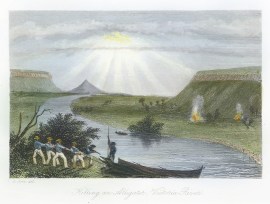
Land on the north side of Blue-mud Bay: taken Jan. 29. 1803 at eleven a.m. - Antique View from 1814

Genuine antique
dated:

1814

Description:

Rare c.19th coastal profile of Blue Mud Bay coast by William Westall, artist on board Matthew Flinders seminal survey of the Australia coast on the Investigator.

Blue Mud Bay is situated on the eastern coast of Arnhem Land, Northern Territory, facing Groote Eylandt on the western side of the Gulf of Carpentaria.

January 27, 1803
Next morning we steered westward, with a fair wind, to explore the main coast up to Mount Grindall, and see the northern part of Blue-mud Bay.

January 28, 1803
Whilst the botanists continued to follow their pursuits upon Point Blane, I went over in the whale-boat to Mount Grindall, with the landscape painter; from whence, after cutting down some small trees at the top, my view extended over all the neighbouring islands, points, and bays. Blue-mud Bay was seen to reach further north than Mount Grindall, making it to be upon a long point, which I also named Point Grindall, from respect to the present vice-admiral of that name; further west, in the bay, was a stream running five or six miles into the land, terminating in a swamp, and with shoal banks and a low island at the entrance; all the northern part of the bay, indeed, seemed to be shallow, and to have no ship passage into it on the north side of Isle Woodah. The large bight between Points Grindall and Blane extended two leagues above the ship, but it did not appear to receive any stream of water; a still larger bight, between Point Blane and Cape Shield was also visible, though not so distinct as to speak of it particularly: the extremity of the cape bore S. 76° 15’ E. An observation to the north and south, taken on the outermost rocks, places Mount Grindall in 13° 15½’ south; and the longitude from survey is 136° 6 1/3’ east. Mr. Westall’s sketch in the Atlas, taken from the ship at anchor under Point Blane, will show the appearance of this mount and of the neighbouring land. (Atlas, Pl. XVIII. View 13.)’

From: Flinders, M. A Voyage to Terra Australis, undertaken for the purpose of completing the discovery of that vast country, and prosecuted in the years 1801, 1802, and 1803, in His Majesty’s Ship The Investigator and subsequently in the armed vessel Porpoise and Cumberland schooner. 

References:
Ferguson, J. A. Bibliography of Australia Volumes 1-8, Canberra 1976 : 756.
Tooley, R.V. The Mapping of Australia. London 1979 : pp. 77-79.
Perry, T. & Prescott, D. A guide to maps of Australia in books published 1780-1830. Canberra 1996 : 1814..
Ferguson, J. A. Bibliography of Australia Volumes 1-8, Canberra 1976 : 576.
Hill, J. The Hill Collection of Pacific Voyages. San Diego 1974 : 614.
Wantrup, J. Australian Rare Books. Sydney, 1987 : 67a.
Ingleton, G. Charting a Continent. Sydney 1944 : 6487.

Collections:
National Library Australia: Bib ID 589314
Royal Collection Trust UK: RCIN 1054637
Silent World Foundation, Sydney.: SKU SF000813
State Library Victoria: CCF 919.4 F64V


William Westall (1781 - 1850)

Westall was a landscape artist born at Hertford, England. He was taught to draw by his elder half-brother Richard (1765-1836), a water-colour painter, Royal Academician and painting teacher to Princess Victoria. In 1799 he was admitted to the Royal Academy School, where he was studying when at 19 he was appointed landscape artist with Matthew Flinders' Investigator expedition to Australia, at a salary of 300 guineas. During the voyage he made a large number of pencil-and-wash landscapes in places visited by the Investigator and a series of coast profiles in pencil. When the Porpoise ran aground on Wreck Reef his sketches were 'wetted and partly destroyed' and, while Westall travelled in China, the drawings, regarded as part of the official record of the voyage, were taken by Lieutenant Robert Fowler to England. There, at the suggestion of Sir Joseph Banks, they were handed to Richard Westall to be 'restored to a proper state'. After spending some time in China and India Westall returned to London in February 1805 and sought access to the sketches to paint a picture for exhibition at the Royal Academy and showed a View of the Bay of Pines at the academy later in the year. In the summer of 1805 Westall went to Madeira and twelve months later to Jamaica. After returning to England he painted a series of water-colour views of the places he had visited and these were shown in a Brook Street gallery and at the Associated Artists' exhibition in 1808. Later he received commissions from the Admiralty to paint nine pictures to illustrate Flinders' A Voyage to Terra Australis … (1814), and was engaged by several London publishers to paint water-colours to be reproduced as aquatints.  

View other items by William Westall

Related Products

Choose currency

Exchange rates are only indicative. All orders will be processed in Australian dollars. The actual amount charged may vary depending on the exchange rate and conversion fees applied by your credit card issuer.

Account Login

The List

Join our exclusive mailing list for first access to new acquisitions and special offers.