Artist:
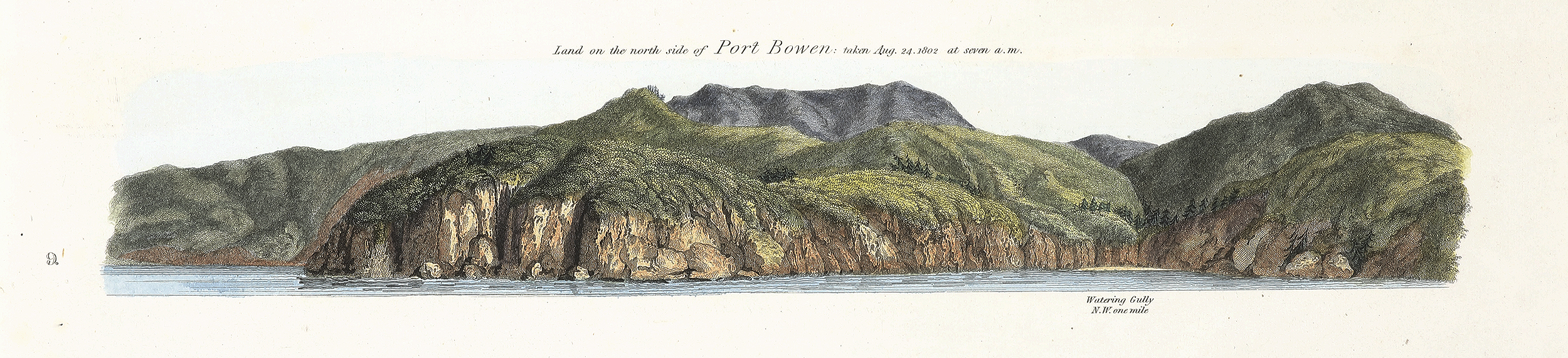
Rare c.19th coastal profile of Port Bowen coast by William Westall, artist on board Matthew Flinders seminal survey of the Australia coast on the Investigator. Flinder account: For a ship wanting to take in water and pine logs, the most … Read Full Description
$A 475
Within Australia
All orders ship freewithin Australia
Rest of the World
Orders over A$300
ship free worldwide
Full Title:
Date:
Artist:
Condition:
Technique:
Image Size:
Paper Size:

Genuine antique
dated:
Description:
Rare c.19th coastal profile of Port Bowen coast by William Westall, artist on board Matthew Flinders seminal survey of the Australia coast on the Investigator.
Flinder account:
For a ship wanting to take in water and pine logs, the most convenient place is under Entrance Island, where we lay in the Investigator; indeed fresh water was not found in any other place; but this anchorage is not tenable against a strong south-east wind. At the entrance of the southern arm, just within Cape Clinton, a ship may lie at all times in perfect safety; and might either be laid on shore or be hove down, there being 3 fathoms close to the rocks, at each end of the beach; it is moreover probable, that fresh water might be there found, or be procured by digging at the foot of the hills. In the southern arm the bottom is muddy; but it is of sand in other parts of the port. Of the country round Port Bowen not much can be said in praise; it is in general either sandy or stony, and unfit for cultivation; nevertheless, besides pines, there are trees, principally eucalyptus, of moderate size, and the vallies of Cape Clinton are overspread with a tolerably good grass. No inhabitants were seen, but in every part where I landed, fires had been made, and the woods of Cape Clinton were then burning; the natives had also been upon Entrance Island, which implied them to have canoes, although none were seen. There are kangaroos in the woods; hawks, and the bald-headed mocking bird of Port Jackson are common; and ducks, sea-pies, and gulls frequent the shoals at low water. Fish were more abundant here than in any port before visited; those taken in the seine at the watering beach were principally mullet, but sharks and flying fish were numerous. The latitude of the north-west end of Entrance Island, from an observation taken by lieutenant Flinders in an artificial horizon, is 22° 28′ 28″ south. Longitude from twelve sets of lunar distances by the same officer, 150° 47′ 54″; and by the time keepers, 150° 45′ 36″; but from the fifty sets which fix Broad Sound, and the reduction from thence by survey, the more correct situation will be 150° 45′ 0″ east. Dip of the south end of the needle, 50° 20′. Variation from azimuths with the theodolite, 7° 40′ east; but on the top of the island, where my bearings were taken, the variation appeared to be 8° 30′ east; and 8° in other parts of the port. The time of high water, as near as it could be ascertained, was ten hours after the moon’s passage over and under the meridian, being half an hour later than in Keppel Bay; and the tide rises more than nine feet, but how much was not known; it is however to be presumed, from what was observed to the south and to the north of Port Bowen, that the spring tides do not rise less than fifteen feet. TUESDAY 24 AUGUST 1802 At daylight of the 24th, we steered out of Port Bowen by the northern passage, as we had gone in. The wind was from the westward; but so light, that when the ebb tide made from the north-west at ten o’clock, it was necessary to drop the kedge anchor for a time. In the evening we came to, in 10 fathoms fine grey sand, one mile and a half from the main; being sheltered between N. E. by E. and E. by S. by the same cluster of small isles upon which the pine trees had been first seen. In the morning [WEDNESDAY 25 AUGUST 1802] we worked onward along the coast, against a breeze at north-west, till ten o’clock; when the tide being unfavourable, an anchor was dropped in 15 fathoms, sand and shells, near three islets, of which the middlemost and highest bore S. 29° E., one mile: these were also a part, and the most northern of Harvey’s Isles. A boat was lowered down, and I landed with the botanical gentlemen on the middle islet; where we found grass and a few shrubs, and also ants, grasshoppers, and lizards. Upon the rocks were oysters of the small, crumply kind, which seemed to indicate that the sea here is not violently agitated; and in the water we saw several large turtle, but were not able to harpoon any of them. Several of the Northumberland Isles were in sight from the top of the islet, and the following observations were taken. Latitude, observed in artificial horizon, 22° 20′ 42″ Longitude, deduced from survey, 150 42 Peaked Islet in the offing bore S. 35 35 E. Island Head, distant 3 miles, S. 82 45 W. Cape Townshend, the rock near it, N. 57 45 W. Northumberland Isle, the 4th, a peak, N. 43 30 W. When the tide slacked in the afternoon we stretched over towards Island Head, and saw a canoe with two Indians, who made for the shore near a place where the woods were on fire. At dusk we anchored in 18 fathoms, soft mud, in a bight between Island Head and Cape Townshend, at the bottom of which was an opening one mile wide, where captain Cook had suspected an entrance into Shoalwater Bay. The Lady Nelson had fallen to leeward, as usual; and not being come up in the morning [THURSDAY 26 AUGUST 1802], the master was sent ahead of the ship in a boat, and we steered for the opening with a strong flood tide in our favour. From 22 fathoms, the water shoaled to 12, and suddenly to 3, on a rocky bottom, just as we reached the entrance. A kedge anchor was dropped immediately; but seeing that the opening went through, and that the master had deep water further in, it was weighed again, and we backed and filled the sails, drifting up with the tide so long as it continued to run. At nine o’clock the anchor was let go in 6 fathoms, sand and shells, one mile within the entrance, the points of which bore N. 34° and S. 89° E.; but the extent of deep water was barely sufficient for the ship to swing at a whole cable.
From: Flinders, M. A Voyage to Terra Australis, undertaken for the purpose of completing the discovery of that vast country, and prosecuted in the years 1801, 1802, and 1803, in His Majesty’s Ship The Investigator and subsequently in the armed vessel Porpoise and Cumberland schooner.
References:
Ferguson, J. A. Bibliography of Australia Volumes 1-8, Canberra 1976 : 756.
Tooley, R.V. The Mapping of Australia. London 1979 : pp. 77-79.
Perry, T. & Prescott, D. A guide to maps of Australia in books published 1780-1830. Canberra 1996 : 1814..
Ferguson, J. A. Bibliography of Australia Volumes 1-8, Canberra 1976 : 576.
Hill, J. The Hill Collection of Pacific Voyages. San Diego 1974 : 614.
Wantrup, J. Australian Rare Books. Sydney, 1987 : 67a.
Ingleton, G. Charting a Continent. Sydney 1944 : 6487.
Collections:
National Library Australia: Bib ID 589314
Royal Collection Trust UK: RCIN 1054637
Silent World Foundation, Sydney.: SKU SF000813
State Library Victoria: CCF 919.4 F64V
William Westall (1781 - 1850)
Westall was a landscape artist born at Hertford, England. He was taught to draw by his elder half-brother Richard (1765-1836), a water-colour painter, Royal Academician and painting teacher to Princess Victoria. In 1799 he was admitted to the Royal Academy School, where he was studying when at 19 he was appointed landscape artist with Matthew Flinders' Investigator expedition to Australia, at a salary of 300 guineas. During the voyage he made a large number of pencil-and-wash landscapes in places visited by the Investigator and a series of coast profiles in pencil. When the Porpoise ran aground on Wreck Reef his sketches were 'wetted and partly destroyed' and, while Westall travelled in China, the drawings, regarded as part of the official record of the voyage, were taken by Lieutenant Robert Fowler to England. There, at the suggestion of Sir Joseph Banks, they were handed to Richard Westall to be 'restored to a proper state'. After spending some time in China and India Westall returned to London in February 1805 and sought access to the sketches to paint a picture for exhibition at the Royal Academy and showed a View of the Bay of Pines at the academy later in the year. In the summer of 1805 Westall went to Madeira and twelve months later to Jamaica. After returning to England he painted a series of water-colour views of the places he had visited and these were shown in a Brook Street gallery and at the Associated Artists' exhibition in 1808. Later he received commissions from the Admiralty to paint nine pictures to illustrate Flinders' A Voyage to Terra Australis … (1814), and was engaged by several London publishers to paint water-colours to be reproduced as aquatints.
Exchange rates are only indicative. All orders will be processed in Australian dollars. The actual amount charged may vary depending on the exchange rate and conversion fees applied by your credit card issuer.
Join our exclusive mailing list for first access to new acquisitions and special offers.