Within Australia
All orders ship freewithin Australia
Rest of the World
Orders over A$300
ship free worldwide
Artist:
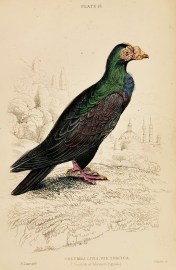
The finest c.19th hand coloured engraving of the Gang-gang, from Hyacinthe Bougainville’s account of his visit to Australia in 1825. Modern binomial name: Callocephalon fimbriatum First described: Grant, 1803 Distribution: VIC, ACT, NSW From: Bougainville, H. Journal de la Navigation … Read Full Description
$A 2,850
Within Australia
All orders ship freewithin Australia
Rest of the World
Orders over A$300
ship free worldwide
Full Title:
Date:
Artist:
Condition:
Technique:
Image Size:
Paper Size:
Genuine antique
dated:
Description:
The finest c.19th hand coloured engraving of the Gang-gang, from Hyacinthe Bougainville’s account of his visit to Australia in 1825.
Modern binomial name: Callocephalon fimbriatum
First described: Grant, 1803
Distribution: VIC, ACT, NSW
From: Bougainville, H. Journal de la Navigation Autour du Globe de la frigate La Thetis et de la corvette L’Esperance pendant les annes 1824, 1825 et 1826.
References:
Ferguson, J. A. Bibliography of Australia Volumes 1-8, Canberra 1976 : 2236.
Tooley, R.V. The Mapping of Australia. London 1979 : 982.
Sabin, J. A Dictionary of Books Relating to America, from its Discovery to the Present Time. New York. (1936) 1967 : 6875.
Hill, J. The Hill Collection of Pacific Voyages. San Diego 1974 : p.115.
Collections:
National Library Australia: Bib ID: 125099 Bibliotheque Nationale de France: ark:/12148/bpt6k5039222
State Library New South Wales: Record Identifier 74VvmAXpKJOl
State Library Victoria: RARELTEF ; 910.41 B66
Pancrace Bessa (1772 - 1835)
Pancrace Bessa (1772–1835) studied at the Muséum National d’Histoire Naturelle in Paris (commonly known as the Jardin des Plantes) where he came under the artistic influence of the master botanical artist and chair of iconography Gerard van Spaendonck (1746–1822) and the famous flower painter Pierre-Joseph Redouté (1759–1840)—with whom it is thought he directly studied. Bessa was hired as a peintre des fleurs to portray rare plants for the famous collection of vélins—the paintings on vellum begun in the mid-17th century for Gaston d’Orleans, inherited by Louis XIV and transferred to the Jardin du Roi—that was nationalized and renamed the Muséum National d’Histoire Naturelle in 1793. The Muséum was an internationally recognized center for research in the natural sciences with a staff of the leading French botanists and artists and a strong relationship with the Académie Royale des Sciences in Paris. Through the connections he made at the Muséum, Pancrace Bessa illustrated some of the most important botanical publications by the leading French botanists, horticulturists and agriculturists of the day, portraying new species of fruits, flowers and trees from the Americas, Africa, Asia and Australia. For some works he was the sole illustrator, and for others he collaborated with talented artists of the day, such as his teacher Pierre-Joseph Redouté. Many of Bessa’s original paintings were reproduced using the technique of stipple engraving.
Exchange rates are only indicative. All orders will be processed in Australian dollars. The actual amount charged may vary depending on the exchange rate and conversion fees applied by your credit card issuer.
Join our exclusive mailing list for first access to new acquisitions and special offers.