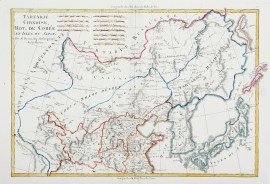
Gilles Robert de Vaugondy (1688 - 1766)
Prominent French cartographer and publisher active in Paris, who inherited and extended the intellectual and material legacy of the Sanson family, long regarded as the founders of modern French cartography.
Born in Paris, he became closely associated with the Sanson dynasty through Sanson’s grandson, from whom he acquired a substantial collection of engraved plates, later augmented by those of Pierre Mortier and Alexis-Hubert Jaillot. Drawing upon these foundations, de Vaugondy distinguished himself by revising earlier cartographic models in the light of new scientific knowledge rather than merely reproducing them. He worked in close collaboration with his son, Didier Robert de Vaugondy (1723–1786), an accomplished globemaker who was later appointed Géographe du Roi to Louis XV. Together they formed one of the most influential father-and-son partnerships in eighteenth-century cartography. Their crowning achievement was the
Atlas Universel of 1757, a monumental work that integrated the results of recent voyages of exploration, astronomical observations, and contemporary scholarly research, and which set new standards for accuracy and critical evaluation of sources. The Vaugondys placed particular emphasis on precision, grounding their maps in journals, surveys, and scientific data, and thereby differentiating themselves from many of their contemporaries who relied heavily on uncritical copying. Active during the French Enlightenment, their work represents the high point of French mapmaking in the period and played a significant role in shaping European geographical knowledge of the wider world. By the time of his death in Paris in 1766, Gilles Robert de Vaugondy had established a respected and enduring cartographic enterprise, renowned for its detailed and up-to-date representations of global geography. He was also one of the leading exponents of the French School of Theoretical Cartography and like Nicholas Bellin popularised the notion of an imaginary east coast of Australia joined to the Solomon Islands.
View other items by Gilles Robert de Vaugondy