Abraham Ortelius (1527 - 1598)
Flemish cartographer, geographer, and publisher, born in Antwerp on 14 April 1527. He is celebrated as the creator of the Theatrum Orbis Terrarum (Theatre of the World), first published in 1570, widely regarded as the first modern atlas and one of the most influential cartographic works of the sixteenth century.
Trained as a map colourist and illuminator, Ortelius joined the Antwerp Guild of St Luke as a map illuminator in 1547, initially working in partnership with his sister, Anne. He began his career as a map and print dealer, trading in geographical materials and decorative prints across Europe. His extensive travels—to France, Germany, Italy, and notably to London where he met the English cartographer John Dee and the great mapmaker Gerardus Mercator—broadened his intellectual and professional network. Mercator’s work and ideas profoundly influenced Ortelius’s approach to geography and cosmography.
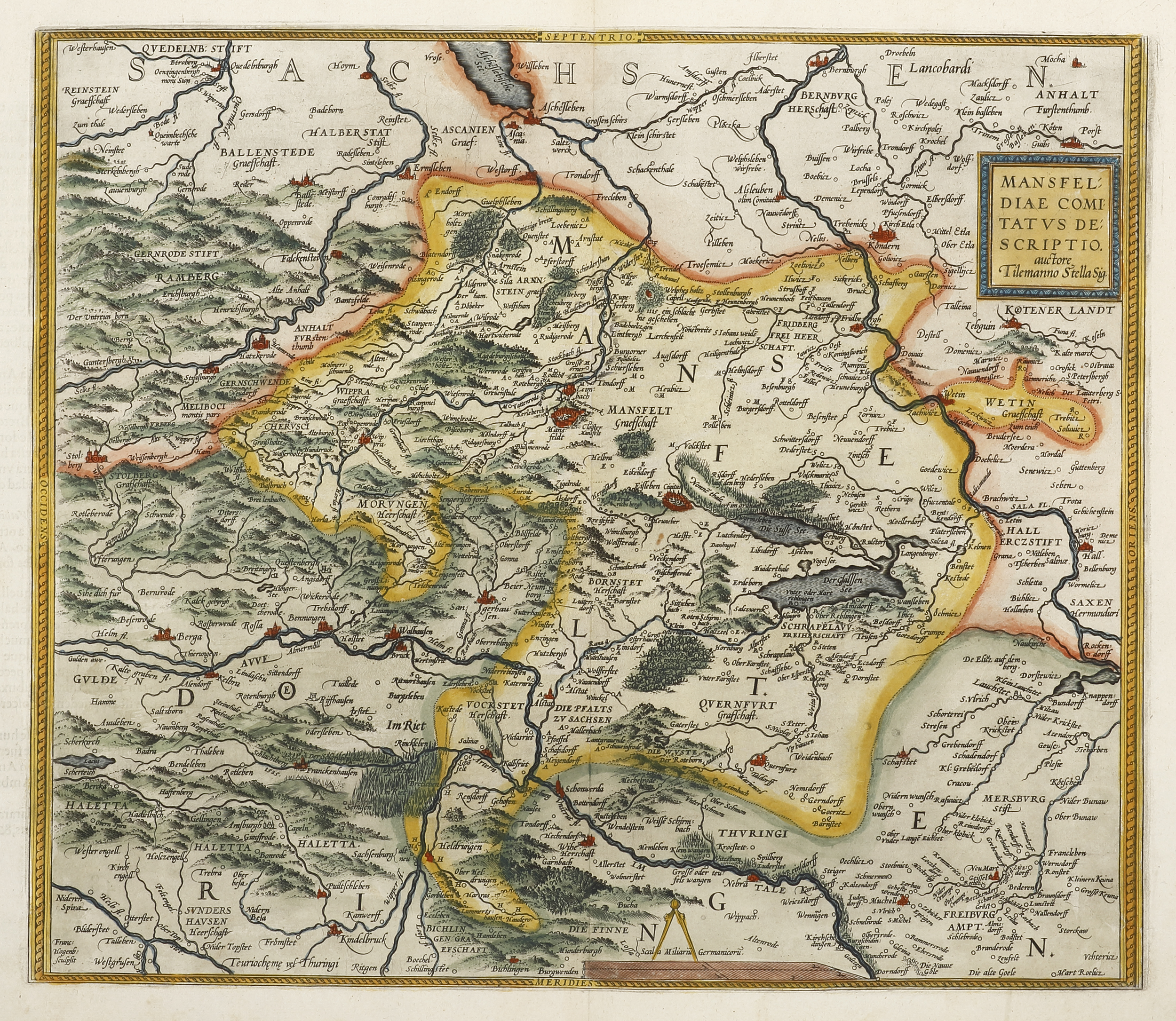
Ortelius’s Theatrum Orbis Terrarum was first issued in Antwerp in 1570 by the printer Gilles Coppens de Diest. Comprising seventy engraved maps with accompanying text, it presented a consistent format and unified design, with maps engraved chiefly by Frans Hogenberg. Each map was carefully attributed to its original source, a practice that reflected Ortelius’s scholarly integrity and established an early model for bibliographic citation in cartography. The Theatrum was an unprecedented success, appearing in more than forty editions and seven languages over the next four decades.
In 1573 Ortelius issued the Additamentum, the first supplement to the atlas, introducing new maps and expanding its global scope. Among his other important works were the Synonymia Geographica (1578), a geographical dictionary of ancient and modern place names, and Thesaurus Geographicus (1596), both significant contributions to Renaissance geographical scholarship.
Ortelius was also among the first to propose, in marginal notes to his maps, that the continents might once have been joined before drifting apart—an early precursor to modern theories of continental drift. His combination of scientific precision, humanist learning, and aesthetic refinement made him a central figure in the golden age of Netherlandish cartography.
He maintained close associations with leading scholars and artists of his time, including Justus Lipsius, Christopher Plantin, and the cartographers Gerard de Jode and Petrus Plancius. His friendship with Mercator remained of great importance throughout his life, and Mercator dedicated several works to him.
Ortelius was appointed Royal Geographer to King Philip II of Spain in 1575, in recognition of his contributions to geography and the prestige his atlas brought to the Spanish Netherlands. He continued to reside in Antwerp, where he also acted as a patron to younger scholars and artists.
Abraham Ortelius died in Antwerp on 28 June 1598 and was buried in the Church of St Michael’s Abbey. His epitaph reads Quietis cultor sine lite, uxore, prole—“A worshipper of tranquillity, without dispute, wife, or children.” His maps and atlases remain milestones in the history of cartography, bridging medieval cosmography and the emerging scientific geography of the early modern world.
View other items by Abraham Ortelius