Within Australia
All orders ship freewithin Australia
Rest of the World
Orders over A$300
ship free worldwide
Mapmaker:
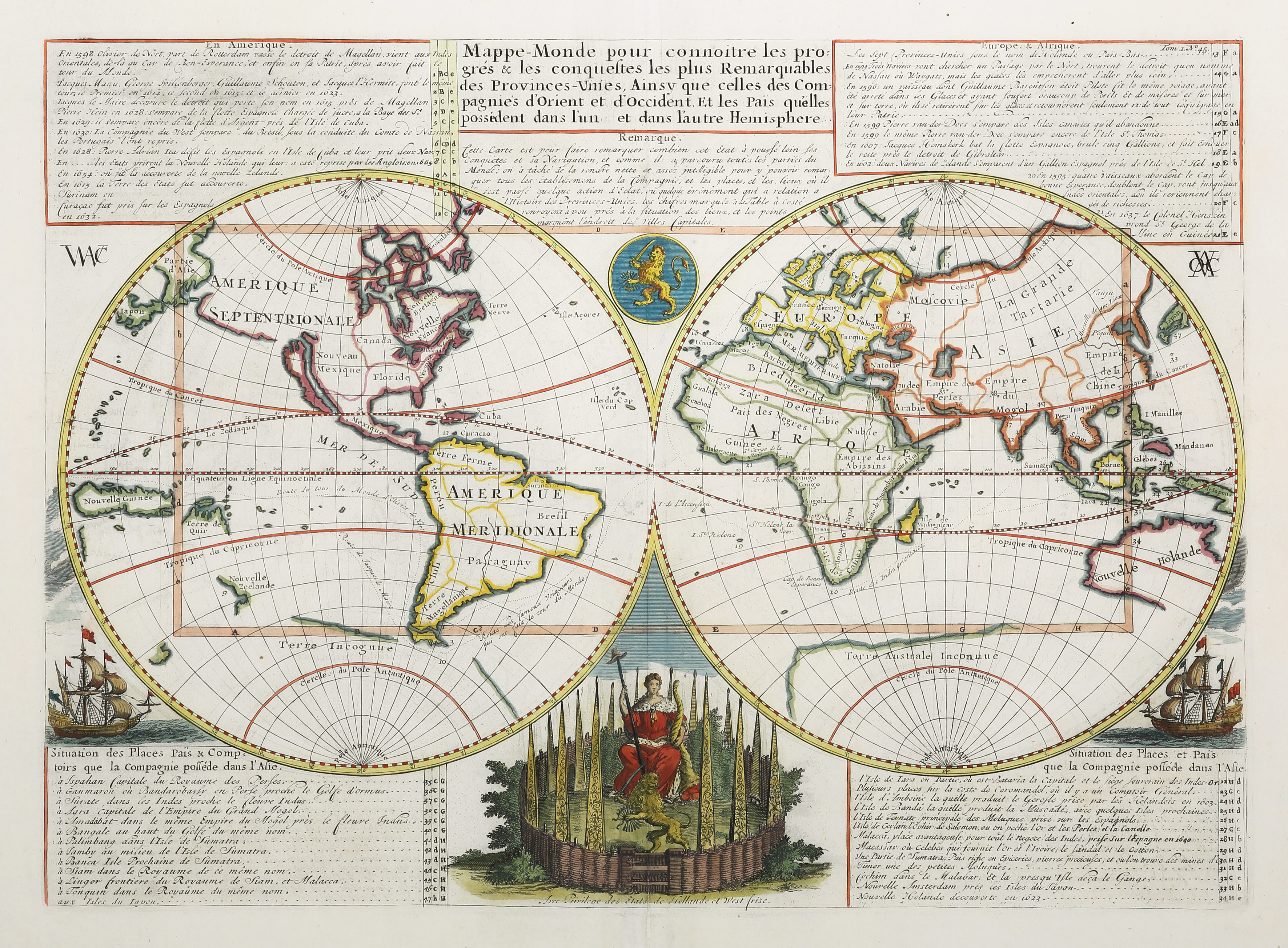
Scarce c.18th hand coloured double-hemisphere world map describing the voyages and discoveries made by the Dutch East India Company and other trading companies from 1598. This was the year after Frederick de Houtman returned from the first Dutch voyage, to … Read Full Description
$A 1,450
Within Australia
All orders ship freewithin Australia
Rest of the World
Orders over A$300
ship free worldwide
Full Title:
Date:
Mapmaker:
Condition:
Technique:
Image Size:
Paper Size:
Genuine antique
dated:
Description:
Scarce c.18th hand coloured double-hemisphere world map describing the voyages and discoveries made by the Dutch East India Company and other trading companies from 1598.
This was the year after Frederick de Houtman returned from the first Dutch voyage, to the East Indies with a load of spices, leading to the creation of the VOC. While this map was originally issued in 1670, neither the cartographer nor the source of that map is known. The plate was later obtained by Chatelain who retained the original geographic features and text but added numerous decorative elements, making it visually more attractive than the original. The known continents and principal countries are labelled while other places are numbered according to a reference list contained within the four panels adorning each corner of the map. The central cartouche depicts the Dutch Maiden holding a horn of plenty and a staff with a Cap of Liberty while seated in the symbolical Garden of Holland, or Hollandse Tuin, which is enclosed by a wattle fence. The garden symbolised the liberated Netherlands after the revolt against Spain and the formation of the Dutch Republic in 1581.The Dutch Republic Lion stands protecting the gate to the garden and holds in one paw a sword and in the other, a cluster of arrows representing the Seven United Provinces of the Netherlands. Another depiction of the lion appears in a circular emblem situated at the top of the map between the two hemispheres. Tracks of a number of explorers are shown as well as an outdated route to the Indies traversing north-east across the Indian Ocean in a direct path to Java. By 1617, all VOC ships travelling to the East Indies were required to take the route pioneered by Hendrik Brouwer in 1611 which took advantage of the prevailing strong westerly winds known as the Roaring Forties by sailing in a south-easterly direction and then turning due north to Java on nearing the Australia coast. Australia is shown with the discoveries made by Abel Tasman on his first and second voyages 1642-44.
From: Chatelain, Atlas Historique, ou, Nouvelle introduction istoire la Chronologie & la Geographie Ancienne & Moderne.
Henri Abraham Chatelain (1684 - 1743)
Chatelain was a Huguenot pastor of Parisian origins. He lived consecutively in Paris, St. Martins, London (c. 1710), the Hague (c. 1721) and Amsterdam (c. 1728). Chatelain was a skilled artist and knew combining a wealth of historical and geographical information with delicate engraving and an uncomplicated composition. Groundbreaking for its time, this work included studies of geography, history, ethnology, heraldry, and cosmography. His maps with his elegant engraving are a superb example from the golden age of French mapmaking.The publishing firm of Chatelain, Chatelain Frères and Chatelain & Fils is recorded in Amsterdam, from around 1700-1770, with Zacharias living "op den Dam" (Dam Square) in 1730. Henri Abraham Chatelain, his father Zacharie Chatelain (d.1723) and his younger brother Zacharie Junior (1690-1754), worked as a partnership publishing the Atlas Historique, Ou Nouvelle Introduction à L'Histoire under several different Chatelain imprints, depending on the Chatelain family partnerships at the time of publication. The atlas was published in seven volumes between 1705 and 1720, with a second edition appearing in 1732. The volumes I-IV with a Third edition and volume I with a final edition in 1739. Henri Abraham Chatelain, whose "Atlas Historique" was one of the most expansive Dutch encyclopedias of the age. First published in 1705, Chatelain's Atlas Historique was part of an immense seven-volume encyclopedia. Although the main focus of the text was geography, the work also included a wealth of historical, political, and genealogical information. The text was compiled by Nicholas Gueudeville and Garillon with a supplement by H.P. de Limiers and the maps were engraved by Chatelain, primarily after charts by De L'Isle. The atlas was published in Amsterdam between 1705 and 1721 and was later reissued by Zacharie Chatelain between 1732 and 1739.
Exchange rates are only indicative. All orders will be processed in Australian dollars. The actual amount charged may vary depending on the exchange rate and conversion fees applied by your credit card issuer.
Join our exclusive mailing list for first access to new acquisitions and special offers.