Within Australia
All orders ship freewithin Australia
Rest of the World
Orders over A$300
ship free worldwide
Artist:
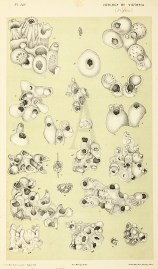
Rare lithograph from, Frederick McCoy’s, “Natural history of Victoria; Prodromus of the zoology of Victoria; or figures and descriptions of the living species of all classes of the Victorian indigenous animals” Fig 2 Membranipora Woodsii Fig 3 Membranipora Lineata Fig 4 … Read Full Description
$A 40
Within Australia
All orders ship freewithin Australia
Rest of the World
Orders over A$300
ship free worldwide
Full Title:
Date:
Artist:
Condition:
Technique:
Image Size:
Genuine antique
dated:
Description:
Rare lithograph from, Frederick McCoy’s, “Natural history of Victoria; Prodromus of the zoology of Victoria; or figures and descriptions of the living species of all classes of the Victorian indigenous animals”
Fig 2 Membranipora Woodsii
Fig 3 Membranipora Lineata
Fig 4 Membranipora Rosswlii
Fig 5&6 Membranipora Lacroixii
Collections:
National Library Australia: Bib ID: 850045
State Library New South Wales: Call Number: DSM/Q591.992/M
State Library Victoria: RARELT 591.9945 M13
State Library South Australia: 591.9945 M131 b
Smithsonian Institution: Call Number QL339.V6 M12
Royal Collection Trust UK: RCIN 1055668
James Ripper (1840 - 1916)
Born in Cornwall Ripper's Prodromus contribution was limited to the Bryozoan plates, as he worked exclusively for Paul Howard McGillivray. It is unclear whether this professional arrangement was due to anything other than geography. The arts-centric Ripper would likely have crossed paths with McGillivray at the Bendigo Institute, where the latter was both founder and an influential member. James Ripper was first employed in the lithography of the Bryozoan plates for decade five, published in 1880. Within five years this had developed to the stage where he and McGillivray co-drafted the illustrations for decade ten, but Ripper ceased drafting for the final six decades, although he continued the lithography. This may have been due to the rather simplistic nature of Ripper's drafting, or simply McGillivray's frugality in the economic climate of the late 1880s. But as has been noted, Ripper's rendering, whilst simpler than earlier works, was much larger and clearer. While it appears Ripper did no other lithographic or drafting work in his lifetime, he had a lucrative career as an instrument tuner. At the conclusion of the Prodromus, he returned to an amateur interest in art.
Exchange rates are only indicative. All orders will be processed in Australian dollars. The actual amount charged may vary depending on the exchange rate and conversion fees applied by your credit card issuer.
Join our exclusive mailing list for first access to new acquisitions and special offers.