Within Australia
All orders ship freewithin Australia
Rest of the World
Orders over A$300
ship free worldwide
Artist:
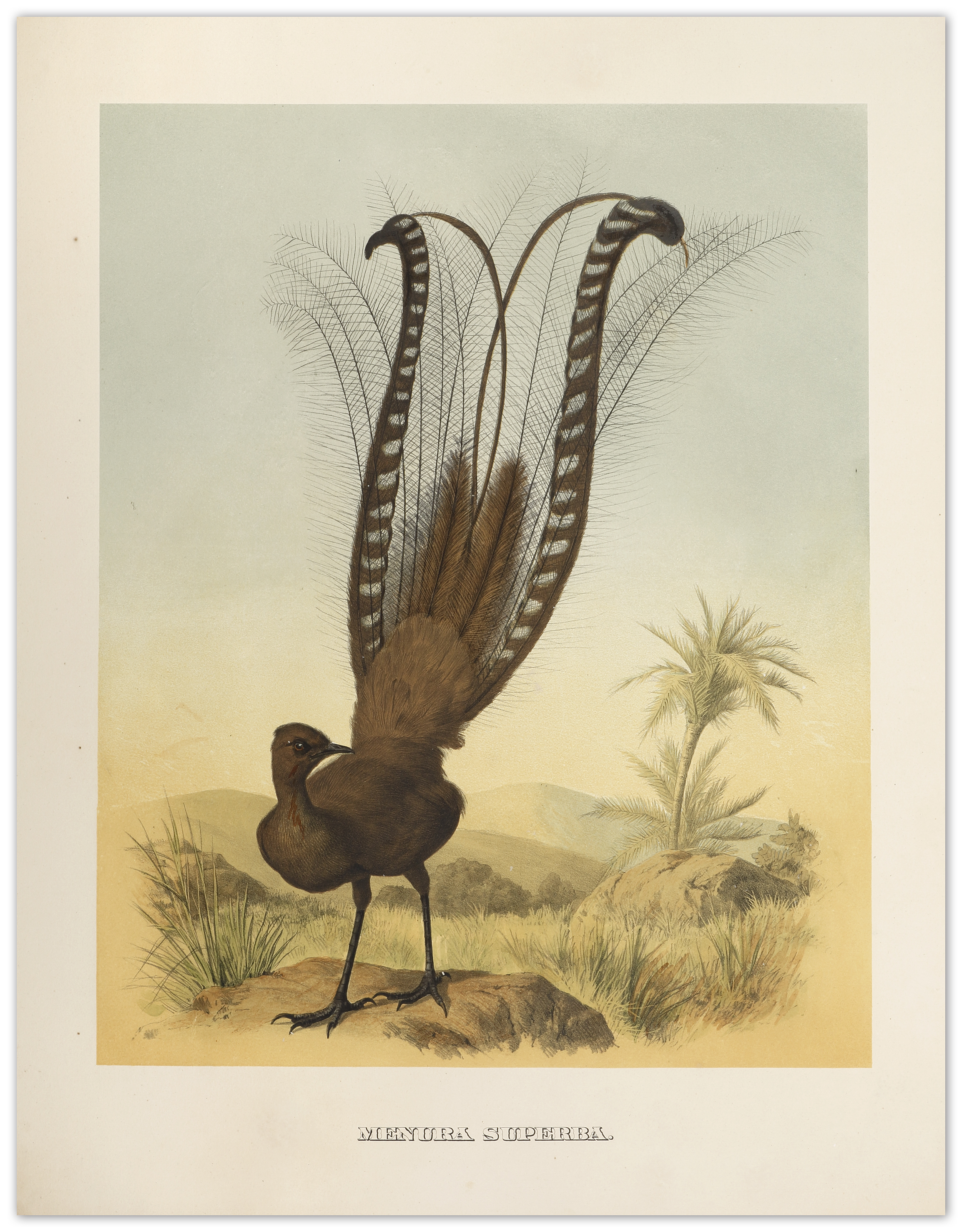
Rare, large scale c.19th colour lithograph of Australia’s iconic Lyre Bird, by Joseph Smit (1836-1929). First edition, from this rare series, with beautiful plates on a grand scale, including some of smit’s finest work (Sitwell) Aboriginal names: Weringerong Modern binomial … Read Full Description
$A 3,250
Within Australia
All orders ship freewithin Australia
Rest of the World
Orders over A$300
ship free worldwide
Full Title:
Date:
Artist:
Condition:
Technique:
Image Size:
Paper Size:
Genuine antique
dated:
Description:
Rare, large scale c.19th colour lithograph of Australia’s iconic Lyre Bird, by Joseph Smit (1836-1929).
First edition, from this rare series, with beautiful plates on a grand scale, including some of smit’s finest work (Sitwell)
Aboriginal names: Weringerong
Modern binomial name: Menura novae hollandiae
First described: Thomas Davies 1800
Distribution: VIC, NSW, QLD and introduced to Tasmania.
The Lyre Bird was first sighted November 1797 by a an ex-convict who lived with the Aborigines after his term had expired. It was first caught on 26th January 1798 and was described by Thomas Davies 4th November 1800 to the Linnean Society of London.
1797 First sighting. An ex-convict who lived with Aboriginals after his term expired in 1792, said that there was in the bush near Sydney, “a bird of the pheasant species’. Near Sydney, John Wilson (Barrington 1802)
1798 First recorded sighting We saw nothing strange except a few rock kangaroos with long black brush tails, and two pheasants which we could not get a shot at. Nepean, John Price (Historical Records NSW, 3 Appendix C.)
1798 First capture Here I shot a bird about the size of a Pheasant, but the tail of it very much resembles a Peacock, with large long feathers which are white, orange, and lead colour, and black at the ends; its body betwixt a brown and green, brown under his neck and black upon his head. Black legs and very long claws. Near Bargo, John Price (Historical Records NSW, 3 Appendix C.)
1798 Mimicry of the Lyrebird They sing for two hours in the morning, beginning from the time when they quit the valley, until they attain the summit of the hill; where they scrape together a small hillock, on which they stand, with their tail spread over them, imitating successively the note of every bird known in the country. South-west of Sydney David Collins (An account of the English Colony…)
1800 Scientific description The total length of this singular bird from the point of the bill to the end of the broad tail feathers is 43 inches; 25 of which are in the tail alone. The bill rather exceeds an inch in length, is strong, formed much like that of a peacock… Blackheath, Thomas Davies. (Transactions of the Linnean Society of London)
From: Cory, C.B. Beautiful and Curious Birds of the World.
Joseph Smit (1836 - 1929)
Dutch-born zoological artist who became one of the most prolific and respected wildlife artists of the Victorian era. Born in Lisse, Netherlands, he initially trained as a lithographer and received his first major break when Hermann Schlegel, director of the Natural History Museum in Leiden, commissioned him to create lithographs for a book on the birds of the Dutch East Indies. This success led to an invitation to Britain in 1866 by Philip Lutley Sclater to illustrate Exotic Ornithology, prompting Smit to move his family to London and begin a long, distinguished career in English natural history circles. In London, Smit formed a significant professional partnership with the renowned animal painter Joseph Wolf, often performing the lithography for Wolf’s drawings on major projects such as The Book of Antelopes and Zoological Sketches. Over the following decades, he contributed hundreds of accurate and highly detailed illustrations to the Zoological Society of London publications, including roughly 600 for its Proceedings and nearly 150 for its Transactions. His versatility extended beyond birds and mammals; he notably provided some of the earliest popular reconstructions of dinosaurs and prehistoric creatures for Henry Neville Hutchinson’s 1892 book, Extinct Monsters. Following Wolf’s death in 1899, Smit was widely regarded as England’s leading mammal illustrator, known for setting his subjects in realistic, attractive habitats. He worked on 15 major bird books and contributed to numerous scientific journals like Nature and The Field. In 1905, he retired to Radlett, Hertfordshire, where he lived until his death in 1929 at the age of 93.
Exchange rates are only indicative. All orders will be processed in Australian dollars. The actual amount charged may vary depending on the exchange rate and conversion fees applied by your credit card issuer.
Join our exclusive mailing list for first access to new acquisitions and special offers.