Within Australia
All orders ship freewithin Australia
Rest of the World
Orders over A$300
ship free worldwide
Artist:
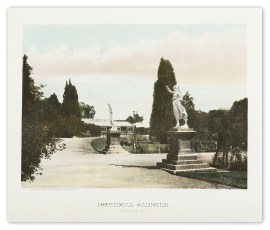
Unrecorded separately issued lithograph by Samuel Thomas Gill (1818-1880), of the Wesleyan Chapel, Pirie Stree, Adelaide in 1851, initialled and dated lower left of the image. Not held in any institutional collection or recorded in any standard Gill reference work. … Read Full Description
$A 1,950
Within Australia
All orders ship freewithin Australia
Rest of the World
Orders over A$300
ship free worldwide
Full Title:
Date:
Artist:
Condition:
Technique:
Image Size:
Paper Size:
Genuine antique
dated:
Description:
Unrecorded separately issued lithograph by Samuel Thomas Gill (1818-1880), of the Wesleyan Chapel, Pirie Stree, Adelaide in 1851, initialled and dated lower left of the image. Not held in any institutional collection or recorded in any standard Gill reference work.
Printed and published by Penman and Galbraith, Pirie Street, Adelaide.
The church was designed by Edward Stuckey and officially opened in 1852. It was the ‘cathedral church’ of Methodism in Adelaide and seated 800 people downstairs and 400 in the galleries. The church building was compulsorily acquired by the Adelaide City Council and demolished in 1972 to make way for the Colonel Light Centre. The church’s memorial plaques, stained glass windows, wood panelling from the pulpit and large organ were moved to Stow Church, to where the congregation relocated.
Samuel Thomas Gill (1818 - 1880)
Samuel Thomas Gill (1818-1880) S.T. Gill as he is often now known, was born at Somerset, England, the son of Rev. Samuel Gill, Baptist minister, and educated at Plymouth in a school kept by his parents, and later at Dr Seabrook's academy. His father taught him drawing and he was later employed in London as 'Draftsman and Water Colour Painter' by the Hubard Profile Gallery, an establishment which produced silhouettes. He arrived in South Australia in 1839 and by March 1840 had established a studio in Gawler Place, Adelaide, which was open from 'eleven till dusk'; he offered to produce portraits of human beings, horses and dogs, and to sketch houses and transfer the sketches 'to paper suited for home conveyance'. In 1846 he accompanied the Horrock's expedition which reached the head of Spencer Gulf. In 1852 Gill travelled to the Victoria and in the next twenty years produced drawings, watercolours and lithographs of scenes of the Victorian and New South Wales gold fields. After 1870 Gill fell into obscurity and on 27 October 1880 he collapsed in Post Office Place, Melbourne, and was found to be dead when taken to hospital. Gill's legacy is a large body of work which portrayed life during the greatest gold boom the world had ever seen.
Exchange rates are only indicative. All orders will be processed in Australian dollars. The actual amount charged may vary depending on the exchange rate and conversion fees applied by your credit card issuer.
Join our exclusive mailing list for first access to new acquisitions and special offers.