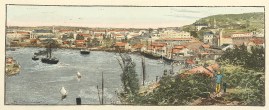
Rare c.19th coastal profile of Prince of Wales Island, Torres Strait Island by William Westall, artist on board Matthew Flinders seminal survey of the Australia coast on the Investigator.
Flinders Sunday 31 October 1802
At daylight in the morning the south-east trade blew fresh with squally weather. We steered south-westward, passing at seven o’clock between two dry sands, three or four miles apart, with a depth of 15 fathoms; at eight, another dry bank was left two miles to the southward, and a small, low island set at N. by W., two or three leagues. From this time, and running at the rate of seven knots, nothing was seen until ten; a dry sand then bore N. 78° W., two miles and a half, and two more low isles were seen to the northward; the soundings had become regular, between 10 and 9 fathoms, and the bottom was of mixed sand and shells, fit for anchorage. Our latitude at noon was 10° 26′ 45″, and longitude 142° 39½’; and we had high land bearing S. 3° E. ten or twelve miles, which I supposed might be the easternmost of the York Isles, although captain Cook’s longitude of it was 38′ more westward. The weather being hazy, no other land was seen, nor any reefs; but at one o’clock, I set these bearings: York Isle, high flat top, S. 35° E. A more northern, double isle, S. 84 W. A high peaked hill (Mt. Ernest of Bligh), N. 16 W. [NORTH COAST. PRINCE OF WALES’ ISLANDS.] At two o’clock, when we passed on the north side of the double isle, it was seen to be surrounded with a coral reef, and there were rocks on its west and south sides. We then hauled tip S. W. by S. for some rocky islets lying, as I supposed, off Cape York; but finding no shelter there, bore away round the north end of an island, of which Mr. Westall took a view (Atlas, Plate XVIII. View 12), and anchored in 7 fathoms, gravel and shells, one mile and a half from the land, and two or three cables length from a shoal to the southward, which became dry at low water. Our latitude here was 10° 30′ from bearings, and longitude by time-keeper 142(? illegible in book) 18½’ east; but I was altogether at a loss to know what islands these were, under which we had anchored. Supposing the flat-topped island to have been the easternmost York Isle, the land we had in sight to the southward should have been Cape York; but no such isles as those around us were laid down by captain Cook, to the north of that cape. On consulting the sketch made by captain Bligh in the Bounty’s launch (Voyage to the South Seas, p. 220), it appeared that the first land was not the easternmost isle, but one much nearer to Cape York; and that our anchorage was under the southern group of the Prince of Wales’ Islands, the longitude of which, by captain Cook, is 1° 12′ west of what I make it.* The north-eastern isle of this group, under which we more immediately lay, is that named Wednesday Island by captain Bligh; to the other isles he gave no name; but the one westward of the ship seems to have been the Hammond’s Island of captain Edwards, when passing here with the Pandora’s boats. So soon as the weather cleared a little, the subjoined bearings were taken. [* Mr. Wales deduces from captain Cook’s observations in the Endeavour, that the error of his chart here, is 35′ west (_Astron. Observations_, p. 131).] Wednesday I., distant 1½ to 3 miles, S. 89° E. to 21° W. Hammond’s Isle, dist. 4 or 5 miles, S. 52 W. to 71 W. Hawkesbury I. (of Edwards), highest part, N. 52 W. Mount Augustus (of Bligh), N. 2 W. A small isle, distant three leagues, N. 24 E. Mount Ernest, peak, N. 36 E. Double Isle, passed at 2 p.m., N. 70½ E. Breakers on a reef, distant 3½ miles, N. 64 to 30 W.
From: Flinders, M. A Voyage to Terra Australis, undertaken for the purpose of completing the discovery of that vast country, and prosecuted in the years 1801, 1802, and 1803, in His Majesty’s Ship The Investigator and subsequently in the armed vessel Porpoise and Cumberland schooner.
References:
Ferguson, J. A. Bibliography of Australia Volumes 1-8, Canberra 1976 : 756.
Tooley, R.V. The Mapping of Australia. London 1979 : pp. 77-79.
Perry, T. & Prescott, D. A guide to maps of Australia in books published 1780-1830. Canberra 1996 : 1814..
Ferguson, J. A. Bibliography of Australia Volumes 1-8, Canberra 1976 : 576.
Hill, J. The Hill Collection of Pacific Voyages. San Diego 1974 : 614.
Wantrup, J. Australian Rare Books. Sydney, 1987 : 67a.
Ingleton, G. Charting a Continent. Sydney 1944 : 6487.
Collections:
National Library Australia: Bib ID 589314
Royal Collection Trust UK: RCIN 1054637
Silent World Foundation, Sydney.: SKU SF000813
State Library Victoria: CCF 919.4 F64V