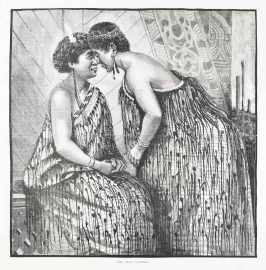
C1863

Old New Zealand being incidents of Native Customs …

Scarce c.19th account of early New Zealand written by Frederick Edward Manning who lived with the Maori. Pp. viii, 216, 52.  Bound in original brown embossed cloth with gilt lettering to the spine. Published by Smith, Elder and Company, 1863.  Originally … Read Full Description

$A 350

In stock

S/N: BK-NZ-MANING–488378
(BC04)
Free Shipping
[ASIA-Carte Hydro-Geo-Graphique Des Indes Oriental… ASIA

Within Australia

All orders ship freewithin Australia

[ASIA-Carte Hydro-Geo-Graphique Des Indes Oriental… ASIA

Rest of the World

Orders over A$300
ship free worldwide

See Shipping page for Terms & Conditions

Details

Full Title:

Old New Zealand being incidents of Native Customs …

Date:

C1863

Condition:

Minor bumbing to covers, toning to front end paper, otherwise in good condition.

Technique:

Embossed cloth binding with gilt lettering on spine.

Image Size: 

203mm 
x 203mm

Paper Size: 

132mm 
x 132mm
AUTHENTICITY
Old New Zealand being incidents of Native Customs and Character in the Old Times. - Antique Book from 1863

Genuine antique
dated:

1863

Description:

Scarce c.19th account of early New Zealand written by Frederick Edward Manning who lived with the Maori.

Pp. viii, 216, 52.  Bound in original brown embossed cloth with gilt lettering to the spine. Published by Smith, Elder and Company, 1863. 

Originally composed in the mid-nineteenth century, this historical narrative offers an unvarnished depiction of Māori society during a period of profound transformation precipitated by increasing contact with British settlers. Drawing upon the author’s own experiences, the text blends personal anecdote with ethnographic observation, offering valuable insight into Māori life at the threshold of colonial encroachment. The work opens with a tone of reflective nostalgia, as the narrator evokes the so-called “good old times”—a pre-colonial New Zealand unshaped by British governance and the imposition of European norms. Through a stylistic interplay of humour and wistfulness, the author recounts his earliest encounters with Māori communities, illuminating their social customs, hospitality, and initial reactions to European trade practices. These recollections are not merely descriptive; they serve to underscore the stark contrast between traditional Māori lifeways and the rapidly encroaching forces of colonial modernity.


References:
Bagnall, A.G. New Zealand National Bibliography to the Year 1960 Wellington: 3345.

Collections:
National Library Australia: Bib ID: 2248329
State Library New South Wales: 991016783059702626
National Library New Zealand: NLNZ ALMA 99826793502836
State Library Victoria: Record ID 991694743607636

Frederick Edward Maning (1812 - 1883)

Early settler in New Zealand, a writer, and a judge of the Native Land Court. He published two books under the pseudonym of "a Pakeha Maori". Maning arrived in the Hokianga area at age 22, on 30 June 1833, and lived among the Ngāpuhi Māori. With Maning's physical skills and great stature, as well as his considerable good humour, he quickly gained favour with the tribe. He became known as a Pākehā Māori (a European turned native) and his arrival in New Zealand is the subject of the first chapters of his book Old New Zealand. In 1837, he sold his property and returned to Hobart. He returned to Hokianga in March 1839 and in September purchased 200 acres (0.8 km2) for a farm at Onoke, at the mouth of the Whirinaki River. He built a house there that was standing until it was destroyed by fire in 2004. He took a Māori wife, Moengaroa, of Te Hikutu hapū of Ngāpuhi, and they had four children, Susan, Maria Amina, Hauraki Hereward and Mary. In 1840, Maning acted as a translator at meetings about the Treaty of Waitangi, and he advised the local Māori to not sign. His vocal opposition to the Treaty was primarily because he had settled with the Māori precisely to escape from the restrictions of European civilisation. He feared that the introduction of European style law would put a damper on his lifestyle and on his entrepreneurial trading activities. He warned the Māori that European colonisation would degrade them. Governor William Hobson countered by telling the Māori that without British Law, lawless self-interested Europeans without any regard for Māori rights would soon take all their land. Maning's book Old New Zealand is, in part, a lament for the lost freedom enjoyed before European rule.

View other items by Frederick Edward Maning

Related Products

Choose currency

Exchange rates are only indicative. All orders will be processed in Australian dollars. The actual amount charged may vary depending on the exchange rate and conversion fees applied by your credit card issuer.

Account Login

The List

Join our exclusive mailing list for first access to new acquisitions and special offers.